Category: Product safety & documents

Guides to product safety rules, CE and UKCA marking, technical files, declarations of conformity, labels and warnings.

  • GPSR risk assessment: a template and worked example for sellers

    GPSR risk assessment: a template and worked example for sellers

    A GPSR risk assessment is the manufacturer’s written analysis of what could go wrong with a consumer product, who could be hurt and what was done about it. Under the EU General Product Safety Regulation it must be done before the product goes on sale in the EU or Northern Ireland, and kept with the technical documentation for 10 years.

    Regulation (EU) 2023/988 calls it an internal risk analysis. This guide gives you a template built from the safety aspects the law lists, the step-by-step method the UK’s Office for Product Safety and Standards (OPSS) uses for its own assessments, and a worked example. If you sell into the EU from outside it, this is also one of the first documents your EU responsible person needs to see, because checking that it exists is part of their job.

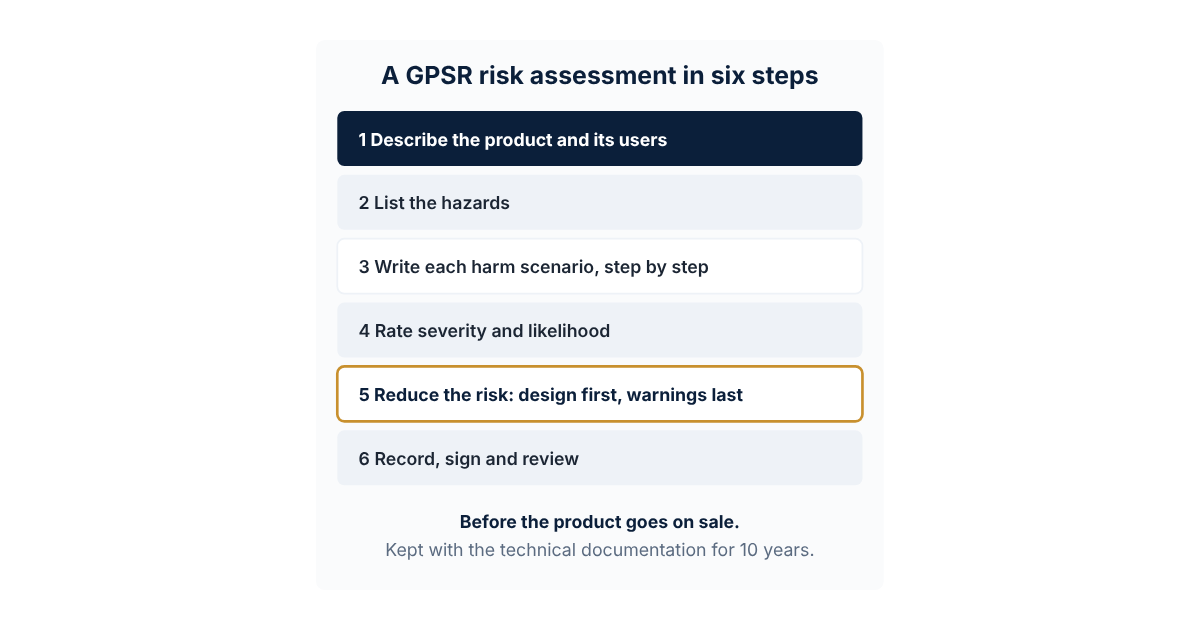
    A GPSR risk assessment in six stepsSix steps. 1: describe the product and who uses it. 2: list the hazards. 3: write each harm scenario step by step. 4: rate severity and likelihood. 5: reduce the risk, design first and warnings last. 6: record, sign and review. Done before the product goes on sale and kept with the technical documentation for 10 years.A GPSR risk assessment in six steps1 Describe the product and its users2 List the hazards3 Write each harm scenario, step by step4 Rate severity and likelihood5 Reduce the risk: design first, warnings last6 Record, sign and reviewBefore the product goes on sale.Kept with the technical documentation for 10 years.
    The order this guide’s template follows, from describing the product to keeping the record up to date.

    What the GPSR asks for, and from whom

    The GPSR has applied since 13 December 2024 to products placed on the market from that date. It covers consumer products where no specific EU rules with the same aim exist; where sector rules do exist, it covers only the risks they don’t. GOV.UK’s detailed guidance on the Regulation sets out who does what with the risk analysis:

    WhoWhat they do with the risk analysis
    ManufacturerCarries out the internal risk assessment and draws up technical documentation before placing the product on the market. The documentation gives a general description of the product and the characteristics relevant for assessing its safety.
    ImporterMakes sure the manufacturer has done the risk assessment and drawn up the technical documentation before the product goes on the market.
    Responsible economic operator (often called the EU responsible person)Checks that the technical documentation has been drawn up and contains, where they apply, an analysis of possible risks with the solutions used to remove or reduce them, and a list of the relevant standards. Keeps it available to market surveillance authorities for 10 years, regularly checks the products against it, and provides it on a reasoned request.

    A Declaration of Conformity is a different document. It belongs to the CE regime; for a general product covered by the GPSR alone, what the law asks for is the risk analysis and technical documentation. Our technical file guide lists everything else that sits alongside the risk analysis, and our GPSR explainer covers the wider regulation.

    What the assessment has to consider

    The GPSR sets out the aspects to take into account when deciding whether a product is safe. Each one becomes a question your risk assessment should answer:

    Aspect in the GPSRThe question to answer
    Characteristics: design, technical features, composition, packaging, assembly, installation, use and maintenance instructionsWhat could fail, break, come loose, heat up, leak or trap a finger?
    Effect of other products used with it, including non-embedded items that change how it worksWhat will people plug in, attach, refill or charge it with?
    Effect it has on other products, including interconnectionWhat could it damage or interfere with?
    Presentation, labelling and age suitabilityDoes the packaging or listing invite unsafe use?
    Categories of consumers, especially children, older people and persons with disabilities, and gender differencesWho will really use it, not only who it is aimed at?
    Appearance: food-imitating products, or products likely to appeal to or be used by childrenCould a child mistake it for food or a toy?
    Cybersecurity features, where the nature of the product requires themFor connected products: could outside interference make it unsafe?
    Evolving, learning and predictive functions, where relevantFor smart products: could a change in behaviour create a new risk?

    A GPSR risk assessment template, section by section

    Use one assessment per product, or per group of products that share a design, materials and supplier. A new material, supplier or design change is a reason to look at the risks again.

    SectionWhat to writeEvidence to attach
    1. Product identificationName, model, type, batch or serial numbering, photosPhotos of the product, label and packaging
    2. Intended use and usersWhat it is for, who buys it, who else is likely to use it, and reasonably foreseeable misuseListing text, instructions
    3. Rules that applyAny sector law (for example toy or electrical law) and which risks are left for the GPSRYour own scoping note
    4. HazardsEach hazard on its own line: mechanical, thermal, chemical, choking, fire, and the rest that fit your productSupplier specifications, material data
    5. Harm scenariosFor each hazard, the steps from normal use to injury, and who is hurtComplaints, returns, incident data
    6. Severity and likelihoodHow bad the injury could be, and how likely each step isTest reports, standards used
    7. MeasuresWhat removes or reduces each risk: design change, guard, material, test, then warningTest reports after the change
    8. Warnings and instructionsThe exact safety text, in each language you sell inLabel and insert artwork
    9. ConclusionWhether the remaining risk is acceptable for sale, and whySigned and dated
    10. Review logDate, what changed (supplier, design, complaint) and what you didUpdated reports

    How to write harm scenarios: the OPSS method

    The hardest part of any risk assessment is section 5. OPSS’s Product Safety Risk Assessment Methodology (PRISM) is written for market surveillance authorities in Great Britain, not for sellers, but it shows the level of reasoning an authority will apply. OPSS says it is aligned with the EU Safety Gate approach and reflects the same risk level matrix, and that its Excel toolkit is used by non-regulators to record post-market risk assessment outcomes.

    OPSS’s worked example for a portable juice blender shows the method:

    1. Name the hazard. The blades could start with the bottle removed, because there was no interlock.
    2. Say who could be harmed. Anyone handling the base with the blades exposed.
    3. Write the steps to harm. The user removes the bottle; doesn’t attach the blade guides for storage; presses the power button twice by accident; touches the turning blades.
    4. Grade the injury. PRISM uses severity levels; cuts in this scenario were rated a level 2 injury, while a battery fire in another scenario was rated level 4.
    5. Give each step a probability and multiply them. 1.0 × 0.1 × 0.01 × 0.25 = 0.00025, or 1 in 4,000, which the example rated a medium risk.

    Two lessons carry straight into your own assessment. First, scenarios with the same injury level can be combined: the blender’s two 1 in 4,000 scenarios became about 1 in 2,000 for the product. Second, OPSS warns that the probabilities in its examples are illustrations and should not be copied into other assessments. Your numbers have to come from your own product, tests and complaints. In its 2024 update, OPSS also added “functional” hazards to its list: harm linked to what the product is for, such as drowning with products used on or near water.

    Worked example: a folding wooden step stool

    A fictional UK brand sells a two-step folding stool for kitchens and wants to list it in Germany and France. For this example, assume no sector law covers it, so the GPSR applies in full.

    HazardHarm scenarioWhoMeasure
    Collapse under loadHinge lock not fully engaged; user stands on it; stool folds; fall from heightAdults, older usersLock that clicks visibly into place; load test on each new batch; maximum load on the label
    Finger trap in the hingeUser folds the stool with a hand on the frame; fingers caught in the closing gapAdults, children helpingWider gap or cover at the hinge; folding instructions with a picture
    Tipping sidewaysUser leans to reach a high shelf; stool tipsAll usersWider base, non-slip feet; warning not to over-reach
    SplintersRough edge on a step; hand or foot cutAll usersSanded edges checked at goods-in
    Climbed by childrenChild uses it to reach a worktop; fallsChildren (a likely user, not the intended one)Warning on the stool and in the listing; no toy-like colours or shapes

    The brand records a conclusion for each line, translates the warnings into German and French, and adds a review trigger: any complaint about the hinge reopens the assessment. The test reports and the signed assessment go into the technical documentation, where its EU responsible person can check them.

    Reduce the risk first, warn last

    A warning doesn’t make a dangerous design safe. In Great Britain the 2005 Regulations say so directly: the presence of warnings does not exempt anyone from the other requirements. So in section 7, change the design, materials or testing first, and use warnings only for the risk that is left.

    Whatever is left must reach the buyer. Under the GPSR, a product that can’t be used safely without them must come with clear instructions and safety information in a language consumers can easily understand, and online listings must show warnings in the local language. Our guide to GPSR warnings and safety information shows how to turn the risk assessment into label and listing text.

    Keeping the assessment current

    • Before sale, not after. The GPSR asks for the risk analysis before the product is placed on the market.
    • On every change. New supplier, new material, new design or a new country with a different language.
    • On every complaint. In Great Britain, GOV.UK’s list of producer duties includes sample testing marketed products and investigating, and if necessary keeping a register of, safety complaints. The same habit gives your EU file the evidence it needs.

    Great Britain and Northern Ireland

    The GPSR applies in Northern Ireland but not in Great Britain, which stays under the General Product Safety Regulations 2005. In Great Britain the producer must make sure a product is safe before placing it on the market, give consumers the information they need to assess risks that aren’t obvious, mark the product for traceability and take steps to stay informed of risks. In our view, a written risk assessment is the simplest way to show you did that, even where the GB rules don’t ask for one in the GPSR’s terms. If you ship to Northern Ireland, the responsible operator must be established in Northern Ireland or the EU; our guide to GPSR for UK small businesses explains when each set of rules applies.

    Your next step

    If you sell into the EU or Northern Ireland from outside, EU Brand Support can act as your EU Responsible Person: we hold and review your technical file, including the risk assessment, before we take a product on, and tell you what is missing. If you would rather build the file yourself, our compliance template packs include a risk assessment template for each product category, at £45 per category. A template is a starting point: the hazards, tests and conclusions still have to be real for your product.

    This guide is general information, not legal advice.

    Frequently asked questions

    What is GPSR compliance?

    Making sure a consumer product placed on the EU or Northern Ireland market is safe, has an economic operator established in the EU (or, for Northern Ireland, in Northern Ireland or the EU) responsible for it, carries the required identification and contact details, and is backed by a risk analysis and technical documentation. Our GPSR explainer covers each part.

    Who writes the GPSR risk assessment?

    The manufacturer, meaning whoever makes the product or has it made and sells it under their own name or trade mark. The importer makes sure it exists, and the responsible person checks it and keeps it available to the authorities.

    Is a GPSR risk assessment the same as a Declaration of Conformity?

    No. A Declaration of Conformity belongs to the CE regime. A product covered by the GPSR alone needs a risk analysis and technical documentation instead.

    Do I need a GPSR risk assessment for UK sales?

    For Northern Ireland, yes: the GPSR applies there. For Great Britain, the GPSR doesn’t apply; the General Product Safety Regulations 2005 do, and they still require you to sell only safe products.

    How long do I keep it?

    The technical documentation, including the risk analysis, is kept for 10 years and made available to market surveillance authorities on request.

    Sources

  • UKCA marking cost: what you pay for, and what you can skip

    UKCA marking cost: what you pay for, and what you can skip

    You don’t buy or apply for the UKCA mark: under GOV.UK guidance, the manufacturer puts it on the product, using artwork GOV.UK offers as a download. What costs money is the work behind the mark: testing, an approved body’s assessment where the law requires one, the technical file and Declaration of Conformity, and, for brands outside the UK, a UK importer or authorised representative.

    Most of the bill turns on one question: can your product be self-declared, or does its regulation require a UK Approved Body? Below is each cost line, how to avoid paying twice if you already sell in the EU, and our own fixed prices for the parts we handle, including the UK name and address that our UK Responsible Person service provides.

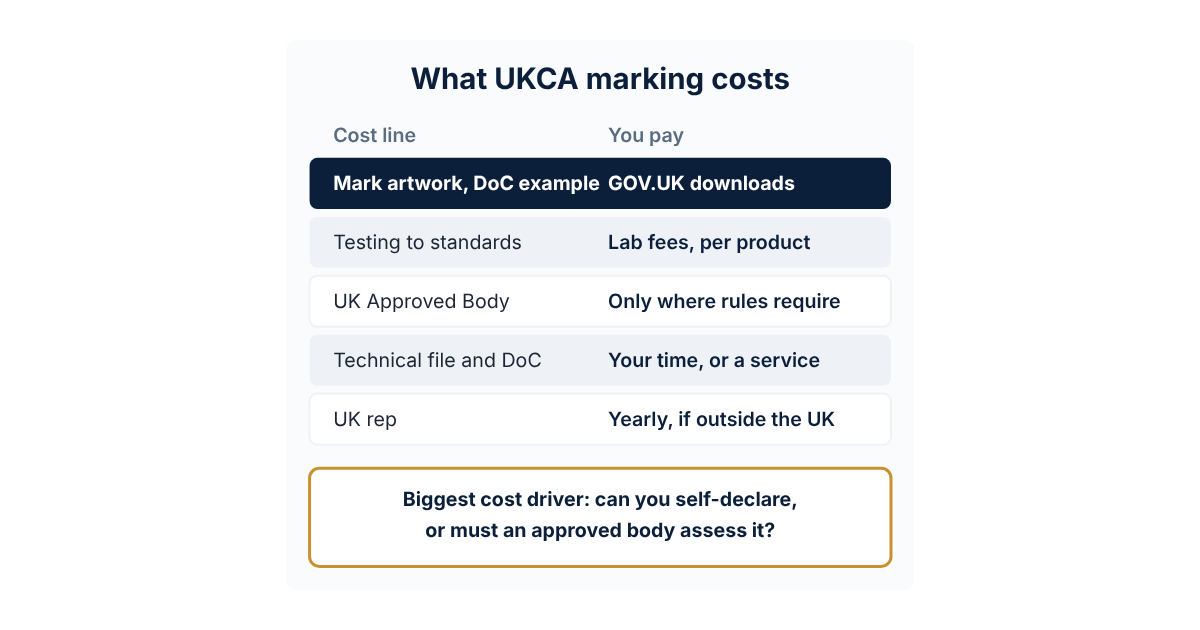
    What UKCA marking costsFive cost lines. Mark artwork and an example Declaration of Conformity: GOV.UK provides both as downloads. Testing to standards: lab fees, per product. UK Approved Body: only where the product’s rules require one. Technical file and Declaration of Conformity: your time, or a service. UK importer or authorised representative: yearly, if you are outside the UK. The biggest cost driver is whether you can self-declare.What UKCA marking costsCost lineYou payMark artwork, DoC exampleGOV.UK downloadsTesting to standardsLab fees, per productUK Approved BodyOnly where rules requireTechnical file and DoCYour time, or a serviceUK repYearly, if outside the UKBiggest cost driver: can you self-declare,or must an approved body assess it?
    You affix the mark yourself; the testing, assessment, paperwork and UK operator behind it are what cost money.

    What UKCA marking costs, line by line

    Cost line When you pay it Who sets the price
    UKCA mark artwork and an example UK Declaration of Conformity Not a cost line: both are downloads on GOV.UK n/a (you affix the mark yourself)
    Working out which regulations apply Once per product Your time, or an adviser’s fee
    Testing against the relevant standards Once per product, and again if the design, characteristics or standards change The test lab
    UK Approved Body assessment Only where the product’s regulation requires third-party assessment The approved body
    Technical file and UK Declaration of Conformity Once per product, then kept up to date Your time, or a service (ours is from £495 per self-declared product)
    Marking and labels: the mark at least 5mm high, plus manufacturer and importer name and postal address When you print packaging or labels Your printer
    UK importer or authorised representative Every year, if the manufacturer is outside the UK The provider (ours is from £25 a month, or £250 a year, per brand)
    Keeping the documents For the period the legislation sets, typically 10 years after each product is placed on the GB market Your own storage, or your representative’s

    The design-change line matters more than it looks. Economic operators must make sure each individual product still complies when it is placed on the market, taking account of changes to the product’s design, its characteristics and the standards the declaration was drawn up to. A new supplier, a different battery or a revised standard can mean new test reports and an updated file.

    Self-declare or approved body: the biggest cost driver

    Where self-declaration is allowed, your costs are the testing and the paperwork. Where it isn’t, a UK Approved Body accredited by the UK Accreditation Service (UKAS) has to test the product or review its test reports, and you pay for that assessment on top.

    Under GOV.UK’s list, self-declaration covers all products under the electrical equipment safety, electromagnetic compatibility (EMC), RoHS and aerosol dispenser regulations, but only Category I personal protective equipment and Category I pressure equipment. Toys and radio equipment can be self-declared except where designated standards covering the essential requirements don’t exist or weren’t applied in full (for toys, also where a standard was published with a restriction). The full list, sector by sector, is in our guide to what UKCA marking means and which products need it.

    Two practical points follow from that list:

    • For toys and radio equipment, applying the designated standards in full keeps you on the cheaper route. A test report that covers only part of a standard can move the product into approved body territory.
    • Approved body fees aren’t published by GOV.UK. The government’s UK Market Conformity Assessment Bodies database listed 196 bodies (approved bodies and other recognised types) when we checked on 5 November 2026, each with the legislative areas it covers, so you can ask more than one for a quote.

    How to avoid paying for UKCA twice

    If you already sell in the EU, much of the work may already be done.

    • Use your CE marking. Great Britain continues to recognise CE marking for many product types, with no end date stated. When the government announced the indefinite extension in August 2023, it said it would cut business costs, and it listed 18 regulations, including toys, radio equipment, low voltage electrical equipment, EMC, machinery, PPE and aerosols. Medical devices, construction products and some other sectors have separate rules.
    • Fast-Track UKCA. The Product Safety and Metrology (Amendment) Regulations 2024 let you put a UKCA mark on a product where recognised EU requirements and conformity assessment processes have been met, so the EU work you have already paid for can support the UK mark.
    • Choose the certificate that covers both markets. UK Approved Bodies can only certify for UKCA marking. EU notified bodies certify against EU requirements, and that certificate can also be used in Great Britain under CE recognition or Fast-Track UKCA. If you sell in both markets and need a third party, that difference can save you a second assessment.
    • Don’t change the product to add the mark. For most sectors, legislation lets the UKCA marking go on a label affixed to the product or on an accompanying document until 11pm on 31 December 2027. Cableways, construction products, marine equipment, medical devices, rail products, transportable pressure equipment and uncrewed aircraft systems have their own rules.

    The cost overseas brands forget: a UK operator

    For UKCA or CE goods sold in Great Britain, importers and authorised representatives must be established in the UK, and the importer’s name and address normally appear on the product or its packaging. An EU representative doesn’t cover Great Britain. Unlike testing, this is a recurring cost: the role lasts as long as you sell.

    Our UK Responsible Person cover is from £25 a month, or £250 a year paid annually, per brand. It gives you a UK address for labels and listings through UK Brand Support Ltd, our UK company, holds and reviews your technical file, handles authority requests and includes one category template pack. We review your Declaration of Conformity, test reports and marking before we take you on, and if a product needs testing or a certificate you don’t have, we tell you before you pay. Plans for the EU, the UK or both are on our pricing page.

    Worked example: a Bluetooth speaker for amazon.co.uk

    A fictional brand outside the UK makes a battery-powered Bluetooth speaker and wants to sell it on amazon.co.uk. It doesn’t sell in the EU yet. Suppose the speaker falls under the Radio Equipment Regulations 2017 and the RoHS Regulations 2012, and the factory’s test reports apply the designated standards in full.

    Cost line In this example
    Mark artwork and DoC example Downloads from GOV.UK
    Approved body None: both regulations allow self-declaration here
    Testing The factory’s reports, checked against the standards; new lab tests only for gaps, at the lab’s price
    Technical file and UK DoC Built in-house from the template pack included with UK cover, or from £495 with our technical file service
    UK authorised representative From £250 for the year, paid annually, with UK Brand Support Ltd as UK authorised representative (we review the technical file before taking any product on). Whoever imports the stock into the UK still has importer duties, including putting its name and address on the product or packaging

    Once we’ve agreed to take the product on, the known cost for the first year is from £250 if the brand builds the file itself, or from £745 with our file service, plus any lab fees for gaps. If the reports had covered the standards only in part, the radio regulations would require an approved body, and its quote would be added. That one detail in the test reports is the difference between the cheap route and the expensive one.

    Quick answers to the other UKCA questions

    What does UKCA marking stand for and mean?

    UK Conformity Assessed. Like CE, it shows the manufacturer believes the product meets the requirements that apply to it. It applies in Great Britain (England, Scotland and Wales), not in the Crown dependencies.

    What products need UKCA marking?

    Only products whose sector regulation requires a conformity mark. The UKCA and CE regimes span over 20 product types, including toys, electrical equipment, radio equipment, machinery, PPE and aerosols, and many of them can use CE marking instead in Great Britain. Not every product needs a mark.

    How do I get UKCA marking?

    Identify every regulation that applies, follow each one’s conformity route (self-declaration or an approved body), build the technical file, sign a UK Declaration of Conformity and affix the mark with your name and address. GOV.UK describes no separate application or registration for the mark itself.

    Your next step

    If the paperwork is the gap, our technical file and Declaration of Conformity service builds both from your test reports, from £495 per self-declared product, with any new lab testing passed on at cost. If you’re outside the UK and need a UK name and address, start with our UK Responsible Person service. Prefer to do it yourself? Our compliance template packs are £45 per category. A template is a starting point: it doesn’t replace testing or an approved body where the law requires one.

    This guide is general information, not legal advice. Check the GOV.UK guidance for your specific product.

    Frequently asked questions

    Is there a fee to register a UKCA mark?

    GOV.UK’s process has no registration step for the mark. The manufacturer, or an authorised representative where agreed, affixes it once the product meets its rules. The costs are the testing, any approved body assessment and the paperwork.

    Is UKCA cheaper than CE?

    GOV.UK sets out the same steps for both: testing, any third-party assessment, a technical file and a declaration. The difference is reach: a UK Approved Body certificate is for UKCA only, while EU requirements and notified body certificates can be used in Great Britain under CE recognition or Fast-Track UKCA. If you sell in both markets, the EU route often avoids paying twice.

    Do I pay for UKCA marking every year?

    Not for the mark. Ongoing costs are a UK importer or authorised representative if you’re outside the UK, keeping the documents for the period the law sets (typically 10 years), and new tests if the design or standards change.

    Will a template pack make my product compliant?

    No. It gives you the structure of the file and the declaration. The product still has to meet its requirements, with testing and an approved body where the regulation requires them.

    Sources

  • Jewellery nickel, cadmium and lead regulations: EU and UK limits

    Jewellery nickel, cadmium and lead regulations: EU and UK limits

    Jewellery nickel and cadmium regulations in the EU and UK come from REACH Annex XVII. Entry 27 limits how much nickel jewellery can release onto the skin, entry 23 caps cadmium in metal parts at 0.01% by weight, and entry 63 caps lead in any individual part at 0.05% by weight. Great Britain applies the same restrictions through UK REACH. On top of that, GPSR in the EU and the General Product Safety Regulations 2005 in Great Britain require the product to be safe and traceable.

    This guide is for jewellery brands and Amazon sellers outside the UK and EU selling earrings, necklaces, rings, bracelets, watches and hair accessories into either market. If you need an EU or UK name and address for your labels and listings, see our EU and UK Responsible Person service.

    Metal limits for jewellery under REACHA bar chart comparing nickel release limits under REACH entry 27, in micrograms per square centimetre per week: below 0.2 for piercing post assemblies and no more than 0.5 for items in direct and prolonged skin contact. Coated items must keep release within 0.5 for at least two years of normal use. Below the chart, two panels: cadmium under entry 23 is limited to below 0.01% by weight of metal, and lead under entry 63 to below 0.05% by weight in each part. The same limits apply in Great Britain under UK REACH.Metal limits for jewelleryNickel releaseREACH entry 27, µg per cm² per weekPiercing posts0.2Skin contact items0.5Coated items: within 0.5 for 2 years of normal useCadmium0.01%by weight of metalREACH entry 23Lead0.05%by weight, each partREACH entry 63Same limits in Great Britain under UK REACH
    REACH limits for nickel release, cadmium and lead in jewellery. Products must be below these limits.

    Who the jewellery metal limits apply to

    The cadmium and lead restrictions cover jewellery and imitation jewellery articles and hair accessories, including bracelets, necklaces, rings, piercing jewellery, wrist watches and wrist-wear, brooches and cufflinks. Both also apply to metal beads and other components sold for jewellery making, so suppliers of findings and craft parts are caught too.

    The nickel restriction is wider. It covers piercing post assemblies and any article intended to come into direct and prolonged contact with the skin, which includes earrings, necklaces, bracelets, rings, watch cases and straps, and also clothing parts such as rivets and zips.

    Anyone placing these products on the market is responsible for meeting the limits. GB Trading Standards guidance says manufacturers and importers are normally expected to test, while other sellers should check compliance with their supplier, for example by asking for test certificates. It says doing nothing is not enough.

    The laws that apply

    TopicEUGreat Britain
    Nickel releaseREACH Annex XVII entry 27: below 0.2 µg/cm²/week for piercing posts; no more than 0.5 µg/cm²/week for prolonged skin contactUK REACH, same limits
    CadmiumREACH Annex XVII entry 23: below 0.01% by weight of the metalUK REACH, same limit
    LeadREACH Annex XVII entry 63: below 0.05% by weight in any individual partUK REACH, same limit
    General product safetyGeneral Product Safety Regulation (EU) 2023/988General Product Safety Regulations 2005
    Precious metal markingNational rules, which vary between member statesHallmarking Act 1973

    Nickel release limits explained

    Nickel is a common cause of contact allergy, so the rule limits how much nickel the item releases, not how much it contains. There are two limits:

    • Piercing post assemblies: release must be below 0.2 µg/cm²/week. The post assembly is the part inserted into the piercing plus any parts that hold the piece against the wound, such as a butterfly or ball.
    • Items in direct and prolonged skin contact: release must not exceed 0.5 µg/cm²/week.

    Plated or coated items with a nickel-bearing base metal are allowed only if the coating keeps release within the 0.5 limit for at least two years of normal use. Testing for release uses EN 1811, and the abrasion and corrosion method for coated items is EN 12472. If your supplier only gives you a nickel content figure, ask for a release test instead.

    Cadmium and lead limits

    Cadmium must not be present at 0.01% or more by weight of the metal in metal beads and components for jewellery making, or in metal parts of jewellery, imitation jewellery and hair accessories. The restriction does not apply to articles placed on the market before 10 December 2011, or to jewellery that was more than 50 years old on that date.

    Lead must not be present at 0.05% or more by weight in any individual part, which includes base materials and components. There are exemptions for crystal glass, internal watch components that consumers cannot reach, non-synthetic or reconstructed precious and semi-precious stones not treated with lead, and enamels. Articles first placed on the market before 9 October 2013 are also exempt.

    Low-cost alloy jewellery, especially zinc alloys and solders, is where cadmium and lead failures tend to show up, so test each alloy rather than each design.

    What your test reports and labels need

    • A nickel release report to EN 1811 for each skin-contact metal, with EN 12472 pre-treatment for coated items.
    • Cadmium and lead content reports covering every metal part, including findings, clasps and solder.
    • A GPSR risk assessment that covers the materials, small parts and who is likely to use the product.
    • A type, batch or serial number on the product or, where it is too small, its packaging or accompanying document.
    • The manufacturer’s name and postal and electronic address, and the responsible person’s details where you are outside the market.

    For gold, silver, platinum and palladium sold in Great Britain, the Hallmarking Act 1973 also applies. Articles at or above the exemption weights (1 g for gold, 7.78 g for silver, 0.5 g for platinum and 1 g for palladium) must be hallmarked before they can be described as precious metal. Hallmarks from EEA countries are accepted only if applied before 31 December 2020, though marks under the international Hallmarking Convention are accepted.

    The responsible person and economic operator angle

    Under EU GPSR, jewellery cannot be placed on the EU market unless there is an economic operator established in the EU responsible for it. For a brand outside the EU, that is usually an importer or an authorised representative, often called the EU responsible person. Their name and contact details go on the product, packaging or accompanying document, and on your online listings. Our GPSR label template guide shows how to fit the details on small items.

    In Great Britain the General Product Safety Regulations 2005 make the UK representative, or failing that the importer, the producer when the manufacturer is outside the UK. An EU representative does not cover Great Britain, so a brand selling in both needs both. Our guide to UK Responsible Person requirements explains the difference.

    Common Amazon listing and compliance pitfalls

    • “Nickel free” with no evidence. If you claim it, have a release test to back it, and remember nickel free is a marketing claim, not the legal test.
    • One report for a whole range. A report on one alloy does not cover a different alloy or plating supplier.
    • Testing content, not release. The nickel limit is about release from the surface over time.
    • Forgetting the findings. Clasps, ear wires and solder are parts too, and lead and cadmium limits apply to each one.
    • Calling it silver or gold. In Great Britain, describing an unhallmarked item over the exemption weight as precious metal is an offence. Plated items should be described as plated.
    • No EU or UK address. Amazon’s EU stores ask for an EU responsible person on GPSR listings, and listings without one can be blocked.
    • Packaging. Gift boxes and pouches count as packaging. See our EPR registration service.

    Jewellery compliance checklist

    • List every metal and coating in each design, including findings and solder.
    • Get nickel release reports for skin-contact parts and piercing posts.
    • Get cadmium and lead content reports for every metal part.
    • Check exemptions before relying on them, for example for stones or crystal glass.
    • Hallmark precious metal items over the exemption weight before selling them in Great Britain.
    • Complete a GPSR risk assessment and keep it with the reports in your technical file.
    • Add batch numbers, manufacturer details and your EU or UK responsible person’s details.
    • Check your listing claims, such as nickel free or sterling silver, match your evidence.

    Your next step

    If you sell jewellery into the EU or Great Britain from outside, EU Brand Support can act as your EU or UK Responsible Person, giving you an address for labels and listings and holding your test reports for authority requests. Our Jewellery compliance template pack includes Declaration of Conformity, risk assessment and technical file checklist templates in EU and UK versions. For chemical mixtures such as jewellery cleaners, see our CLP labelling service. Not sure where your product sits? Get in touch.

    This guide is general information, not legal advice. Check the rules for your specific product.

    Frequently asked questions

    What is the nickel limit for earrings?

    For the post that goes through the piercing, nickel release must be below 0.2 µg/cm²/week. Other parts of the earring in prolonged skin contact must not exceed 0.5 µg/cm²/week.

    Is cadmium banned in jewellery?

    Metal parts of jewellery, imitation jewellery and hair accessories must contain less than 0.01% cadmium by weight of the metal, which in practice rules out deliberate use.

    Do the same limits apply in the UK after Brexit?

    Yes, for now. The restrictions were carried into UK REACH, which applies in Great Britain. The two lists can diverge over time, so check the HSE restrictions list for GB sales.

    Does stainless steel jewellery need nickel testing?

    Many stainless steels contain nickel, so you should have release test evidence for stainless steel items in prolonged skin contact rather than assume they pass.

    Sources

  • Baby product safety regulations: UK and EU rules for childcare products

    Baby product safety regulations: UK and EU rules for childcare products

    Baby product safety regulations in the EU and UK are built on general product safety law, with a European standard for each type of childcare article on top. Unless the product is also a toy or is electrical, there is usually no CE marking law for it: in the EU the General Product Safety Regulation (EU) 2023/988 (GPSR) applies, and in Great Britain the General Product Safety Regulations 2005.

    This guide is for brands outside the UK and EU selling pushchairs, cots, high chairs, baby carriers, soothers, cups and similar products on Amazon or other marketplaces. If you need an EU or UK name and address for your labels and listings, see our EU and UK Responsible Person service.

    Baby product compliance checklistBaby and childcare products fall under the General Product Safety Regulation (EU) 2023/988 in the EU and the General Product Safety Regulations 2005 in Great Britain. Then check six things: the right childcare standard, such as EN 1888 for pushchairs or EN 716 for cots; chemicals including phthalates and BPA; small parts, cords and choking risks; warnings in the local language; a batch number and your details on the product; and an EU and UK responsible person if you are based outside. If the product is also a toy, toy safety law applies as well.Baby products: what appliesEUGPSR(EU) 2023/988Great BritainGeneral Product SafetyRegulations 2005Then check each product:1Childcare standard, e.g. EN 1888, EN 7162Chemicals: phthalates and BPA3Small parts, cords and choking risks4Warnings in the local language5Batch number and your details on it6EU and UK responsible personAlso a toy? Toy safety law applies too.
    The general safety law for baby products in the EU and Great Britain, and what to check for each product.

    Who these rules apply to

    GPSR has applied in the EU since 13 December 2024. It covers products intended for consumers, or likely to be used by them, and places duties on manufacturers, importers, distributors, fulfilment service providers and online marketplaces. If you design or brand a baby product and sell it into the EU, you are treated as its manufacturer, even if a factory makes it for you.

    Most of what parents buy for babies are childcare articles. EU chemicals law defines these as products intended to help children sleep or relax, for their hygiene or feeding, or for sucking on. Pushchairs, cots, high chairs, carriers, bottles, cups and soothers all fit. Toys are a separate legal category with their own law, and some products sit in both.

    GPSR asks you to assess risks with the users in mind, including vulnerable consumers such as children. For products made for babies that is the whole point of the assessment, so authorities and marketplaces expect strong evidence.

    The laws that apply

    AreaEUGreat Britain
    General safetyGPSR (EU) 2023/988General Product Safety Regulations 2005
    Childcare standardsEuropean (EN) standards, some referenced in the Official Journal under GPSRThe same standards published as BS EN
    PhthalatesREACH Annex XVII entries 51 and 52UK REACH restrictions (HSE)
    BPA and feeding itemsFood contact rules, including Regulation (EU) 2024/3190GB food contact rules (Food Standards Agency)
    ToysToy Safety Directive 2009/48/EC, replaced by Regulation (EU) 2025/2509 from 1 August 2030Toy (Safety) Regulations 2011
    Electrical items such as monitors and bottle warmersLVD, EMC, RoHS and, if wireless, REDUK equivalents; CE marking still recognised

    Childcare standards

    For most childcare articles, safety is shown by testing against a European standard. The common ones for marketplace sellers are:

    • EN 1888 for pushchairs and prams
    • EN 716 for children’s cots and folding cots for domestic use
    • EN 1466 for carry cots and stands
    • EN 14988 for children’s high chairs
    • EN 13209 for baby carriers (part 2 covers soft carriers)
    • EN 14350 for children’s drinking equipment
    • EN 1400 for soothers and EN 12586 for soother holders
    • EN 1930 for safety barriers such as stair gates
    • EN 1273 for baby walkers

    Under GPSR, a product that meets a European standard whose reference is published in the Official Journal is presumed safe for the risks that standard covers. In April 2026 the Commission consolidated that list in Implementing Decision (EU) 2026/901, which moved the standards listed under the old directive across to GPSR and updated some of them. The high chair standard, for example, is now listed as EN 14988:2017+A2:2024, with the previous version usable until 27 October 2027. Check that your test report uses the version on the current list. Where a standard is not listed it gives no presumption, but it is still one of the benchmarks GPSR expects you to take into account.

    Chemicals: phthalates and BPA

    • Phthalates: REACH entry 51 limits DEHP, DBP, BBP and DIBP to under 0.1% by weight of the plasticised material in toys and childcare articles. Entry 52 sets the same limit for DINP, DIDP and DNOP in toys and childcare articles that children can put in their mouths.
    • BPA: it has not been allowed in polycarbonate infant feeding bottles in the EU since 2011, and Regulation (EU) 2024/3190 now bans BPA in most food contact materials. The main transition period for newly placed products ended on 20 July 2026.

    Great Britain runs its own chemicals regime (UK REACH) and its own food contact rules, so EU changes do not automatically apply there. Check the HSE and Food Standards Agency positions for GB sales. Northern Ireland follows the EU rules on many of these points.

    What the product, label and documents need

    GPSR requires the product, or where that is not possible its packaging or an accompanying document, to show:

    • a type, batch or serial number that identifies it
    • the manufacturer’s name, registered trade name or trade mark, and a postal and electronic address
    • instructions and safety information in a language consumers in that country can easily understand

    Most childcare standards also set their own warning text and say where it must appear, for example warnings about never leaving a child unattended or about suffocation risks from loose bedding. Use the wording from the standard, translated for each country you sell in. Our guides to GPSR warnings and safety information and the GPSR label template show how to lay this out.

    Behind the label you need technical documentation: a description of the product, your internal risk analysis, test reports against the relevant standards and chemical tests. GPSR asks manufacturers to keep it for 10 years after the product is placed on the market. Our guide to the technical file covers what to include.

    Why a non-EU or non-UK seller needs a responsible person

    Under GPSR, a product cannot be placed on the EU market unless there is an economic operator established in the EU responsible for it. For a brand outside the EU, that is usually an importer or an authorised representative, often called the EU responsible person. Their name, postal and electronic address go on the product or packaging and in your listings.

    In Great Britain the General Product Safety Regulations 2005 make your UK representative the producer if the manufacturer is not established in the UK; otherwise the business importing the product takes on that role. For toys and electrical baby products, the UK rules also require a UK-established importer or authorised representative. Our article on UK Responsible Person requirements explains who needs what, and our guide to GPSR for Northern Ireland covers sales there.

    Common Amazon pitfalls

    • Wrong classification. A rattle on a soother clip, or a play arch on a bouncer, can bring toy law into scope. Decide early which rules apply.
    • Old or mismatched test reports. A report for a different model, a different factory or a superseded version of the standard is a common reason documents are rejected.
    • Incomplete GPSR fields. EU listings need the manufacturer’s details, the responsible person’s details where the manufacturer is outside the EU, product identifiers and the warnings. Our guide to the GPSR manufacturer field explains what to enter.
    • English-only warnings on products sold in Germany, France, Italy, Spain or other EU stores.
    • Unproven claims. “BPA free” or “non-toxic” in a title should be backed by test reports you can produce.
    • Forgetting packaging. Selling into Germany or France usually means packaging EPR registration as well; see our EPR registration service.

    Amazon told sellers in its EU stores to have an EU responsible person, label products with contact details and a batch or serial number, and give safety information in the language of the country of sale. Amazon may also ask for test reports or other documents for children’s products, so check the category requirements in Seller Central before you list.

    Baby product compliance checklist

    1. Decide whether the product is a childcare article, a toy, an electrical product or more than one.
    2. Identify the European standard for each product type and check its current version.
    3. Get test reports for the exact model, including phthalates and, for feeding items, food contact and BPA.
    4. Write a risk assessment covering small parts, cords, entrapment and suffocation.
    5. Put the standard’s warnings, in each local language, on the product, packaging and instructions.
    6. Add a batch or serial number and your name and addresses.
    7. Appoint an EU responsible person and, for GB, a UK representative or importer, and add their details.
    8. Fill in the GPSR fields and upload label images on every EU listing.
    9. Keep the technical file for 10 years.

    Your next step

    If you sell baby or childcare products into the EU or Great Britain from outside, EU Brand Support can act as your EU or UK Responsible Person. We give you an address for labels and listings, review your test reports before taking a product on, hold your technical file and handle authority requests. Our Baby & Toddler Products compliance template pack includes Declaration of Conformity, risk assessment and technical file checklist templates in EU and UK versions. Questions about a specific product? Contact us.

    This guide is general information, not legal advice. Check the rules for your specific product.

    Frequently asked questions

    Do baby products need CE marking?

    Only if a CE marking law applies, such as toy, electrical or radio equipment law. A pushchair, cot or high chair with no electrical parts is covered by GPSR and must not carry CE marking just for that.

    Are EN standards for childcare articles mandatory?

    They are voluntary, but they are the usual way to show a baby product is safe. Meeting a standard listed in the Official Journal gives a presumption of safety for the risks it covers.

    Do I need separate documents for the UK and the EU?

    Your test reports and risk assessment can usually serve both, as long as they cover the rules in each market. Labels, operators and some chemical rules differ, so check each one.

    Do I need an EU responsible person to sell baby products on Amazon?

    If you are outside the EU, yes. GPSR requires an economic operator established in the EU, and Amazon asks for one in its EU stores.

    Sources

  • Furniture fire safety regulations UK: a guide for online sellers

    Furniture fire safety regulations UK: a guide for online sellers

    Furniture fire safety regulations in the UK are set by the Furniture and Furnishings (Fire) (Safety) Regulations 1988. They require upholstered furniture for domestic use, such as sofas, armchairs, beds, mattresses, cushions and pillows, to pass ignition tests and carry a permanent label. Since 30 October 2025 a separate display label is no longer required and many baby products are outside the rules. A wider reform is under consultation, but the 1988 rules still apply today.

    This guide is for furniture brands and Amazon sellers outside the UK shipping upholstered products into the UK, and for UK sellers expanding into the EU. If you need a UK or EU name and address for your labels and listings, see our UK and EU Responsible Person service.

    Anatomy of the UK furniture permanent labelA sewn-in label headed CARELESSNESS CAUSES FIRE, followed by six items in order: the name and postcode of the manufacturer or first UK importer; the batch or identification number, if any; the date of manufacture or import; a description of the filling materials; a description of the cover materials; and whether an interliner is used. The label must be durable and securely attached, with lettering of at least 10 point. Display labels have not been required since 30 October 2025. Some items, such as cushions and pillows, can leave some details out.Anatomy of the permanent labelCARELESSNESS CAUSES FIRE1Maker or UK importer and postcode2Batch or ID number, if any3Date of manufacture or import4Description of filling materials5Description of cover materials6Whether an interliner is usedDurable and securely attached,with lettering of at least 10 point.Display labels not required since 30 Oct 2025
    What the full permanent label shows under Schedule 7 of the 1988 Regulations. Some items, such as cushions and pillows, can leave out some details.

    Who the furniture fire safety regulations apply to

    The Regulations cover upholstered furniture intended for private use in a dwelling, including beds, divans, sofa-beds, cushions, mattresses and pillows. They also cover outdoor furniture that is suitable for use indoors, such as upholstered conservatory and garden dining sets, and they apply to second-hand furniture supplied by businesses as well as new.

    Some products are outside the rules:

    • furniture made before 1 January 1950, and upholstery materials for it
    • goods for export
    • bedding and floor coverings, such as carpets and rugs
    • since 30 October 2025, a list of baby and children’s products, including small cot mattresses, prams, pushchairs, cots, carry cots, travel cots, play pens, play mats, changing mats, car seats, highchairs, bouncers and baby walkers

    The excluded baby products still have to be safe: they now fall under the General Product Safety Regulations 2005 in Great Britain instead.

    The duties fall on manufacturers, importers and anyone supplying the furniture in the course of business, including online sellers and retailers. Where the manufacturer is outside the UK, the first UK importer’s name goes on the permanent label.

    The laws that apply

    TopicUnited KingdomEU
    Fire safety of upholstered furnitureFurniture and Furnishings (Fire) (Safety) Regulations 1988, as amended, including by the 2025 Amendment RegulationsNo single EU furniture flammability law; GPSR applies, plus any national rules in the country of sale
    LabellingPermanent label under Schedule 7; display label no longer required from 30 October 2025GPSR traceability details: batch or type number, manufacturer and EU responsible person
    General product safetyGeneral Product Safety Regulations 2005 in Great Britain; EU GPSR in Northern IrelandGeneral Product Safety Regulation (EU) 2023/988
    Chemicals in foams and fabricsUK REACH restrictionsEU REACH restrictions
    PackagingUK packaging EPRNational packaging EPR schemes, and the Packaging and Packaging Waste Regulation

    What the product and test reports need

    In outline, upholstered furniture in scope must meet three ignition requirements:

    • Cigarette test: the upholstery must resist ignition from a smouldering cigarette.
    • Match test: covers must pass the match test, either on their own or with a compliant interliner.
    • Fire-retardant fillings: foams and other fillings must meet the filling tests set out in the Regulations.

    Trading Standards guidance also says mattresses should meet BS 7177 on resistance to ignition. Ask your factory for test reports from an accredited lab that name the exact cover fabric, filling and interliner used, because a change of fabric or foam supplier can invalidate them. Keep the reports, the bill of materials and your supplier’s declarations together: Trading Standards will ask for them if there is a complaint.

    Fire rules are not the only safety requirement. The furniture must also be safe in other ways, with no sharp edges, splinters or unstable parts, under general product safety law.

    Display labels and the permanent label

    Until 30 October 2025, new furniture had to carry a display label at the point of sale. The 2025 Amendment Regulations removed that requirement, so new products no longer need one.

    The permanent label is still required on new upholstered furniture, other than mattresses and bed bases. The full version must show, in this order, the words CARELESSNESS CAUSES FIRE, the name and postcode of the manufacturer or first UK importer, a batch or identification number if any, the date of manufacture or import, a description of the filling and cover materials, and whether a compliant interliner is used. There is a shorter alternative form, and some products, such as cushions, pillows and covers, can omit certain items.

    The label must be durable and securely attached, on an external surface, with lettering of at least 10 point on a contrasting background. Each piece of a set, such as a three-piece suite, needs its own label. Stitching is not required by law, but it is the best way to show the label is original.

    Second-hand furniture and marketplaces

    Second-hand upholstered furniture supplied by a business must meet the same standards as new. GB guidance says items without the required labelling may not comply and should not be sold until you have expert advice, for example from the original manufacturer. If you resell returns or refurbished stock on a marketplace, check the permanent label is still present on each piece.

    The reform proposals: what is changing

    The government consulted on a new approach to the fire safety of domestic upholstered furniture from 31 March to 23 June 2026. Its proposals include basing the requirements on a smoulder test rather than open-flame tests, allowing more practical testing such as component testing, reducing the use of chemical flame retardants, and narrowing the scope, for example by taking re-upholstery, repair and second-hand furniture out. The proposals may change in response to feedback.

    As of this guide, the government says it is analysing the responses and has not published its response, an implementation timeline or a transition period. Until new rules are made and in force, the 1988 Regulations, as amended, are the law. Build products and labels to the current rules and check GOV.UK before each new range.

    Selling furniture into the EU

    There is no single EU law on furniture flammability. In the EU, GPSR requires products to be safe, with a risk assessment, traceability details and an economic operator established in the EU. Some member states, Ireland among them, have national fire safety rules for domestic furniture, so check the rules in each country you sell to. A UK permanent label does not replace the GPSR labelling details.

    The responsible person angle

    Under EU GPSR, upholstered furniture cannot be placed on the EU market unless there is an economic operator established in the EU responsible for it, usually an importer or an authorised representative. Their details go on the product or packaging and on your listings. Our GPSR label template guide shows a worked layout.

    In Great Britain, the General Product Safety Regulations 2005 make the UK representative, or failing that the importer, the producer when the manufacturer is outside the UK. An EU representative does not cover Great Britain. See our guide to UK Responsible Person requirements.

    Common Amazon listing and compliance pitfalls

    • Test reports for the wrong fabric. A report on the sample fabric does not cover a different colourway from another mill.
    • No permanent label, or a stapled one. A missing or easily removed label is the first thing an inspector checks.
    • Wrong importer on the label. If you are outside the UK, the label should name the first UK importer, not just the overseas factory.
    • Assuming baby products are still in scope, or out of scope. Check the 2025 list; excluded items still need a GPSR risk assessment.
    • Treating the reform as law. The consultation proposals are not yet in force.
    • No EU address for EU stores. Amazon’s EU stores ask for an EU responsible person on GPSR listings.
    • Packaging EPR. Large furniture packaging adds up fast. See our EPR registration service.

    Furniture fire safety checklist

    • Confirm the product is upholstered furniture in scope, and check the 2025 exclusions.
    • Get cigarette, match and filling test reports for the exact materials used.
    • For mattresses, check BS 7177 evidence.
    • Fix a durable permanent label to each piece, naming the first UK importer if you are outside the UK.
    • Complete a general product safety risk assessment and keep a technical file.
    • Appoint an EU responsible person for EU sales and a UK representative or importer for GB.
    • Watch for the government’s response to the 2026 consultation.

    Your next step

    If you sell upholstered furniture into the UK or EU from outside, EU Brand Support can act as your UK or EU Responsible Person, giving you an address for labels and listings and holding your test reports for authority requests. Our Furniture compliance template pack includes Declaration of Conformity, risk assessment and technical file checklist templates in EU and UK versions. Questions about a product? Get in touch.

    This guide is general information, not legal advice. Check the rules for your specific product.

    Frequently asked questions

    Do I still need a display label on new furniture?

    No. The display label requirement was removed from 30 October 2025. The permanent label is still required.

    Are the UK furniture fire safety regulations changing?

    The government consulted on a new regime in 2026, including a smoulder test and a narrower scope. It has not yet published its response or a timeline, so the current rules still apply.

    Do the regulations apply to second-hand furniture?

    Yes, at present, when it is supplied by a business. The reform proposals would take second-hand furniture out of scope, but that is not yet law.

    Do the UK rules apply in the EU?

    No. The EU has no single equivalent law, so EU sales rely on GPSR and any national rules in the country of sale.

    Sources

  • Consumer electronics compliance: EU and UK rules for online sellers

    Consumer electronics compliance: EU and UK rules for online sellers

    Consumer electronics compliance in the EU and UK means meeting a stack of product laws at once: electrical safety, electromagnetic compatibility and restricted substances for almost every gadget, radio and cybersecurity rules for anything wireless, plus battery, waste electrical (WEEE) and general product safety duties. The product carries the CE mark (UKCA or CE in Great Britain) once all of them are met, and a business established in each market has to stand behind it.

    This guide is for brands and Amazon sellers outside the UK and EU selling chargers, headphones, smart home devices, LED lights, power banks and similar products. If you need an EU or UK name and address for your labels and listings, see our EU and UK Responsible Person service.

    Which rules an electronic product triggersEvery electronic product: EMC, RoHS and GPSR. Mains powered: Low Voltage Directive. Radio, WiFi or Bluetooth: Radio Equipment Directive. Connects to the internet: RED cybersecurity rules in the EU and the PSTI regime in the UK. Battery included: Batteries Regulation. Phone, tablet or laptop: USB-C common charger rules in the EU. Sold in the EU or UK: WEEE registration. Then the CE mark (UKCA or CE in Great Britain), a Declaration of Conformity, a technical file and an EU and UK operator.Which rules does a gadget trigger?If the product isCheckEvery electronic productEMC, RoHS and GPSRMains powered?Low Voltage DirectiveRadio, WiFi or Bluetooth?Radio Equipment DirectiveConnects to the internet?RED cyber rules, UK PSTIBattery included?Batteries RegulationPhone, tablet or laptop?USB‑C charger (EU)Sold in the EU or UKWEEE registrationThen: CE mark (UKCA or CE in GB), DoC,technical file, EU and UK operator
    A quick way to see which EU and UK rules a consumer electronic product falls under.

    Who this applies to

    Anyone placing electrical or electronic products on the EU, Great Britain or Northern Ireland market: manufacturers and brand owners, importers, and sellers who put their own name on a product made by someone else. If your brand is on it, you are normally treated as the manufacturer, even if a factory in another country designed it. Fulfilment by Amazon does not change who is responsible for the product.

    The laws that apply

    CoversEUGreat Britain
    Electrical safety (50 to 1,000 V AC, 75 to 1,500 V DC)Low Voltage Directive 2014/35/EUElectrical Equipment (Safety) Regulations 2016
    Electromagnetic compatibilityEMC Directive 2014/30/EUElectromagnetic Compatibility Regulations 2016
    Radio, WiFi, BluetoothRadio Equipment Directive 2014/53/EU, including cybersecurity rules and the common chargerRadio Equipment Regulations 2017
    Restricted substancesRoHS Directive 2011/65/EURoHS Regulations 2012
    Connected product securityRED Delegated Regulation (EU) 2022/30; later the Cyber Resilience Act (EU) 2024/2847Product Security and Telecommunications Infrastructure (PSTI) regime
    BatteriesBatteries Regulation (EU) 2023/1542Waste Batteries and Accumulators Regulations 2009
    Electrical wasteWEEE Directive 2012/19/EU, through national registersWEEE Regulations 2013
    General safety and online listingsGPSR (EU) 2023/988General Product Safety Regulations 2005

    Northern Ireland follows the EU rules for these products under the Windsor Framework. Great Britain recognises CE marking for the electrical safety, EMC, radio and RoHS regulations alongside UKCA; our UKCA marking guide explains how that works.

    Recent changes to know about

    • RED cybersecurity (EU), from 1 August 2025. Internet-connected radio equipment, and wireless toys, childcare products and wearables that process personal data, must meet the network protection, data protection and fraud requirements of Articles 3(3)(d), (e) and (f). The EN 18031 series of harmonised standards was published with restrictions, and where a restriction applies to your product a notified body has to be involved.
    • UK PSTI, from 29 April 2024. Connectable consumer products sold in the UK must not use universal default passwords, must publish a way to report security issues, and must state the minimum period of security updates. A statement of compliance has to accompany the product, and importers and distributors have duties too.
    • EU common charger. Phones, tablets, cameras, headphones, portable speakers, keyboards and other listed devices sold in the EU have needed a USB‑C port since 28 December 2024, and laptops since 28 April 2026. Buyers must be offered the device without a charger, and the packaging shows a label saying whether one is included.
    • Cyber Resilience Act. Its vulnerability and incident reporting duties for manufacturers have applied since 11 September 2026; most of its product requirements apply from 11 December 2027.
    • Batteries Regulation. The separate collection symbol has been required since 18 August 2025. Further labelling, a QR code and rules on user-removable portable batteries follow in stages, with removability and the QR code due from 18 February 2027.
    • UK WEEE and online marketplaces. Amended UK WEEE rules make online marketplaces responsible for in-scope household electricals sold through them by overseas sellers, with costs phasing in from 2026.

    What the product, label and documents need

    1. Test reports against the harmonised (EU) or designated (GB) standards for safety, EMC, radio and, where relevant, cybersecurity, plus RoHS material evidence from your supplier.
    2. A technical file with the design, risk assessment, test reports and component lists, kept for 10 years. Our technical file guide covers the contents.
    3. A signed Declaration of Conformity listing every directive or regulation that applies. Our Declaration of Conformity for consumer electronics guide has a filled-in example.
    4. The CE mark (or UKCA in GB) on the product, or on its packaging where the product is too small.
    5. Identification and contact details: a type, batch or serial number, the manufacturer’s name, postal and electronic address, and the importer or responsible person’s details.
    6. The crossed-out wheelie bin symbol for WEEE and for batteries, and any battery capacity or chemistry labels that apply.
    7. Safety instructions and warnings in the language of each country of sale.
    8. For connected products in the UK, a PSTI statement of compliance.

    WEEE, batteries and packaging registrations

    Electrical products carry producer responsibility for waste. In the EU, each country runs its own WEEE register, and many require sellers based outside the country to appoint an authorised representative there; Germany’s ElektroG is the best-known example. Batteries and packaging have their own registrations on top. Amazon asks for EPR registration numbers in some countries, including Germany and France, before it lets you sell in-scope products there. Our EPR registration service handles WEEE, battery and packaging registrations, and our guide to EPR registration costs sets out what to budget.

    The responsible person: why sellers outside the EU and UK need one

    CE-marked electronics cannot be placed on the EU market unless an economic operator established in the EU is responsible for them: a manufacturer, importer, authorised representative or fulfilment service provider. That operator keeps the Declaration of Conformity and technical documentation available, cooperates with market surveillance authorities and has its name and address on the product or packaging and on every EU listing.

    Great Britain has a parallel rule: importers and authorised representatives for UKCA or CE goods must be established in the UK. An EU representative does not cover GB, so a brand selling on Amazon.co.uk and the EU stores usually needs both. Our article on what GPSR is explains the EU responsible person in more depth.

    Common Amazon and marketplace pitfalls

    • A Declaration of Conformity that misses a law. A Bluetooth speaker with a battery needs RED, RoHS and battery rules covered, not just EMC. A Declaration listing the LVD for a radio product is a common error, because RED already covers its electrical safety.
    • Factory certificates with no link to your brand. A test report in the factory’s name for a different model number won’t satisfy Amazon or an authority.
    • Connected devices with no cybersecurity evidence. Since 1 August 2025, a WiFi plug or camera sold in the EU needs to show it meets the RED cybersecurity requirements, and in the UK it needs a PSTI statement of compliance.
    • No WEEE or battery registration. Missing EPR numbers can block listings in Germany and France.
    • Bundling a charger with no unbundled option for devices in scope of the EU common charger rule.
    • Only English instructions on EU listings and in the box.

    Consumer electronics compliance checklist

    • List every law the product falls under, using the table above.
    • Get test reports for the exact model, in your or the manufacturer’s name.
    • Check RED cybersecurity (EU) and PSTI (UK) for anything that connects.
    • Build the technical file and sign EU and UK Declarations of Conformity.
    • Mark the product with CE (and UKCA if you choose), the bin symbol and identification details.
    • Register for WEEE, batteries and packaging where you sell, with an authorised representative where required.
    • Appoint an EU responsible person and a UK importer or authorised representative.
    • Add safety information in each country’s language and complete the GPSR fields on EU listings.

    Your next step

    If you sell electronics into the EU or Great Britain from outside, EU Brand Support can act as your EU and UK Responsible Person. We check your Declaration of Conformity, test reports and markings before taking a product on, give you an address for packaging and listings, and hold your technical file for authority requests. Our Consumer Electronics compliance template pack includes Declaration of Conformity, risk assessment and technical file checklist templates in EU and UK versions. Not sure which laws apply to your product? Ask us.

    This guide is general information, not legal advice. Check the rules for your specific product.

    Frequently asked questions

    Do I need both the LVD and RED for a wireless product?

    No. Radio equipment is covered by RED, which includes the electrical safety and EMC requirements, so its Declaration of Conformity lists RED (plus RoHS and any others) rather than the LVD and EMC Directive.

    Does the EU RED cybersecurity rule apply in Great Britain?

    No. Great Britain uses the PSTI regime for connectable consumer products instead. Northern Ireland follows EU product rules for radio equipment.

    Can I sell CE marked electronics in the UK?

    Yes, for the electrical safety, EMC, radio and RoHS regulations Great Britain currently recognises CE alongside UKCA. You still need a UK-established importer or authorised representative if you are outside the UK.

    Who registers for WEEE when I sell on Amazon?

    In the EU, normally the producer, which for a non-EU brand often means appointing an authorised representative in each country. In the UK, amended rules make online marketplaces responsible for household electricals sold by overseas sellers through them.

    Sources

  • Home appliance compliance: EU and UK rules for kettles, fans, heaters and other electricals

    Home appliance compliance: EU and UK rules for kettles, fans, heaters and other electricals

    Home appliance compliance in the EU and UK is a stack of separate laws, not one certificate. A mains-powered kettle, fan or air fryer usually has to meet electrical safety, electromagnetic compatibility and hazardous substances rules before it can carry CE marking, and many appliances also fall under ecodesign, energy labelling, WEEE and battery rules.

    This guide is for brands outside the UK and EU selling small and large household appliances on Amazon or other marketplaces. If you need an EU or UK name and address for your labels and listings, see our EU and UK Responsible Person service.

    The home appliance document stackWhat a mains appliance needs for EU and UK sale, in six layers. Test: the Low Voltage, EMC and RoHS rules, plus the Radio Equipment rules if it is wireless. Prove: a technical file and test reports. Declare: EU and UK Declarations of Conformity. Energy: ecodesign rules and the energy label, registered in EPREL. Recycle: WEEE, battery and packaging producer responsibility. Represent: an EU and UK responsible person. CE or UKCA marking goes on after the first three steps.The home appliance document stackWhat a mains appliance needs for EU and UK sale1 TestLVD, EMC and RoHS (RED if wireless)2 ProveTechnical file and test reports3 DeclareEU and UK Declarations of ConformityEnergyEcodesign and energy label (EPREL)RecycleWEEE, battery and packaging EPRRepresentEU and UK responsible personCE or UKCA marking goes on after steps 1 to 3.
    The layers of law and paperwork behind a home appliance sold in the EU and Great Britain.

    Who these rules apply to

    The rules apply to whoever places the appliance on the market: the manufacturer, or the brand that puts its name on it, plus the importer and anyone distributing it. If you sell an own-brand appliance made by a factory abroad, you are its manufacturer for these purposes. That covers kitchen appliances such as kettles, toasters, blenders and air fryers, heating and cooling products such as fans and heaters, personal care items such as hair dryers, and large appliances such as fridges and washing machines.

    The laws that apply

    EU lawWhat it coversGreat Britain
    Low Voltage Directive 2014/35/EUElectrical safety for equipment rated 50 to 1,000 V AC or 75 to 1,500 V DCElectrical Equipment (Safety) Regulations 2016
    EMC Directive 2014/30/EUElectromagnetic interference and immunityElectromagnetic Compatibility Regulations 2016
    RoHS Directive 2011/65/EURestricted substances such as lead, mercury and cadmium in electrical equipmentRoHS Regulations 2012
    Radio Equipment Directive 2014/53/EUAppliances with Wi-Fi or Bluetooth; cybersecurity requirements have applied since 1 August 2025Radio Equipment Regulations 2017; product security rules (PSTI) for connectable products since 29 April 2024
    Ecodesign: ESPR (EU) 2024/1781 and product measures made under Directive 2009/125/ECEnergy use, standby power and other design rules for listed product groupsEcodesign for Energy-Related Products Regulations 2010
    Energy Labelling Regulation (EU) 2017/1369Energy labels and EPREL registration for listed product groupsEnergy Information Regulations 2011, with GB labels
    WEEE Directive 2012/19/EUProducer registration and take-back in each countryWEEE Regulations 2013
    Batteries Regulation (EU) 2023/1542Batteries in or supplied with the applianceWaste Batteries and Accumulators Regulations 2009
    GPSR (EU) 2023/988Risks not covered by the laws above, and information in online listingsGeneral Product Safety Regulations 2005

    Appliances that touch food, such as kettles, blenders and air fryer baskets, are also covered by food contact materials rules. In Great Britain, the government’s position is that CE marking remains recognised for products under the electrical safety, EMC, RoHS, radio and ecodesign regulations, so most sellers can use the same CE-marked product in both markets. Our guide to UKCA marking explains the details.

    What the appliance, label and documents need

    On the product and packaging

    • CE marking (and, if you choose, UKCA for Great Britain)
    • a rating plate with the electrical ratings set by the safety standard
    • a type, batch or serial number
    • the manufacturer’s name and postal address, and the importer’s details where there is one
    • the crossed-out wheeled bin symbol for WEEE
    • instructions and safety information in the language of the country of sale
    • for the UK, a plug that meets the UK plug rules

    Behind the product

    The technical file is the evidence behind the CE mark. For household appliances it usually includes test reports to the EN 60335 safety series (part 1 plus the part for your product type), EMC reports to EN 55014, RoHS evidence such as material declarations or test results, the circuit diagram, the bill of materials and your risk assessment. You then sign an EU Declaration of Conformity, and a UK one if you use UKCA. Keep both for 10 years. Our Declaration of Conformity guide and technical file guide show what goes in each.

    Energy labels and EPREL

    Fridges, washing machines, dishwashers, tumble dryers, ovens, range hoods, TVs and lamps are among the product groups with an energy label. Before placing one on the EU market, the supplier (the manufacturer, importer or authorised representative) must register the model in the EU product database, EPREL. Online listings must show the label and the product information sheet. Most small kitchen appliances, such as kettles and toasters, have no energy label, but check the product-specific ecodesign measures before you assume nothing applies.

    Great Britain uses its own labels, which you can create through the GOV.UK energy label service. Labels for products sold in Northern Ireland are created in EPREL.

    WEEE, batteries and packaging

    Every EU country runs its own WEEE register, and you must register as a producer in each one you sell to. If you sell into a country without being established there, you usually need an authorised representative for WEEE in that country. Amazon checks EPR registration numbers in some stores, Germany and France in particular.

    The Batteries Regulation is phasing in: producer responsibility rules have applied since 18 August 2025, new labelling requirements are being introduced from August 2026, and rules on removable and replaceable portable batteries are due from February 2027. Packaging EPR applies on top. Our EPR registration service covers WEEE, batteries and packaging, and our EPR cost guide sets out what you pay.

    Why a non-EU or non-UK seller needs a responsible person

    For CE-marked products such as electrical appliances, EU market surveillance law requires an economic operator established in the EU: a manufacturer, importer, authorised representative or fulfilment service provider. Their name and contact details go on the product, packaging or accompanying document, and they must be able to give authorities the Declaration of Conformity and technical file on request.

    For Great Britain, importers and authorised representatives for UKCA or CE goods must be established in the UK. An EU representative does not cover GB, and a UK one does not cover the EU. Our article on UK Responsible Person requirements sets out the differences.

    Common Amazon pitfalls

    • A CE mark with no evidence. A factory certificate of compliance is not a Declaration of Conformity, and it is not a test report. Amazon and authorities may ask for both.
    • Reports for a different model. Test reports must match your model, ratings and factory, and should be in your brand’s name or tied to it.
    • Wireless features ignored. An app-controlled heater or smart plug brings in radio equipment rules, EU cybersecurity requirements and, in the UK, the product security regime.
    • Missing energy labels or product information sheets on listings for labelled product groups.
    • No WEEE registration number for Germany or France, which can stop a listing.
    • English-only manuals on EU listings, or EU plugs on UK listings.

    Home appliance compliance checklist

    1. List every law that applies, including radio, ecodesign and energy labelling.
    2. Get test reports for the exact model against the current standards.
    3. Build the technical file and sign the EU (and, if needed, UK) Declaration of Conformity.
    4. Add CE marking, the rating plate, batch number, your details and the WEEE symbol.
    5. Register labelled models in EPREL and create GB labels where needed.
    6. Register for WEEE, batteries and packaging EPR in each country you sell to.
    7. Translate the instructions and safety information.
    8. Appoint an EU responsible person and a UK importer or authorised representative, and add their details.
    9. Keep everything for 10 years.

    Your next step

    If you sell appliances into the EU or Great Britain from outside, EU Brand Support can act as your EU or UK Responsible Person, giving you an address for labels and listings, reviewing your Declaration of Conformity and test reports, holding your technical file and handling authority requests. Our Home Appliances compliance template pack includes Declaration of Conformity, risk assessment and technical file checklist templates in EU and UK versions. Questions about a specific product? Contact us.

    This guide is general information, not legal advice. Check the rules for your specific product.

    Frequently asked questions

    Do I need UKCA marking to sell appliances in the UK?

    Not for most appliances. Great Britain continues to recognise CE marking for products under the electrical safety, EMC, RoHS, radio and ecodesign regulations. You still need a UK-established importer or authorised representative.

    Does a kettle need an energy label?

    Not at present. Energy labels apply only to the product groups listed in the EU and GB energy labelling rules, and kettles are not one of them.

    Do I need to register for WEEE in every EU country?

    Yes, in each country where you place appliances on the market, often through an authorised representative there.

    Who signs the Declaration of Conformity?

    The manufacturer, or an authorised representative it has given a written mandate to. The person signing takes responsibility for the product’s compliance.

    Sources

  • PPE regulation for UK and EU sellers: categories, certificates and labels

    PPE regulation for UK and EU sellers: categories, certificates and labels

    The PPE Regulation (EU) 2016/425 covers products designed to be worn or held to protect the user against risks to health or safety, from sunglasses and gardening gloves to cycling helmets, hi-vis vests and FFP2 masks. Everything in scope needs CE marking, and anything above the lowest risk category needs an independent body to examine it before you can sell it. Great Britain applies its own version of the same regulation.

    This guide is for brands outside the UK and EU selling PPE on Amazon or other marketplaces. If you need an EU or UK name and address for your labels and listings, see our EU and UK Responsible Person service.

    PPE risk categoriesPPE falls into three risk categories that rise in risk. Category I covers minimal risks and is self assessed under Module A, for example sunglasses and gardening gloves. Category II covers medium risks and needs a notified body under Modules B and C, for example cycling helmets and visibility vests. Category III covers serious or fatal risks and needs a notified body under Modules B and C2 or B and D, for example FFP2 masks, chemical gloves and harnesses. Category III CE marking shows the notified body number.PPE risk categoriesRising riskCategory IMinimal riskCategory IIMedium riskCategory IIISerious orfatal riskSelf assessedNotified bodyNotified bodyModule AModules B + CB + C2 or B + DSunglassesCycling helmetsFFP2 masksGardening glovesVisibility vestsChemical glovesHarnessesCategory III marking shows the body’s number.
    The three PPE risk categories, how each is assessed and typical marketplace examples.

    Who the PPE Regulation applies to

    The regulation applies to PPE for both professional and private use, and to the manufacturers, importers, authorised representatives and distributors who make it available. If you put your brand on PPE made by a factory abroad, you are the manufacturer.

    Whether a product is PPE depends largely on what it is designed and sold to do. Gloves sold to protect against cuts or chemicals are PPE; fashion gloves are not. Sunglasses are PPE because they protect the eyes from sunlight. The regulation excludes some products, including PPE designed for private use against weather conditions that are not extreme, or against damp and water during dishwashing, PPE for the armed forces or law enforcement, and motorcycle helmets covered by UNECE Regulation 22.

    The laws that apply

    MarketLawMarkingThird-party body
    EURegulation (EU) 2016/425CEEU notified body (Categories II and III)
    Great BritainRegulation 2016/425 as it applies in GB, with the PPE Enforcement Regulations 2018CE or UKCAEU notified body for CE, UK approved body for UKCA
    Northern IrelandRegulation (EU) 2016/425CE, or CE with UKNIEU notified body, or UK notified body for UKNI

    The UK government extended recognition of CE marking for PPE in Great Britain indefinitely in 2024, so a CE-marked product can be sold in GB without a UKCA mark. GPSR (EU) 2023/988 also applies alongside the PPE Regulation for matters the PPE rules do not cover, such as the information required on online listings.

    The three risk categories

    CategoryRisks coveredConformity assessmentTypical products
    IMinimal risks, such as superficial mechanical injury, mild cleaning agents, hot surfaces up to 50°C and sunlightModule A: the manufacturer self-assessesSunglasses, light gardening gloves
    IIRisks not listed in Category I or IIIModule B (EU type-examination by a notified body) plus Module CCycling helmets, high visibility clothing, many work gloves
    IIIRisks that can cause very serious consequences such as death or irreversible damage to health, including harmful substances, falls from height, chemicals and biological agentsModule B plus C2 or D, with ongoing notified body checksFFP2 and FFP3 masks, chemical protective gloves, fall arrest harnesses

    What the product, label and documents need

    On the product and packaging

    • CE marking, followed for Category III by the identification number of the notified body that monitors production
    • a type, batch or serial number
    • the manufacturer’s name, registered trade name or trade mark and postal address
    • the importer’s name and address where there is one
    • the markings the harmonised standard requires, such as size, performance levels and pictograms

    Instructions and the declaration

    Every item must come with the manufacturer’s instructions and information, in a language the user can easily understand. In Great Britain that means clear, legible English. The instructions must include either the EU Declaration of Conformity or the internet address where it can be accessed.

    Behind the product

    The technical documentation includes the design, the risk assessment, the harmonised standards applied and the test reports. Common standards on marketplaces include EN ISO 12312-1 for sunglasses, EN 1078 for bicycle helmets, EN ISO 20471 for professional high visibility clothing, EN 149 for filtering half masks, EN 388 for gloves against mechanical risks and EN ISO 374 for gloves against chemicals and micro-organisms. For Categories II and III, the EU type-examination certificate is part of the file. Keep it all for 10 years after the PPE is placed on the market. Our technical file guide and Declaration of Conformity guide explain the structure.

    Masks and gloves: PPE or medical device?

    FFP2 and FFP3 respirators are Category III PPE. Surgical masks are medical devices under separate rules, and fabric face coverings with no protective claim are usually neither. Disposable gloves can be PPE, medical devices or both, depending on what they are designed and marketed for. Check how your product is described before you choose a route.

    Why a non-EU or non-UK seller needs a responsible person

    PPE is one of the product types for which EU market surveillance law requires an economic operator established in the EU: a manufacturer, importer, authorised representative or fulfilment service provider. Their name and contact details must be on the product, packaging or accompanying document, and they must be able to give authorities the declaration and technical documentation.

    For Great Britain, the importer or authorised representative must be UK-based. Importers must check the conformity assessment, marking and declaration, keep the documents for 10 years and cooperate with enforcement authorities. Our article on UK Responsible Person requirements and our guide to UKCA marking cover the GB side in more detail.

    Common Amazon pitfalls

    • The wrong kind of certificate. A test lab’s “certificate of compliance” or a voluntary attestation is not an EU type-examination certificate from a notified body.
    • Certificates that do not match. The certificate must cover your product and manufacturer. A factory’s certificate in its own name does not automatically cover your brand.
    • Expired certificates. EU type-examination certificates last for a maximum of five years and must be renewed.
    • Unchecked notified body numbers. Check the body and its scope in the European Commission’s NANDO database.
    • Missing Category III number after the CE marking.
    • Unsupported claims such as “FFP2”, “cut resistant” or “UV400” in a title without test reports to back them.
    • Instructions only in English on EU stores, or missing user information leaflets.

    Amazon may ask for the declaration, certificates and test reports before PPE can be listed, so check the category requirements in Seller Central before you list.

    PPE compliance checklist

    1. Confirm the product is PPE and not excluded or a medical device.
    2. Decide its risk category from the regulation’s Annex I.
    3. Identify the harmonised standards and test the exact model.
    4. For Categories II and III, get an EU type-examination certificate in your name, and set up production monitoring for Category III.
    5. Build the technical documentation and sign the EU Declaration of Conformity (and the UK one if you use UKCA).
    6. Mark the product with CE (plus the body number for Category III), batch number and your details.
    7. Write instructions in each local language, including where to find the declaration.
    8. Appoint an EU responsible person and a UK importer or authorised representative, and add their details.
    9. Track certificate expiry dates and keep everything for 10 years.

    Your next step

    If you sell PPE into the EU or Great Britain from outside, EU Brand Support can act as your EU or UK Responsible Person, giving you an address for labels and listings, checking your certificates and declaration before taking a product on, holding your technical documentation and handling authority requests. Our PPE compliance template pack includes Declaration of Conformity, risk assessment and technical file checklist templates in EU and UK versions. Questions about a specific product? Contact us.

    This guide is general information, not legal advice. Check the rules for your specific product.

    Frequently asked questions

    Are sunglasses PPE?

    Yes. Sunglasses protect against sunlight and are usually Category I PPE, so the manufacturer self-assesses them, commonly against EN ISO 12312-1, and adds CE marking.

    Do cycling helmets need a notified body?

    Yes. Bicycle helmets are usually Category II PPE, so they need an EU type-examination certificate from a notified body before CE marking.

    Is CE marking still accepted for PPE in the UK?

    Yes. Great Britain recognises CE marking for PPE with no end date. You still need a UK-based importer or authorised representative.

    Can I use my factory’s certificate?

    Only if it covers your product and you are named as the manufacturer, or you have an arrangement with the certificate holder that the notified body accepts. Otherwise you need your own certificate.

    Sources

  • Textile labelling regulations: EU and UK rules for clothing and home textiles

    Textile labelling regulations: EU and UK rules for clothing and home textiles

    Textile labelling regulations in the EU and UK require clothing and other textile products to show their fibre composition: the permitted fibre name and percentage by weight of each fibre, on a durable label, in the language of the country where they are sold, and in the online listing before purchase. In the EU and Northern Ireland the rules are in Regulation (EU) No 1007/2011; in Great Britain they are in the Textile Products (Labelling and Fibre Composition) Regulations 2012, alongside the assimilated version of the EU regulation.

    This guide is for brands and Amazon sellers outside the UK and EU selling clothing, bedding, towels, curtains, bags and similar products. Textiles carry no CE mark, but they still need an EU business responsible for them under the General Product Safety Regulation: our EU and UK Responsible Person service covers that part.

    What a textile label must showAn example sewn-in label reading 80% cotton, 20% polyester in English, French and German, with a batch number. Callouts: fibre names from the official list; percentages by weight, highest first; in the language of each country of sale; durable, legible and firmly attached. Also: show fibre content online before purchase, add GPSR details, and register for textile EPR where a country runs it.What a textile label must show80% cotton20% polyester80% coton20% polyester80% Baumwolle20% PolyesterBatch 2611AFibre names fromthe official listPercentages by weight,highest firstLanguage of eachcountry of saleDurable, legible andfirmly attachedAlso: show fibre content online beforepurchase, add GPSR details, and registerfor textile EPR where a country runs it
    An example fibre composition label for a product sold in the UK, France and Germany.

    Which products the rules cover

    The rules apply to textile products: raw, semi-worked, worked or made-up products made only of textile fibres, and products containing at least 80% textile fibres by weight. That catches clothing, bedding, towels, table linen, curtains and most fabric accessories. The textile parts of some other products are also covered, including furniture, mattress and umbrella coverings, and the textile parts of carpets and camping goods.

    Some items are exempt from fibre labelling, listed in an annex to the regulation. Examples include toys, watch straps, labels and badges, disposable articles, and travel goods made of textiles. Check the list for your exact product type before you decide a label isn’t needed. Toys have their own rules; see our guide to toy safety regulations.

    The laws that apply

    CoversEU and Northern IrelandGreat Britain
    Fibre names and composition labellingTextile Regulation (EU) No 1007/2011Textile Products (Labelling and Fibre Composition) Regulations 2012, with assimilated Regulation 1007/2011
    General safety, traceability and online listingsGPSR (EU) 2023/988General Product Safety Regulations 2005
    Restricted chemicals (for example azo dyes and CMR substances in clothing)REACH Annex XVIIUK REACH
    Waste and producer responsibilityNational textile EPR schemes, to be required EU-wide under Directive (EU) 2025/1892No textile EPR scheme at the time of writing; packaging EPR applies
    Accurate descriptionsUnfair commercial practices lawDigital Markets, Competition and Consumers Act 2024; Consumer Rights Act 2015

    What the label must show

    • Permitted fibre names only. Use the names in Annex I of the regulation, such as cotton, wool, polyester, polyamide or elastane. Trade names like “Lycra” can appear alongside but not instead of the fibre name, and abbreviations are not allowed.
    • Percentages by weight of every fibre, in descending order. Where fibres of up to 5% each, or up to 15% together, cannot easily be stated at manufacture, they can be grouped as “other fibres” with their total percentage.
    • Terms like “100%”, “pure” or “all” only for products made wholly of one fibre, within the small tolerances the regulation allows.
    • Each component with a different fibre content shown separately, for example the lining and outer of a jacket.
    • “Contains non-textile parts of animal origin” where the product includes leather, fur, bone or similar.
    • The right language. In the EU, the official language or languages of the country where the product is sold, unless that country allows otherwise. In Great Britain, English.
    • A durable, easily legible, visible and accessible label, firmly attached where it is a label rather than a marking.

    Care symbols and country of origin are not required by the textile regulation itself, though many brands add them and any origin claim must be accurate. GPSR adds its own traceability details for the EU: a type, batch or serial number, the manufacturer’s name and postal and electronic address, and the EU responsible person. Our GPSR label template shows how those fit alongside a care and content label.

    Online listings must show fibre content

    In the EU, fibre composition has to be clear to the consumer before purchase, including when the purchase is made online. In Great Britain, where a product can be ordered from an advertisement alone, including an internet listing, the advertisement must show the fibre content. So the Amazon material attribute and the bullets or description need to match the sewn-in label, in the language of the marketplace.

    Textile EPR and digital labelling: what is changing

    The revised Waste Framework Directive, Directive (EU) 2025/1892, entered into force on 16 October 2025. It requires every EU country to set up extended producer responsibility for textiles and footwear by 17 April 2028, covering clothing, accessories, headwear, footwear, bedding, table and kitchen linen and curtains, among other items. Producers, including importers and online sellers from outside the country, will pay fees based on what they place on the market. France and the Netherlands already run textile EPR schemes, and Amazon asks sellers on Amazon.fr for French EPR registration numbers in the categories French EPR covers. Our EPR registration service covers textile, packaging and other registrations.

    The European Commission has been reviewing the Textile Regulation, and industry groups have pushed for digital labelling so that some information can move from the physical label to a QR code. As of mid 2026 they were still calling for the Commission to bring forward its proposal, and no change to the physical label rules had been adopted. Plan on a sewn-in label for now.

    The responsible person: why sellers outside the EU and UK need one

    Textiles are consumer products under GPSR, so a product cannot be placed on the EU market unless an economic operator established in the EU is responsible for it. For a brand outside the EU, that is usually an importer or an authorised representative, and their name and contact details go on the product, packaging or accompanying document and on every EU listing. Our guide to what GPSR is explains the role.

    In Great Britain, the textile labelling duty sits with the manufacturer or the UK importer, and under the General Product Safety Regulations 2005 a non-UK manufacturer’s UK representative or the importer is treated as the producer. Having a UK business named on the product gives buyers, Amazon and Trading Standards someone to contact.

    Common Amazon and marketplace pitfalls

    • Listing and label don’t match. A listing that says “100% cotton” for a product labelled 95% cotton, 5% elastane is misleading and can draw complaints and returns.
    • Trade names instead of fibre names, such as “bamboo” for a viscose made from bamboo. The fibre name is viscose; describe the source separately and accurately.
    • English-only labels in EU stores. A product shipped to customers in Germany or France needs its fibre content in German or French.
    • Care-label-only garments with symbols but no fibre composition.
    • Unchecked chemicals. Ask suppliers for test evidence against REACH restrictions, including azo dyes and the CMR substances restricted in clothing and textiles.
    • No responsible person or EPR number for EU stores, which can block listings.

    Textile labelling checklist

    • Confirm the product is a textile product and not on the exemption list.
    • Get a fibre composition test or certified supplier specification.
    • Write the label with permitted fibre names and percentages, highest first, per component.
    • Translate it for every country of sale; English for Great Britain.
    • Attach a durable label and add a batch number and GPSR contact details.
    • Match the fibre content in every listing.
    • Check REACH and UK REACH chemical restrictions with your supplier.
    • Appoint an EU responsible person and register for textile EPR where required.

    Your next step

    If you sell clothing or home textiles into the EU or Great Britain from outside, EU Brand Support can act as your EU and UK Responsible Person, giving you an address for labels and listings, reviewing your labels before you ship and handling authority requests. Our Textiles and Clothing compliance template pack includes risk assessment and technical file checklist templates in EU and UK versions. Need a hand with a specific product? Contact us.

    This guide is general information, not legal advice. Check the rules for your specific product.

    Frequently asked questions

    Is a care label a legal requirement?

    Not under the EU or GB textile labelling rules. Fibre composition is the legal requirement; care symbols are voluntary, although they help you meet general safety and consumer law where washing instructions matter.

    Do textile labels need to say where the product was made?

    The textile regulation doesn’t require a country of origin. If you do state one, it must be accurate, and customs rules may require origin information for import.

    Can one label cover the UK and several EU countries?

    Yes. A multilingual label with the fibre content in English and each EU language you sell in is common practice, as long as it stays legible.

    Do textiles need CE marking?

    Ordinary clothing and home textiles don’t. Some textile products, such as protective clothing that is personal protective equipment, fall under laws that do require a mark.

    Sources

  • Footwear labelling regulations: EU and UK rules for shoe sellers

    Footwear labelling regulations: EU and UK rules for shoe sellers

    Footwear labelling regulations in the EU and UK require shoes sold to consumers to show the main material of three parts: the upper, the lining and sock, and the outer sole. In the EU the rules come from Directive 94/11/EC, which each member state applies through its own national law. In Great Britain they are set by the Footwear (Indication of Composition) Labelling Regulations 1995. You can use pictograms or words, and at least one shoe in each pair must carry the label.

    This guide is for brands and Amazon sellers outside the UK and EU selling shoes, boots, sandals, trainers and slippers into either market. Labelling is only one part of it: you also need test evidence for restricted chemicals and, if you are based outside the market, an EU or UK name and address for your labels and listings. Our EU and UK Responsible Person service covers that part.

    What a footwear label must coverA side view of a shoe with its three labelled parts: the upper, judged by surface area; the lining and sock, meaning the inside and the insole; and the outer sole, judged by volume. The label names the material making up at least 80% of each part, or the two main materials if no single material reaches 80%. There are four material categories: leather, coated leather, textile and other materials. The information can be given as pictograms or words, on at least one shoe in each pair.What a footwear label must coverUpperby surface areaLining and sockinside and insoleOuter solemeasured by volumeThe 80% ruleName the material making up at least 80%of each part, or the two main materials.Four material categoriesLeatherCoated leatherTextileOther materialsPictograms or words, on at least one shoe per pair.
    The three parts a footwear label covers, the 80% rule and the four material categories.

    Who the footwear labelling rules apply to

    The EU directive covers the labelling of the materials used in the main components of footwear for sale to the consumer. Footwear means all articles with applied soles designed to protect or cover the foot, and the directive’s own list of examples includes everyday shoes, boots, sandals and sports footwear.

    Some products are outside the rules. Under the directive and the GB guidance these include:

    • second-hand or worn footwear
    • protective footwear covered by personal protective equipment law
    • footwear containing asbestos
    • toy footwear, such as fancy-dress shoes for play by children under 14

    Ordinary children’s shoes are not toys, so they need a label like any other pair.

    Responsibility sits mainly with the manufacturer. In the EU, the manufacturer or its authorised agent established in the EU supplies the label and is responsible for the accuracy of the information on it. Where neither is established in the EU, that duty passes to the person who first places the footwear on the EU market. Retailers must still make sure the footwear they sell carries the required label. In Great Britain, manufacturers and importers must make sure footwear is correctly labelled, and retailers must make sure what they sell is labelled correctly.

    The laws that apply

    Labelling is the footwear-specific rule, but a pair of shoes sold on Amazon is also covered by chemicals, product safety and packaging law.

    TopicEUGreat Britain
    Material labellingDirective 94/11/EC, applied through national law in each member stateFootwear (Indication of Composition) Labelling Regulations 1995
    Chromium VI in leatherREACH Annex XVII entry 47: below 3 mg/kg in leather parts that contact the skinUK REACH, which carried the same restriction over
    Other restricted chemicalsREACH Annex XVII, including restrictions on certain CMR substances in clothing, textiles and footwearUK REACH restrictions list, run by HSE
    General product safetyGeneral Product Safety Regulation (EU) 2023/988General Product Safety Regulations 2005
    PackagingNational packaging EPR schemes, and the Packaging and Packaging Waste RegulationUK packaging EPR

    Northern Ireland follows EU GPSR rather than the GB product safety rules, so check which regime applies before you ship stock there.

    What the footwear label must show

    The three parts

    • Upper: the outer face of the structural element attached to the outer sole.
    • Lining and sock: the lining of the upper and the insole, which form the inside of the shoe.
    • Outer sole: the bottom part, which takes the abrasive wear and is attached to the upper.

    Accessories and reinforcements, such as ankle patches, edging, buckles and tabs, are ignored when you work out what the upper is made of.

    The 80% rule

    For each part, the label names the material that makes up at least 80% of the surface area of the upper and of the lining and sock, and at least 80% of the volume of the outer sole. If no single material reaches 80%, you give the two main materials. The materials fall into four categories: leather, coated leather, textile and other materials. A PU or PVC upper that is not leather goes under other materials.

    Pictograms or words

    The manufacturer or its EU authorised agent can choose pictograms or written words. Written words must be in the language or languages the member state of sale requires; in Great Britain, words must be in English. The label must be visible, securely attached and accessible, pictograms must be large enough to be easily understood, and nothing on it may mislead the consumer.

    At least one shoe in each pair must carry the label. The GB guidance says packaging can show the information too, but the footwear itself must be labelled. Where a shop uses pictograms it must display a notice explaining them, and for mail order and internet sales the consumer must be clearly told what the pictograms mean.

    Chemicals and test reports

    If your shoes have leather parts that touch the skin, REACH entry 47 sets a limit for chromium VI of 3 mg/kg of the total dry weight of the leather, applied to each leather part in skin contact. The EU text names EN ISO 17075 as the recognised test method. Ask your factory or tannery for a recent report from an accredited lab for each leather type.

    REACH Annex XVII also restricts certain carcinogenic, mutagenic and reprotoxic (CMR) substances in clothing, textiles and footwear. For Great Britain, check the HSE list of UK REACH restrictions, which can differ from the EU list over time. Under GPSR your safety assessment should cover the materials as well as the design, so keep the test reports in your technical file. If you also sell shoe care sprays or polishes, those are chemical mixtures with their own labelling rules: see our CLP labelling service.

    The responsible person and economic operator angle

    Under EU GPSR, a product cannot be placed on the EU market unless there is an economic operator established in the EU responsible for it. For a brand outside the EU, that is usually an importer or an authorised representative, often called the EU responsible person. The product or its packaging must show a type, batch or serial number, the manufacturer’s name and postal and electronic address, and the EU responsible person’s details where the manufacturer is outside the EU. Our GPSR label template guide shows a worked layout.

    In Great Britain, under the General Product Safety Regulations 2005, where the manufacturer is not established in the UK the producer is its UK representative if it has one, otherwise the business importing the product. An EU representative does not cover Great Britain. Our article on UK Responsible Person requirements explains who needs what.

    Common Amazon listing and compliance pitfalls

    • Label only on the box. The shoe itself must carry the label; a sticker on the carton is not enough.
    • Listing and label disagree. If your listing’s material fields say leather and the label says other materials, one of them is wrong. Keep them consistent.
    • “Vegan leather” in the title. Calling a synthetic upper leather risks a misleading claim. Describe it accurately.
    • No chromium VI report. Leather goods without a test report are hard to defend if a marketplace or authority asks.
    • Pictograms with no explanation. Online buyers must be told what the pictograms mean, so explain them in the listing or on an image.
    • No EU or UK address. Amazon’s EU stores ask for an EU responsible person on GPSR listings. Without one, listings can be blocked.
    • Packaging EPR forgotten. Shoe boxes and tissue are packaging. See our EPR registration service for the countries you ship to.

    Footwear compliance checklist

    • Confirm the product is footwear in scope, not protective or toy footwear.
    • Identify the main material of the upper, lining and sock, and outer sole using the 80% rule.
    • Choose pictograms or words in the right language, and attach the label to at least one shoe per pair.
    • Get chromium VI test reports for leather parts, and check the other REACH and UK REACH restrictions.
    • Complete a GPSR risk assessment and keep it with your test reports.
    • Add a batch number, manufacturer details and your EU or UK responsible person’s details.
    • Make your Amazon listing material fields match the label.
    • Register for packaging EPR where you need to.

    Your next step

    If you sell footwear into the EU or Great Britain from outside, EU Brand Support can act as your EU or UK Responsible Person, giving you an address for your labels and listings and holding your technical file for authority requests. Our Footwear compliance template pack includes Declaration of Conformity, risk assessment and technical file checklist templates in EU and UK versions. Questions about a specific product? Get in touch.

    This guide is general information, not legal advice. Check the rules for your specific product and country of sale.

    Frequently asked questions

    Do I have to use the footwear pictograms?

    No. You can use pictograms or written words. Words must be in the language the country of sale requires, which is English in Great Britain. If you use pictograms online, tell buyers what they mean.

    Can the footwear label go on the box instead of the shoe?

    No. At least one shoe in each pair must carry the label. The box can repeat the information, but it does not replace the label on the shoe.

    Does the chromium VI limit apply to synthetic shoes?

    Entry 47 applies to leather articles and leather parts that come into contact with the skin. A shoe with no leather is not caught by that entry, but other REACH restrictions and GPSR still apply.

    Do I need an EU responsible person to sell shoes on Amazon Europe?

    If you are based outside the EU, yes. GPSR requires an economic operator established in the EU for products placed on the EU market, and Amazon asks for one on its EU stores.

    Sources