Category: Product safety & documents

Guides to product safety rules, CE and UKCA marking, technical files, declarations of conformity, labels and warnings.

  • Toy safety regulations UK: what sellers need for GB and EU toy sales

    Toy safety regulations UK: what sellers need for GB and EU toy sales

    Toy safety regulations in the UK are set by the Toys (Safety) Regulations 2011 in Great Britain, while the EU and Northern Ireland follow the Toy Safety Directive 2009/48/EC, which the new EU Toy Safety Regulation (EU) 2025/2509 replaces from 1 August 2030. Both cover products designed or intended for play by children under 14, and both expect the same core evidence: a safety assessment, test results, a technical file, a Declaration of Conformity and a conformity mark.
    This guide is for brands and Amazon sellers outside the UK and EU selling toys into either market. If you need a UK or EU name and address for your toy labels and listings, see our EU and UK Responsible Person service. Selling cat or dog toys rather than children’s toys? Our guide to pet toy safety regulations explains why those fall under general product safety law instead.

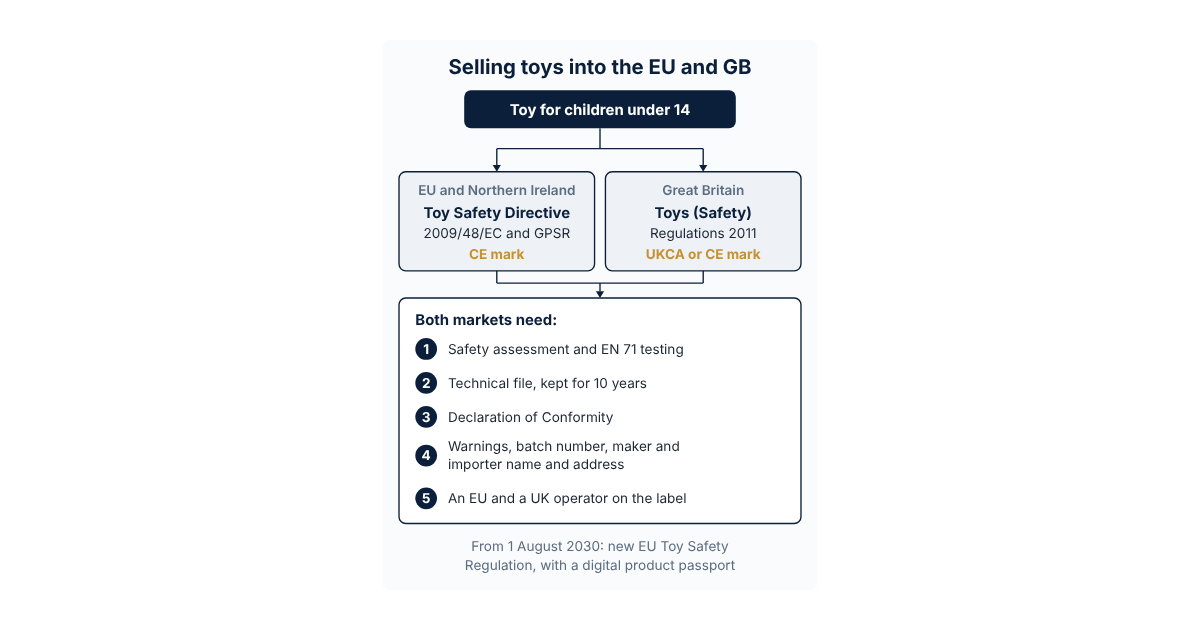
    Selling toys into the EU and Great BritainA toy for children under 14 falls under the Toy Safety Directive 2009/48/EC and GPSR in the EU, with the CE mark, and under the Toys (Safety) Regulations 2011 in Great Britain, with the UKCA or CE mark. Both need a safety assessment and EN 71 testing, a technical file kept for 10 years, a Declaration of Conformity, warnings, a batch number and the manufacturer and importer name and address, and an EU and a UK operator on the label. From 1 August 2030 the new EU Toy Safety Regulation applies, with a digital product passport.Selling toys into the EU and GBToy for children under 14EU and Northern IrelandToy Safety Directive2009/48/EC and GPSRCE markGreat BritainToys (Safety)Regulations 2011UKCA or CE markBoth markets need:1Safety assessment and EN 71 testing2Technical file, kept for 10 years3Declaration of Conformity4Warnings, batch number, maker andimporter name and address5An EU and a UK operator on the labelFrom 1 August 2030: new EU Toy SafetyRegulation, with a digital product passport
    The rules, marks and paperwork for a children’s toy sold in the EU and Great Britain.

    Which products count as toys?

    Both the EU directive and the GB regulations apply to products designed or intended, whether or not exclusively, for use in play by children under 14. The words “whether or not exclusively” matter: a product with a clear play function is a toy even if adults use it too, and the packaging, marketing and listing images all count as evidence of what it is intended for. Some items are expressly excluded, such as sports equipment, Christmas decorations and fashion jewellery for children, so check the exclusion list before you assume either way.

    If a toy has electronics, a battery or a radio module, it also has to meet the rules for those parts. Our consumer electronics compliance guide covers the electrical side.

    The laws that apply

    MarketMain toy lawMarkAlso check
    Great BritainToys (Safety) Regulations 2011UKCA or CEGeneral Product Safety Regulations 2005 for wider duties; UK REACH; PSTI Act for connected toys
    EUToy Safety Directive 2009/48/EC (until 31 July 2030)CEGPSR (EU) 2023/988; REACH; Radio Equipment Directive for connected toys; Batteries Regulation (EU) 2023/1542
    EU from 1 August 2030Toy Safety Regulation (EU) 2025/2509CEDigital product passport; tighter chemical bans
    Northern IrelandEU toy rules under the Windsor FrameworkCE, or CE with UKNIGPSR

    The new EU Toy Safety Regulation

    Regulation (EU) 2025/2509 was published in the Official Journal on 12 December 2025 and applies in full from 1 August 2030, when it repeals Directive 2009/48/EC. Until then, toys must keep meeting the directive. The headline changes for sellers are:

    • A digital product passport for every toy, reached through a data carrier such as a QR code, replacing the paper EU Declaration of Conformity. The technical detail will come in later Commission acts.
    • Wider chemical bans, including intentionally added PFAS and bisphenols, a broader ban on carcinogenic, mutagenic and reprotoxic substances, endocrine disruptors and sensitisers, and a lower limit for allergenic fragrances.
    • New duties for online marketplaces and fulfilment service providers, who will be able to check compliance through the passport.
    • Warnings starting with the word “Warning” or a generic warning pictogram.

    Existing EC type-examination certificates remain valid until 1 February 2031 unless they expire earlier. Plan new product lines with 2030 in mind, especially chemical content, because reformulating a toy takes longer than updating a label.

    Where Great Britain stands

    Great Britain still uses the Toys (Safety) Regulations 2011, which mirror the old EU directive, and recognises CE marking for toys alongside UKCA, as explained in our UKCA marking guide. The government ran a call for evidence on toy safety that closed on 6 October 2026, looking at chemicals, online marketplaces and whether to follow the EU approach. Nothing has been decided, so plan around the 2011 regulations as they stand and watch for changes.

    What the toy, label and documents need

    Under the current rules in both markets, the manufacturer has to:

    1. Carry out a safety assessment covering physical and mechanical, flammability, chemical, electrical, hygiene and radioactivity hazards.
    2. Test the toy, usually against the EN 71 series of standards (EN 71‑1 mechanical, EN 71‑2 flammability, EN 71‑3 migration of certain elements, and others as relevant). Where no suitable standard exists or was fully applied, a notified body (EU) or approved body (GB) has to carry out type examination.
    3. Build the technical file and keep it for 10 years after the toy is placed on the market. Our technical file guide covers what goes in it.
    4. Draw up and sign a Declaration of Conformity listing the toy law and standards applied; see our Declaration of Conformity template.
    5. Affix the CE mark (or UKCA in GB) visibly, legibly and indelibly on the toy, a label or the packaging.
    6. Label the toy with a type, batch or serial number, the manufacturer’s name and postal address, and the importer’s name and address where there is one.
    7. Add the required warnings, preceded by the word “Warning”, in a language consumers in that country easily understand. The age warning for toys that could be dangerous to children under three is the familiar “Not suitable for children under 36 months” with the reason, or the pictogram.

    Toys with button or coin cells, magnets or small parts need particular care in the risk assessment. If the toy contains a battery, the Batteries Regulation and battery take-back rules also apply; our EPR registration service covers packaging, battery and electrical waste registrations.

    The responsible operator: why non-UK and non-EU sellers need one

    In the EU, a toy cannot be placed on the market unless an economic operator established in the EU is responsible for it under GPSR and the market surveillance rules. For a brand outside the EU, that is normally the importer or an authorised representative, often called the EU responsible person. Their name and contact details go on the toy or packaging and on every EU listing.

    In Great Britain, importers and authorised representatives for UKCA or CE toys must be established in the UK. An EU representative does not cover GB, and a UK representative does not cover the EU, so a brand selling in both usually needs one of each. Our article on UK Responsible Person requirements explains the GB side in more detail.

    Common Amazon and marketplace pitfalls

    • Test reports that don’t match the product. A report for a different colour, material or supplier batch may not cover what you sell. Amazon and authorities can ask for the report and Declaration of Conformity, so keep them tied to the exact model.
    • A US test report only. ASTM F963 and a US Children’s Product Certificate do not show conformity with EN 71 or the UK regulations.
    • Missing GPSR listing details. EU listings need the manufacturer’s details, the EU responsible person, product identifiers, a picture and warnings. Our guide to GPSR warnings and safety information shows what to enter.
    • Warnings in English only. A toy sold on Amazon.de needs German warnings and instructions, Amazon.fr needs French, and so on.
    • Calling a toy something else. Listing a children’s plaything as decoration or a collectible to avoid toy law rarely works if the design, images or reviews show children playing with it.

    Toy compliance checklist

    • Confirm the product is a toy and note the age group it is for.
    • Complete the safety assessment and get EN 71 test reports for the exact model.
    • Check REACH and UK REACH restrictions with your supplier.
    • Build the technical file and sign EU and UK Declarations of Conformity.
    • Put the CE mark (and UKCA if you choose) on the toy or packaging.
    • Add the batch number, manufacturer and importer or representative details, and warnings in each country’s language.
    • Appoint an EU responsible operator and a UK importer or authorised representative.
    • Fill in the GPSR fields on every EU listing.
    • Plan for the 2030 Toy Safety Regulation on new designs.

    Your next step

    If you sell toys into the EU or Great Britain from outside, EU Brand Support can act as your EU and UK Responsible Person. We review your test reports, Declaration of Conformity and labels before taking a toy on and agreeing in writing, give you an address for packaging and listings, and hold your technical file for authority requests. For the paperwork, our Toys compliance template pack includes Declaration of Conformity, risk assessment and technical file checklist templates in EU and UK versions. Questions about a specific toy? Get in touch.

    This guide is general information, not legal advice. Check the rules for your specific product.

    Frequently asked questions

    What are the toy safety regulations in the UK?

    In Great Britain, the Toys (Safety) Regulations 2011. Northern Ireland follows EU toy law under the Windsor Framework.

    Can I sell a CE marked toy in the UK?

    Yes. Great Britain currently recognises CE marking for toys alongside UKCA. You still need a UK importer or authorised representative if you are based outside the UK.

    When does the new EU Toy Safety Regulation apply?

    From 1 August 2030. Until then, toys placed on the EU market must meet Directive 2009/48/EC.

    Do I need a notified body for my toy?

    Only if harmonised (or designated) standards covering all the relevant safety requirements do not exist or were not fully applied, or the manufacturer chooses type examination. Most toys tested fully to EN 71 can be self-declared.

    Sources

  • GPSR warning and safety information: what to show and where

    GPSR warning and safety information: what to show and where

    A GPSR warning is the warning or safety information a consumer product sold in the EU or Northern Ireland needs. Under Article 19(d) of the General Product Safety Regulation, every online listing must show those warnings in the local language. Write them from your own risk analysis, not from a generic list, and use the same wording on the box as in the listing.

    Below is a five-step method for turning hazards into warning sentences, a worked example for a brand selling in three languages, and the mistakes to check in a listing’s “warning and safety information” field. Article 19 lists the warnings alongside your EU responsible person’s details, so a brand with no EU base fills both in on the same listing.

    Where the details have to appear

    The GPSR (Regulation (EU) 2023/988) applies to consumer products placed on the EU market from 13 December 2024. It covers products where no specific EU rules with the same aim exist, and where sector rules do exist it covers only the risks they don’t. It applies in Northern Ireland but not in Great Britain, which stays under the UK General Product Safety Regulations 2005.

    For a product in scope, plan for two places:

    Place What has to be there Rule
    On the product, its packaging, the parcel or an accompanying document The responsible person’s name and contact details must be here. Your warning sentences go here too: print them on the product, its packaging or an insert, word for word as in the listing, so the box and the listing match Art 16(3)
    The online listing The same warnings and safety information, in the local language Art 19(d)

    The listing also needs the manufacturer’s name, postal and electronic address, the EU responsible person if the manufacturer is outside the EU, and product identifiers including a picture (Art 19(a) to (c)). Our GPSR label template sets out the blocks on the product itself; this page is about the warnings.

    Where your warnings come from

    Before placing a product on the market, the manufacturer must carry out an internal risk analysis and draw up technical documentation, and keep it for 10 years (Art 9(2) and (3)). Use that analysis as the source of your warnings. A warning is the part of a risk you can’t design out and have to tell the user about.

    A simple way to turn the risk analysis into warning text:

    1. List each hazard the analysis found, for example a small detachable part, a hot surface, a cord, or a material that needs care in use.
    2. Note what you did about it in the design. If the design removes the risk, record that in the analysis instead of writing a warning.
    3. Write one plain sentence for each risk that is left: what the hazard is and what the user should do or avoid.
    4. Use the same sentences everywhere: on the product or packaging, in any leaflet, and in each listing.
    5. Translate them for every country whose buyers your listing reaches.

    Keep the list in your technical documentation next to the risk analysis. Your responsible person must regularly check the product against its technical documentation and labelling rules, and show evidence of those checks on request (Art 16(2)), so the warnings they see on the product should match the file.

    Worked example: a fictional ceramic diffuser

    Fennick Home is a fictional UK brand, used only to show the method. It sells a ceramic oil diffuser with a tea-light holder on Amazon.de and Amazon.fr and on its own website, which delivers to Ireland.

    Hazard in the risk analysis Design step Warning left to give
    Open flame from the tea light Holder sized for one standard tea light, wide stable base Never leave a lit candle unattended. Keep away from things that can catch fire.
    Surface gets hot Thick ceramic walls The bowl gets hot. Let it cool before touching or refilling.
    Children and pets No design change removes this Keep out of reach of children and pets.

    The three sentences go on the box and an insert in each language it sells in, and in each listing: German on Amazon.de, French on Amazon.fr, and on its own site the local language of each country it ships to. Fennick has no EU base, so its listings and packaging also carry its EU responsible person’s details.

    Filling in the marketplace’s safety fields

    Article 22 obliges online marketplaces to give sellers a way to enter product safety information, so check both the listing editor and the bulk upload file for a safety section. When a field asks for “warning and safety information”, enter the warning sentences from your list, in the language of that store. Where there is no field, put them in the description.

    Mistakes to check for before you save the listing:

    • Typing “none” or leaving it blank when the risk analysis found risks that are left.
    • Pasting English text into a store whose buyers read another language.
    • Warnings in the listing that differ from the ones on the box, which makes the checks harder for your responsible person.
    • Generic text copied from another product that doesn’t match this one’s hazards.

    If you have had Amazon’s email about reactivating EU listings, our guide to the “Reactivate your EU listings” email explains what it asks for. For the manufacturer fields on the same form, see who counts as the GPSR manufacturer.

    Great Britain and Northern Ireland orders

    Article 19 doesn’t reach a listing that sells only to Great Britain. A UK shop that also ships to Northern Ireland is a different case: those orders need the warnings above in the listing, and the responsible operator for them must be established in Northern Ireland or the EU.

    Your next step

    Send your warning list to your responsible person with the risk analysis, so their regular checks compare like with like. If you don’t have one yet, our EU Responsible Person service gives you a named EU operator whose details go on your listings and packaging, and holds your technical file. The risk analysis itself stays with you as the manufacturer (Art 9(2)). Our compliance template packs include a risk assessment template to start it. The template gives you a structure; the analysis and the warnings still have to fit your product.

    This page explains the rules in plain English. It isn’t legal advice.

    Frequently asked questions

    What is GPSR warning and safety information?

    The warnings your risk analysis says the user needs, written as plain sentences. Article 19(d) of the GPSR requires every online listing to EU and Northern Ireland consumers to show them in the local language, and a listing field with this name is where they go.

    Do I need warnings if my product is harmless?

    Don’t decide that by feel. Your warnings come from your risk analysis, which you keep with your technical documentation for 10 years (Art 9(2) and (3)). If you conclude a product needs no warnings, record the reasoning there, and don’t type “none” into a listing field without it.

    Which language do the warnings need to be in?

    Article 19(d) says the local language. In practice, plan German warnings for a listing aimed at buyers in Germany and French for buyers in France, and check the language for each other country a store sells into.

    Does a CE-marked product need GPSR warnings as well?

    It can. Where sector rules such as those for toys or electrical goods exist, the GPSR covers only the risks they don’t (Art 2(1)), so check the sector law for any warning requirements of its own first, and use the method above for any risk it doesn’t cover.

    Sources

  • Technical file: what it is, what goes in it and who keeps it

    Technical file: what it is, what goes in it and who keeps it

    A technical file is the set of records a manufacturer prepares before selling a product, showing how it was designed and made, its risks and how they were handled. For CE and UKCA products, and consumer products under the EU General Product Safety Regulation (GPSR), it is normally kept for 10 years and shown to authorities on request.

    What is a technical file?

    UK government guidance calls it a technical file. EU guidance and the GPSR call it technical documentation. In practice they mean the same set of records, and this guide uses both names.

    The EU’s Your Europe guidance describes it as detailed information on the design, manufacture and operation of a product that must show the product meets all EU requirements. It is your evidence. A listing, a label or a supplier’s promise is not.

    If you sell into the EU from outside it, the file also matters to your EU responsible person. Under the GPSR, the economic operator responsible for a product in the EU has to check that the technical documentation has been drawn up, keep it available to market surveillance authorities and regularly check the product against it.

    Which products need one?

    • CE and UKCA marked products. UK guidance says that under the UKCA and CE regulations, manufacturers must prepare a technical file. EU guidance says the documentation is needed to support an EU declaration of conformity and to affix the CE marking where it is required.
    • General consumer products sold in the EU or Northern Ireland. Under the GPSR, manufacturers must carry out an internal risk analysis and draw up technical documentation before placing a product on the market, and keep it for 10 years. This applies even when no CE law covers the product.
    • Great Britain. The GPSR applies in Northern Ireland but not in England, Scotland or Wales, which stay under the UK General Product Safety Regulations 2005. For CE or UKCA products sold in Great Britain, the UKCA and CE guidance above applies.

    Medical devices have their own rules, and this guide does not cover them.

    What goes in a technical file: a checklist

    For CE and UKCA products

    Your Europe lists what the documentation should include at least. UK guidance for the UKCA and CE regimes adds test reports and design documents.

    • The manufacturer’s name and address, or those of any authorised representative
    • A brief description of the product
    • Product identification, such as a serial number
    • Names and addresses of the sites involved in design and manufacture
    • Name and address of any notified body involved, if one was needed
    • The conformity assessment procedure followed
    • Which EU rules apply, and which of their essential requirements are relevant
    • The technical standards used to show compliance (for example EN, ISO or IEC)
    • A risk assessment, and how each risk is dealt with (through design or standards)
    • Critical components and materials, with the evidence for them (such as test reports)
    • Design documents
    • The product label and user instructions

    If a product falls under more than one EU law, the documentation has to show which parts or functions fall under which law and which standards were used for each. If you used non-harmonised standards or in-house methods, explain why and how they show conformity.

    For general products under the GPSR (EU and Northern Ireland)

    UK guidance on the GPSR in Northern Ireland says the technical documentation should give a general description of the product and the characteristics relevant to its safety. The responsible economic operator checks that it contains, where they apply:

    • an analysis of the possible risks and the solutions used to remove or reduce them
    • a list of any relevant standards that apply to the product, including any declaration of conformity

    Technical file or declaration of conformity?

    They are different documents. The technical file is the evidence. A declaration of conformity is the signed statement that the product meets the laws named in it, and it belongs to the CE (and UKCA) regime. For a general product that only falls under the GPSR, what the law asks for is the risk analysis and technical documentation, not a declaration of conformity. If your product does need one, our guide to what goes in an EU and UK declaration of conformity sets out each element.

    Who keeps it, and for how long

    Who What they do with the file
    Manufacturer Draws it up before the product goes on the market and keeps it. EU guidance says 10 years from placing on the market unless a law says otherwise.
    Authorised representative (UKCA/CE) Keeps the technical documentation when the manufacturer asks it to in writing.
    Importer (UKCA/CE in Great Britain) Makes sure the manufacturer drew up the documentation, and keeps it.
    Responsible economic operator (GPSR) Checks it exists, keeps it available to authorities for 10 years and regularly checks the product against it.

    For the UKCA and CE regimes in Great Britain, the 10 years (typical, check your sector’s law) runs from when each individual product is placed on the market, not the first of a production run. The file can be in any official EU language, though authorities may ask for a translation of the parts they need. It can be kept electronically, as long as it stays organised, accessible and available on request.

    Worked example (fictional business)

    Fernside Home is a made-up UK brand that sells cotton cushion covers to customers in Germany and Northern Ireland. For this example, assume no CE law applies to the covers, so the GPSR is the main safety law. Before listing, Fernside’s file holds:

    1. A description of the covers, photos, sizes and the batch numbering used on the labels.
    2. The maker’s name and address, and the site where the covers are sewn.
    3. A risk analysis: who uses them, what could go wrong (for example a zip pull coming loose) and what was done about each risk.
    4. Any standards the maker used, with the reports that back them up.
    5. The label, care instructions and safety information exactly as the customer sees them.
    6. The name and contact details of its EU responsible person, who has seen the file and can produce it if an authority asks.

    When Fernside adds a new fabric from a new mill, it updates the file before the new batch is listed, not after.

    Common gaps in technical files

    • Written after the product went on sale. The rules say before.
    • Standards named, evidence missing. A list of standards with no test reports behind it proves little.
    • Nothing ties the file to the product. Batch or serial numbers on the product should match the records.
    • Nobody can find it. Electronic is fine, but it has to be organised and available when asked for.
    • One file stretched across different products. A new material, supplier or design change needs its risks looked at again.

    Templates and help

    Want it done for you? Our technical file service puts together your CE or UKCA technical file and Declaration of Conformity, from £495 per product. Our compliance template packs include declaration of conformity, risk assessment and technical file templates by product category. A template is a starting point: the risk analysis, any testing and the checks still have to be real for your product. If you sell from outside the EU or Northern Ireland and need someone established there to take on the responsible person role, see our EU and UK Responsible Person service. For the wider picture, read what the GPSR is and who it covers or our UKCA marking guide.

    FAQs

    Is a technical file the same as technical documentation?

    In practice, yes. UK guidance uses “technical file” and EU guidance and the GPSR use “technical documentation” for the records that show a product is safe and meets the rules that apply to it.

    Does every product need a declaration of conformity?

    No. A declaration of conformity belongs to the CE and UKCA regimes. A general product under the GPSR alone needs a risk analysis and technical documentation instead.

    How long do I keep a technical file?

    Usually 10 years from when the product is placed on the market, unless the law for your product says otherwise.

    Can the technical file be digital?

    Yes. It can be stored electronically, as long as it stays accessible, organised and available to authorities when they ask.

    Does the GPSR apply in Great Britain?

    No. It applies in the EU and Northern Ireland. Great Britain stays under the UK General Product Safety Regulations 2005.

    Sources

  • Car accessories GPSR: EU and UK rules for decals, mounts and 12V gadgets

    Car accessories GPSR: EU and UK rules for decals, mounts and 12V gadgets

    Car accessories GPSR rules are simple at the core: most car accessories sold to consumers in the EU fall under the General Product Safety Regulation (EU) 2023/988, and if you are not established in the EU you need an EU-based economic operator, often called an EU responsible person, before you sell. Some accessories are also covered by other laws, such as EMC and RoHS for 12V and USB gadgets or CLP for air fresheners, and Great Britain follows its own General Product Safety Regulations 2005.

    This guide is for small brands outside the EU and UK selling decals, phone mounts, seat covers, air fresheners, organisers and 12V gadgets on Amazon, Shopify or Etsy. If you need an EU or UK name and address for your labels and listings, our EU and UK Responsible Person service covers that part.

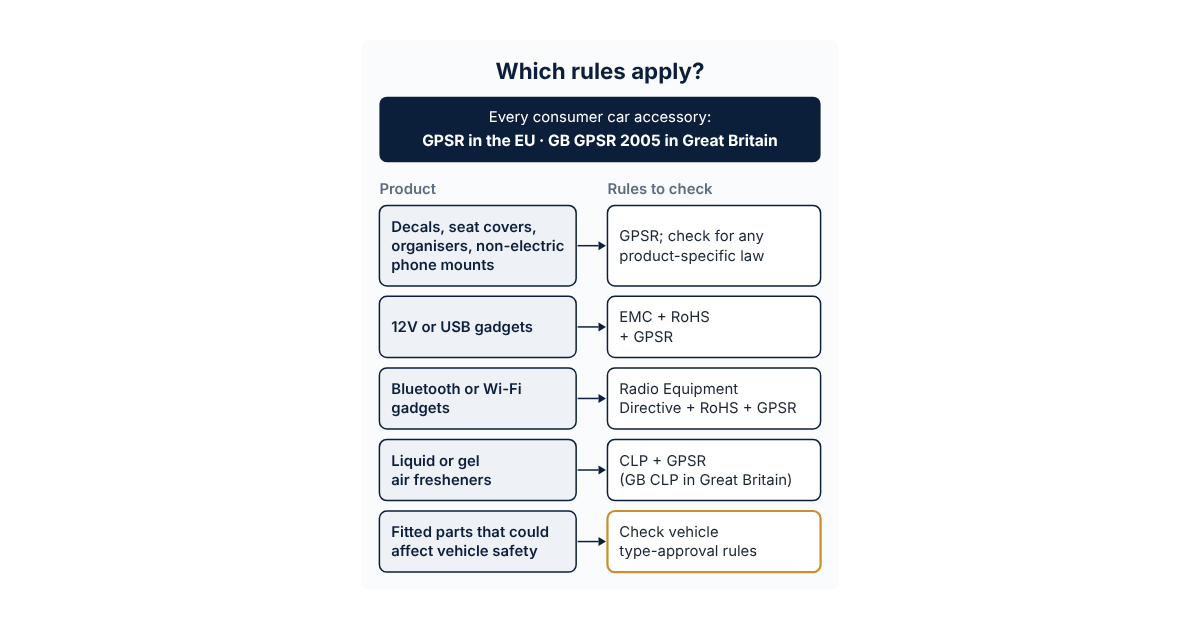
    Which rules apply to car accessoriesEvery consumer car accessory falls under GPSR in the EU and the General Product Safety Regulations 2005 in Great Britain. Decals, seat covers, organisers and non-electric phone mounts: GPSR, checking whether any product-specific law also applies. 12V or USB gadgets: EMC and RoHS plus GPSR. Bluetooth or Wi-Fi gadgets: the Radio Equipment Directive plus RoHS and GPSR. Liquid or gel air fresheners: CLP plus GPSR, with GB CLP in Great Britain. Anything fitted to the vehicle that could affect its safety systems: check vehicle type-approval rules before listing.Which rules apply?Every consumer car accessory:GPSR in the EU · GB GPSR 2005 in Great BritainProductRules to checkDecals, seat covers,organisers, non-electricphone mountsGPSR; check for anyproduct-specific law12V or USB gadgetsEMC + RoHS+ GPSRBluetooth or Wi-FigadgetsRadio EquipmentDirective + RoHS + GPSRLiquid or gelair freshenersCLP + GPSR(GB CLP in Great Britain)Fitted parts that couldaffect vehicle safetyCheck vehicletype-approval rules
    Which EU and UK rules to check for common car accessories.

    Does GPSR apply to car accessories?

    Yes, for consumer products. GPSR covers any item that is intended for consumers or likely, under reasonably foreseeable conditions, to be used by consumers. A phone mount, a seat cover or a boot organiser sold online to drivers fits that description.

    Where a product is also covered by sector rules, GPSR still applies to the aspects and risks those rules do not cover. So an electrical gadget has to meet its sector laws and GPSR for everything else.

    Which car accessories fall under other rules as well?

    Accessory EU rules to check Why
    Vinyl decals, organisers, seat covers, non-electric phone mounts GPSR Consumer products; check whether any product-specific law also applies
    12V or USB gadgets (chargers, fans, lights, vacuum cleaners) EMC Directive 2014/30/EU, RoHS Directive 2011/65/EU, plus GPSR Electrical and electronic equipment
    Gadgets with Bluetooth or Wi-Fi Radio Equipment Directive 2014/53/EU, plus RoHS and GPSR Radio equipment has its own framework
    Liquid or gel air fresheners CLP Regulation (EC) No 1272/2008, plus GPSR Chemical mixtures; hazardous ones need CLP classification and labelling
    Anything fitted to the vehicle that could affect its safety systems Possibly vehicle type-approval rules, Regulation (EU) 2018/858 Check before listing

    12V and USB gadgets

    The EMC Directive makes sure electrical and electronic equipment does not generate, or is not affected by, electromagnetic disturbance. RoHS restricts ten hazardous substances, including lead, mercury and cadmium, in products with an electrical or electronic component unless they are specifically excluded. If the gadget has a radio function, the Radio Equipment Directive sets essential requirements for safety and health, electromagnetic compatibility and use of the radio spectrum.

    One point that surprises sellers: the Low Voltage Directive applies to equipment rated between 50 and 1,000 V AC or 75 and 1,500 V DC. A 12V in-car gadget sits below that range, so its electrical safety risks are not covered by sector law and fall to GPSR.

    Air fresheners

    CLP sets classification, labelling and packaging rules for hazardous substances and mixtures, including pictograms, signal words and standard statements. If your fragrance mixture is classified as hazardous, the label must carry those elements. In Great Britain the equivalent is GB CLP, which HSE runs.

    Parts fitted to the vehicle

    The EU vehicle type-approval regulation covers systems, components and separate technical units, and also parts and equipment that may pose a serious risk to the correct functioning of a vehicle’s essential systems. If your accessory is fitted to the car and could affect how it works or how it was approved, check the vehicle rules before you list it.

    Labelling and listing requirements under GPSR

    Under GPSR the manufacturer must put on the product, or where that is not possible its packaging or an accompanying document:

    • a type, batch or serial number or other element that identifies the product
    • its name, registered trade name or trade mark, and a postal and electronic address
    • clear instructions and safety information in a language consumers in that country can easily understand, unless the product can be used safely without them

    Online offers must clearly show the manufacturer’s details, the EU responsible person’s name and postal and electronic address where the manufacturer is outside the EU, a picture and other product identifiers, and any warnings or safety information in a language consumers can easily understand. Our GPSR label template guide shows a worked layout.

    Car accessories in Great Britain

    In England, Scotland and Wales the General Product Safety Regulations 2005 still apply. They require products to be safe in normal or reasonably foreseeable use. Where the manufacturer is not established in the UK, the producer is its UK representative if it has one, otherwise the UK business that brings the product in from outside the UK.

    The producer must, where reasonable, mark the product or packaging with its name and address and the product reference or batch, give consumers the information they need to assess risks that are not obvious, and monitor the product’s safety.

    Electrical gadgets also fall under GB sector rules, including the Electromagnetic Compatibility Regulations 2016, the RoHS Regulations 2012 and the Radio Equipment Regulations 2017. For UKCA or CE goods, importers and authorised representatives must be established in the UK, and the manufacturer’s and importer’s name and postal address must be on the product. Northern Ireland follows EU GPSR instead. See our guide to UK Responsible Person requirements.

    What Amazon asks for

    Amazon’s announcement on GPSR told sellers in its EU stores to have an EU responsible person, label products with the responsible person’s and manufacturer’s contact details and a type, batch or serial number, and provide safety information and warnings in the language of the country of sale. Listings must show the responsible person and manufacturer details, a product picture and the safety information. Another Amazon announcement said listings in the Amazon UK store need no GPSR submission. If listings have already been blocked, see how to reactivate EU listings after a GPSR email.

    Worked example: a Canadian car-lifestyle brand

    A fictional small brand in Canada sells vinyl decals, a magnetic phone mount, seat covers and a USB-C car fan through Shopify and Etsy. It wants to ship to customers in the EU and the UK.

    • Decals, mount and seat covers: GPSR in the EU. The brand writes a risk assessment, adds a batch number and its name and addresses, and puts care and fitting instructions in the buyer’s language.
    • USB-C fan: EMC and RoHS as well as GPSR in the EU. The brand carries out the conformity assessment, sets up the technical file and issues an EU Declaration of Conformity before it affixes CE marking. In Great Britain the fan needs a UK-established importer or authorised representative.
    • The gap: it has nobody in the EU. It appoints an EU responsible person, adds that name and address to labels and to every EU-facing product page, and keeps its documents ready for authority requests.

    In this example the products themselves are low risk; the missing pieces are the paperwork and the EU and UK contact on the label.

    Your next step

    If you sell car accessories into the EU or Great Britain from outside, EU Brand Support can act as your EU or UK Responsible Person, giving you an address for labels and listings, holding your technical file and handling authority requests. Radio, battery and 12V gadgets are taken on only after we’ve reviewed the documents and agreed in writing. For 12V and USB gadgets, our consumer electronics compliance template pack includes Declaration of Conformity, risk assessment and technical file checklist templates in EU and UK versions. Other categories are in the template shop.

    This guide is general information, not legal advice. Check the rules for your specific product.

    Frequently asked questions

    Do vinyl car decals need GPSR compliance?

    Yes, if they are sold to consumers in the EU. They need a product identifier, manufacturer details, any safety information in the local language and, if you are outside the EU, an EU responsible person.

    Does a 12V car charger need CE marking?

    EMC and RoHS are among the rules that use CE marking; GOV.UK lists both as UKCA or CE regimes where the manufacturer can self-declare. GPSR covers the remaining risks, including electrical safety, because 12V is below the Low Voltage Directive’s range.

    Do I need a UK responsible person for car accessories?

    For UKCA or CE marked goods, such as electrical gadgets, you need a UK-established importer or authorised representative. For other accessories, GB rules place the producer duties on your UK representative or, if you have none, the UK importer.

    Does Amazon UK ask for GPSR information?

    Amazon’s announcement said listings in the UK store need no GPSR submission. EU stores do.

    Sources

  • Pet toy safety regulations: UK and EU rules for cat and dog toys

    Pet toy safety regulations: UK and EU rules for cat and dog toys

    Pet toy safety regulations in the EU and UK start with general product safety law, not toy law: pet toys are made for animals, and the EU Toy Safety Directive covers products designed or intended for play by children under 14. In the EU that means the General Product Safety Regulation (EU) 2023/988, with an EU responsible person if you are based outside the EU, and in Great Britain the General Product Safety Regulations 2005.

    This guide is for brands outside the UK and EU selling cat wands, feather toys, chew toys and similar products on Amazon or their own stores. If you need an EU or UK name and address for your labels and listings, see our EU and UK Responsible Person service.

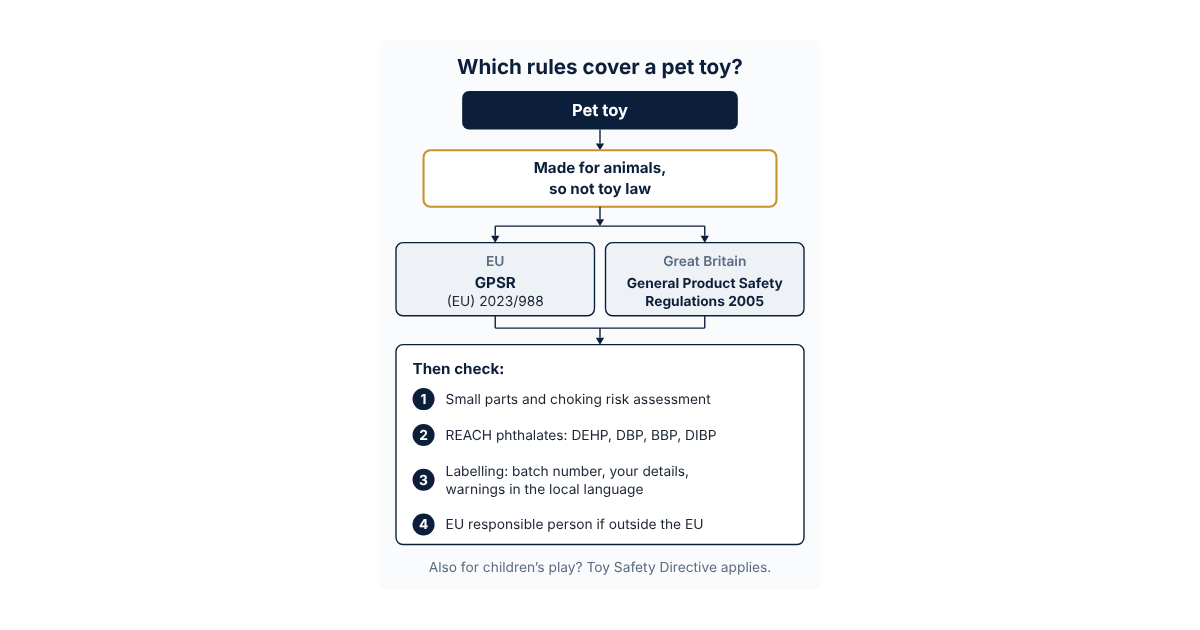
    Which rules cover a pet toyPet toys are made for animals, so toy safety law does not apply as a rule. In the EU they fall under the General Product Safety Regulation (EU) 2023/988; in Great Britain under the General Product Safety Regulations 2005. Then check: a small parts and choking risk assessment; REACH restrictions on the phthalates DEHP, DBP, BBP and DIBP; labelling with a batch number, your details and warnings in the local language; and an EU responsible person if you are outside the EU. If the product is also designed or intended for children’s play, the Toy Safety Directive applies.Which rules cover a pet toy?Pet toyMade for animals,so not toy lawEUGPSR(EU) 2023/988Great BritainGeneral Product SafetyRegulations 2005Then check:1Small parts and choking risk assessment2REACH phthalates: DEHP, DBP, BBP, DIBP3Labelling: batch number, your details,warnings in the local language4EU responsible person if outside the EUAlso for children’s play? Toy Safety Directive applies.
    How pet toys are covered in the EU and Great Britain, and what to check.

    Are pet toys covered by toy safety law?

    Not as a rule. The Toy Safety Directive 2009/48/EC applies to “products designed or intended, whether or not exclusively, for use in play by children under 14 years of age”. A feather wand designed for a cat is not designed for children’s play.

    Two points need care. First, the words “whether or not exclusively” mean a product designed or intended for children’s play as well as for pets would be a toy. If your marketing shows children playing with it, think again. Second, GPSR itself asks you to assess products that, although not designed for children, are likely to be used by them or resemble an object commonly recognised as appealing to or intended for children. A plush mouse that looks like a child’s soft toy has to be assessed with that in mind.

    GPSR for pet toys in the EU

    GPSR covers products intended for consumers or likely, under reasonably foreseeable conditions, to be used by consumers. Pet owners buy and handle pet toys, so they are in scope. Your safety assessment has to take account of, among other things:

    • the product’s design, technical features, composition and packaging
    • the categories of consumers using it, including the risk for vulnerable consumers such as children
    • its appearance, where that could lead people to use it differently from its design

    Small parts and choking risks

    Pet toys are used in family homes, so children are a foreseeable user group. If a toy has bells, beads, feathers or other parts that can come loose, record that risk in your assessment and decide what to do: design it out, test that parts stay attached, or add a warning. GPSR requires clear instructions and safety information in a language consumers in that country can easily understand, unless the product can be used safely without them.

    Restricted substances: phthalates under REACH

    Soft plastic pet toys can contain plasticisers. REACH Annex XVII entry 51 restricts four phthalates, DEHP, DBP, BBP and DIBP, at 0.1% or more by weight of the plasticised material. Since 7 July 2020 that restriction applies to articles in general, not only toys and childcare articles, subject to listed exemptions. Plasticised material includes PVC and polyurethanes as well as coatings, printed designs and adhesives. Ask your supplier for test reports that cover these substances.

    Great Britain has its own chemicals regime, UK REACH, run by HSE, with its own list of restrictions. Check that list for GB sales.

    Labelling and the EU responsible person

    A pet toy cannot be placed on the EU market unless there is an economic operator established in the EU responsible for it. For a brand outside the EU, that is usually an importer or an authorised representative, often called the EU responsible person.

    The manufacturer must make sure the product or, where that is not possible, its packaging or accompanying document shows:

    • a type, batch or serial number or other element that identifies it
    • the manufacturer’s name, registered trade name or trade mark, and a postal and electronic address
    • instructions and safety information in the local language, where needed

    Online listings must show the manufacturer’s details, the responsible person’s name and postal and electronic address where the manufacturer is outside the EU, a picture and product identifiers, and any warnings. Our GPSR label template guide shows a worked layout.

    Pet toys in Great Britain

    In England, Scotland and Wales the General Product Safety Regulations 2005 require products to be safe in normal or reasonably foreseeable use. Where the manufacturer is not established in the UK, the producer is its UK representative if it has one, otherwise the UK business placing the product on the GB market from outside the UK.

    The producer must, where reasonable, mark the product or packaging with its name and address and the product reference or batch, give consumers the information they need to assess risks that are not obvious, and take steps to stay informed of risks, such as sample testing and keeping a complaints register. Northern Ireland follows EU GPSR.

    What Amazon asks for

    Amazon’s GPSR announcement told sellers in its EU stores to have an EU responsible person, label products with the responsible person’s and manufacturer’s contact details and a type, batch or serial number, and give safety information and warnings in the language of the country of sale. Listings must show those details, a product picture and the safety information. Another Amazon announcement said listings in the UK store need no GPSR submission. We could not find a public Amazon page setting out extra GPSR requirements for pet supplies, so check the category requirements in Seller Central before you list.

    Worked example: a US cat toy brand expanding to Europe

    A fictional US brand sells cat wands and feather toys on Amazon.com and wants to launch on Amazon UK and the EU stores.

    • Classification: the toys are designed and marketed for cats, with no images of children playing, so GPSR applies rather than toy law.
    • Risk assessment: it lists detachable feathers, a small bell and the wand’s string as risks, including for children in the home, and adds a warning in each country’s language.
    • Materials: the wand handle has a soft PVC grip, so it asks the factory for a phthalate test report against REACH entry 51.
    • The gap: it has no EU presence. It appoints an EU responsible person, adds that name and address to packaging and to the GPSR fields on each EU listing, and adds a batch number to every carton and product label.

    Your next step

    If you sell pet toys into the EU or Great Britain from outside, EU Brand Support can act as your EU or UK Responsible Person, giving you an address for labels and listings, holding your technical file and handling authority requests. Our Pet Care compliance template pack includes Declaration of Conformity, risk assessment and technical file checklist templates in EU and UK versions, and other categories are in the template shop.

    This guide is general information, not legal advice. Check the rules for your specific product.

    Frequently asked questions

    Do pet toys need CE marking?

    A pet toy that is not a toy for children, and has no electrical or other CE-marked function, is covered by GPSR rather than a CE marking law. CE marking must not be put on products outside the categories that require it.

    Do pet toys need to meet the Toy Safety Directive?

    Not if they are designed and intended only for animals. A product also designed or intended for play by children under 14 would fall under it.

    Are phthalates banned in pet toys?

    Under REACH entry 51, DEHP, DBP, BBP and DIBP are restricted at 0.1% or more by weight of the plasticised material in articles generally, subject to exemptions.

    Do I need an EU responsible person to sell pet toys on Amazon?

    If you are outside the EU, yes. GPSR requires an economic operator established in the EU, and Amazon asks for one for its EU stores.

    Sources

  • Declaration of conformity template: what goes in an EU and UK DoC

    Declaration of conformity template: what goes in an EU and UK DoC

    A declaration of conformity (DoC) template follows the EU model in Decision 768/2008/EC, Annex III: a product number, the manufacturer’s name and address, a sole-responsibility statement, product identification, the laws met, the standards used, any notified body, then place, date, name, function and signature. It is for CE-marked products, not every product.

    This guide gives you a fill-in template with the source of each line, a worked example for a fictional business, the ways a UK DoC differs, and the mistakes to check for before you sign. If you sell from outside the EU or UK and need someone to check your DoC and hold your file, see our EU and UK Responsible Person service.

    What is a declaration of conformity?

    An EU declaration of conformity is a legal document the manufacturer, or its authorised representative, signs to declare that a product meets the EU requirements that apply to it. By signing it, the manufacturer takes full responsibility for the product’s compliance. It is signed only after the conformity assessment is done and the technical documentation is compiled.

    The DoC belongs to the CE marking system. CE marking is only required for products covered by EU rules that specifically mandate it, and where no such rules exist, CE marking must not be used. If your product is covered only by the General Product Safety Regulation, there is no DoC to write: the manufacturer carries out an internal risk analysis and draws up technical documentation (GPSR Article 9(2)). Our GPSR guide covers that side.

    It is not a certificate. There is no central EU body that gives you permission or a certificate to use the CE mark: the manufacturer draws up and signs the DoC itself. Where a law requires a notified body, that body’s details and certificate are referred to in the DoC.

    The declaration of conformity template, line by line

    EU product laws built on the common framework give the DoC the model structure in Annex III of Decision 768/2008/EC. What a DoC must include still varies by product law, so check the law for your product before you fill this in. Copy the eight parts below into your own document:

    Part What to write Where it comes from
    Heading and No. “EU declaration of conformity” and a unique identification of the product Annex III, point 1
    Manufacturer Name and full business address of the manufacturer, or of its authorised representative Annex III, point 2
    Responsibility statement “This declaration of conformity is issued under the sole responsibility of the manufacturer.” Annex III, point 3
    Object of the declaration Identification of the product that allows traceability: model, type or serial number. It may include a photograph Annex III, point 4
    Conformity statement That the product described is in conformity with the relevant EU harmonisation legislation, followed by each law Annex III, point 5
    Standards The harmonised standards used, or the other specifications conformity is declared against Annex III, point 6
    Notified body (where applicable) Name and number of the notified body, what it did, and the certificate it issued Annex III, point 7
    Additional information and signature Anything extra, then “Signed for and on behalf of:”, place and date of issue, name, function and signature Annex III, point 8

    Three rules sit around the template. The DoC must be translated into the language or languages required by the EU country where the product is sold. It must be kept up to date. And it is signed by someone with legal authority to represent the manufacturer or authorised representative, typically a director, compliance officer or senior manager, who does not need to be an EU citizen or resident.

    Declaration of conformity example (fictional business)

    Example only. Fern & Flint Ltd, its product and every detail below are invented. The laws and standards are left as placeholders because they depend entirely on your product.

    EU declaration of conformity No. FF-LT2-2026

    1. Product: Fern & Flint trail lantern, model LT-2, serial numbers from LT2-26-0001

    2. Manufacturer: Fern & Flint Ltd, [full postal address]. Authorised representative: [EU name and address, if appointed]

    3. This declaration of conformity is issued under the sole responsibility of the manufacturer.

    4. Object of the declaration: rechargeable camping lantern, model LT-2, as shown in the attached photograph.

    5. The object of the declaration described above is in conformity with the relevant EU harmonisation legislation: [each Regulation or Directive that applies, with its number and title].

    6. Standards: [each harmonised standard used, with its number and year, copied from the test reports].

    7. Notified body: [name, number, what it did, certificate number], or “not applicable” if the law lets you self-declare.

    8. Additional information: [optional, for example test report numbers]. Signed for and on behalf of: Fern & Flint Ltd. [Place], [date of issue]. [Name], [function], [signature].

    For a filled-in electronics example with the Low Voltage, EMC and RoHS directives already named, see our EU Declaration of Conformity template for consumer electronics.

    UK declaration of conformity: what changes

    For Great Britain (England, Scotland and Wales), government guidance says a DoC is a formal statement that the product complies with the applicable legislation, drawn up once the manufacturer is assured the product is compliant, and offers an example UK DoC template to download. What goes in it varies by product regulation. The guidance says it may include the manufacturer’s or authorised representative’s name and full business address, the product’s serial number, model or type, a full-responsibility statement, any approved body, the legislation, the standards with their dates, the signatory’s name and signature, the date of issue and supplementary information.

    EU DoC UK DoC (Great Britain)
    Legislation listed The EU harmonisation legislation that applies UK legislation, or recognised EU product regulations
    Standards Harmonised standards or other specifications Designated (UK) or harmonised (EU) standards, including the date of the standard
    Third-party body EU notified body, where required UK approved body, which certifies for UKCA only. EU notified body certificates can be used in GB under CE recognition or Fast-Track UKCA
    Authorised representative Established in the EU Established in the UK
    How long to keep it The most recent DoC for 10 years after the product is placed on the EU market Typically 10 years after each individual product is placed on the GB market
    Other names Sector laws may use their own model Some regulations call it a Declaration of Performance (DoP); partly completed machinery uses a Declaration of Incorporation (DoI)

    Great Britain continues to recognise CE marking for many product types, with no end date stated, though medical devices, construction products and some others have separate rules. For UKCA or CE goods in GB, importers and authorised representatives must be established in the UK, so an EU representative does not cover GB. Northern Ireland has its own guidance. Our UKCA marking guide covers which products can be self-declared in GB, and UK Responsible Person requirements by product type covers who you need there.

    Common mistakes to check before you sign

    • Writing a DoC for a product no CE law covers. If no harmonised rule requires CE marking, the mark must not be used. Prepare the GPSR risk analysis and technical documentation instead.
    • Signing before the work is done. The DoC comes after the conformity assessment and the technical documentation, not before.
    • A product description nobody can trace. Use the model, type or serial number exactly as it appears on the product, so the DoC can be matched to the item.
    • Relying on your suppliers’ CE marks. If you place the finished product on the market, your DoC covers the whole product, even if its components are already CE marked.
    • Laws listed without standards. Name the standards or specifications you actually used, with their dates (the GB guidance asks for the date of each standard), and the notified body details where one was involved.
    • The wrong signatory. It must be someone with legal authority to represent the manufacturer or authorised representative, with their name, position, signature and date.
    • No translation. Each EU country where you sell can require its own language or languages.
    • A DoC that never changes. Update it when the product, its components or materials, the applicable law or standards, the manufacturer’s or representative’s contact details, or the assessment body or procedure change. A substantial modification can mean a new conformity assessment.
    • Not knowing where it must be. A DoC is made available to market surveillance authorities on request, but some laws, such as the one for radio equipment, require it to accompany the product.

    Get the template and a second pair of eyes

    Our compliance template packs include Declaration of Conformity, risk assessment and technical file templates by product category. If your catalogue spans several categories, the all-category compliance bundle has all ten category packs, 30 documents in total. A template is a starting point, not compliance: your product still has to meet the rules that apply to it, which usually means test reports.

    If you sell into the EU or GB from outside, our EU and UK Responsible Person service reviews your Declaration of Conformity, risk assessment and test reports before taking you on, and holds your technical file for authority requests.

    This guide is general information, not legal advice. Check the law for your specific product.

    Frequently asked questions

    What is a declaration of conformity?

    A signed legal document in which the manufacturer, or its authorised representative, declares that a product meets the EU requirements that apply to it and takes full responsibility for that. It is part of the CE marking process.

    Is a declaration of conformity a certificate?

    No. The manufacturer draws it up and signs it. No central EU body issues a certificate for CE marking, although where a law requires a notified body, its certificate is referred to in the DoC.

    Does every product need a declaration of conformity?

    No. It applies to products under EU laws that require CE marking, such as toys, electrical equipment and personal protective equipment. Other consumer products sold in the EU fall under general product safety rules, where the requirement is a risk analysis and technical documentation.

    Who can sign a declaration of conformity?

    Someone with legal authority to represent the manufacturer or its authorised representative, typically a director, compliance officer or senior manager. They don’t need to be an EU citizen or resident.

    How long do I keep a declaration of conformity?

    In the EU, keep the most recent DoC for 10 years after the product is placed on the market. In Great Britain it is typically 10 years after each individual product is placed on the market, but check the regulation for your product.

    Is there a declaration of conformity template for medical devices?

    Medical devices have their own EU and GB rules, so check the medical device regulation for what its DoC must contain before you use a general template. In Great Britain only some Class I devices can be self-declared under the Medical Devices Regulations 2002.

    Sources

  • GPSR label template: what goes on or with your product

    GPSR label template: what goes on or with your product

    A GPSR label shows the manufacturer’s name, postal and electronic address, a type, batch or serial number, and the EU responsible person’s contact details. Importers add their own details. If it won’t fit, use the packaging or an accompanying document.

    This page sets out each block of a GPSR label, where each one is allowed to go, and what your online listing needs on top. Ask us for the free label template to copy into your artwork.

    What goes on a GPSR label

    The EU General Product Safety Regulation (GPSR), Regulation (EU) 2023/988, has applied since 13 December 2024 to consumer products placed on the EU market from that date. For a typical consumer product, plan for these five blocks:

    Block What it says Where the rule is
    Manufacturer Name, or registered trade name or registered trade mark, plus a postal and an electronic address GPSR Article 9(6)
    Product identifier A type, batch or serial number, or another element that identifies the product GPSR Article 9(5)
    EU responsible person Name and contact details of the economic operator established in the EU who is responsible for the product GPSR Article 16(3)
    Importer (if you import) Your name, or registered trade name or registered trade mark, plus a postal and an electronic address GPSR Article 11(3)
    Instructions and safety information Clear instructions and safety information, in a language consumers in the country of sale can easily understand GPSR Article 9(7)

    Instructions and safety information aren’t needed where the product can be used safely and as intended without them. Our guide to GPSR rules for car accessories shows what these labels mean for decals, phone mounts and 12V gadgets.

    Where each block can go

    The product itself comes first. The rules allow other places when a detail won’t fit:

    • Product identifier: on the product, or, if its size or nature prevents it, on the packaging or in an accompanying document.
    • Manufacturer details: on the product, or, if that isn’t possible, on the packaging or in an accompanying document.
    • EU responsible person: on the product, its packaging, the parcel or an accompanying document.
    • Importer details: on the product, or, if that isn’t possible, on the packaging or in an accompanying document.
    • Instructions and safety information: they have to accompany the product.

    Your online listing needs its own set

    A label on the box doesn’t cover the listing. Under GPSR Article 19, an online offer must show:

    • the manufacturer’s name and postal and electronic address;
    • the EU responsible person, if the manufacturer is outside the EU;
    • product identifiers, including a picture of the product;
    • warnings and safety information in the local language.

    Our GPSR explainer covers the rest of the regulation, including what online marketplaces have to do.

    Who your EU responsible person can be

    A product can’t be placed on the EU market unless an economic operator established in the EU is responsible for it. That can be an EU manufacturer, an authorised representative with a written mandate, or the importer. A fulfilment service provider counts only if none of those exists.

    The responsible person has real duties. They must regularly check the product against its technical documentation and labelling rules, and show evidence of those checks on request. So the label is something they should have checked, not just a place their name appears. See how our responsible person service works.

    Northern Ireland and Great Britain

    The GPSR applies in Northern Ireland but not in Great Britain, which stays under the UK General Product Safety Regulations 2005. In Northern Ireland, the responsible operator must be established in Northern Ireland or the EU.

    For UKCA or CE-marked goods sold in Great Britain, importers must be established in the UK, and the importer’s name and address normally go on the product or its packaging. Our UK Responsible Persons guide covers the rules for UKCA and CE goods in GB.

    Get the free GPSR label template

    The template lays out all five blocks with fields to fill in, plus a one-page table of where each block can go. It’s a starting point for your artwork, not a compliance check: the details still have to be true, and the warnings still have to match your risk analysis.

    Ask for the free label template, or see our category template packs for consumer electronics and toys. For CE products, our Declaration of Conformity template guide covers the paperwork side. Selling jewellery? Our jewellery template pack has a risk assessment and technical file checklist in EU and UK versions.

    GPSR label FAQs

    What has to be on a GPSR label?

    The manufacturer’s name and postal and electronic address, a product identifier such as a type, batch or serial number, and the EU responsible person’s name and contact details. If you import the product, your own name and addresses go on too. Clear instructions and safety information must accompany the product, unless it can be used safely and as intended without them.

    Can the GPSR details go on the packaging instead of the product?

    Yes, in some cases. The product identifier can move to the packaging or an accompanying document if the product’s size or nature prevents it. Manufacturer and importer details can move there if putting them on the product isn’t possible. The EU responsible person’s details can go on the product, its packaging, the parcel or an accompanying document.

    Does a GPSR label need a CE mark?

    Not because of the GPSR, which doesn’t require a CE mark. Products under the CE laws, such as toys, low voltage and radio equipment, still need CE marking and a Declaration of Conformity under those laws. For a general product under the GPSR alone, the requirement is an internal risk analysis and technical documentation.

    Do products sold in Great Britain need a GPSR label?

    The GPSR applies in Northern Ireland, not in Great Britain. Products sold in Great Britain stay under the UK General Product Safety Regulations 2005, and UKCA or CE goods normally carry the UK importer’s name and address.

    Is an EU address on the label enough?

    No. The address belongs to a responsible person who has duties, including regularly checking the product against its technical documentation and labelling rules and showing evidence of those checks on request.

    What language do the safety instructions need to be in?

    A language consumers can easily understand, as decided by the EU country where the product is sold. If you sell into several countries, plan for each one.

    This page explains the rules in plain English. It isn’t legal advice, and a template doesn’t make a product compliant.

  • UKCA marking: what it means, which products need it and how to get it

    UKCA marking: what it means, which products need it and how to get it

    UKCA marking (UK Conformity Assessed) is the conformity mark for products placed on the market in Great Britain. It is the manufacturer’s claim that the product meets its sector’s rules. It is needed only where a sector regulation requires a conformity mark, and Great Britain continues to recognise CE marking for many of those products, with no end date stated.

    This guide is for brands and Amazon sellers outside the UK who want to know whether their product needs a mark, which route to use, and what has to be in place before stock reaches Great Britain. If you sell UKCA or CE goods into GB from abroad, you will also need a UK-established importer or authorised representative: our UK Responsible Person service covers that part.

    What does UKCA marking mean?

    UKCA stands for UK Conformity Assessed. Like CE (Conformité Européenne), it is the manufacturer’s statement that the product meets the product requirements that apply to it.

    It applies in Great Britain: England, Scotland and Wales. It does not apply in the Crown dependencies, and Northern Ireland has its own arrangements (see below).

    What products need UKCA marking?

    A conformity mark is only needed when a sector-specific regulation asks for one. Products with no such regulation sit under the UK General Product Safety Regulations 2005 in Great Britain instead.

    The UKCA and CE regimes together cover more than 20 product types, mostly the goods that needed CE marking under EU “new approach” laws, plus some other sectors such as aerosols. Common ones for online sellers include toys, electrical equipment, radio equipment, products covered by RoHS, machinery, personal protective equipment and pressure equipment. A product often falls under more than one regulation, and it must meet all of them before it carries the mark.

    Some sectors have their own rules. Medical devices have separate guidance, and construction products are the main exception to the general approach, because designated standards are mandatory there. Check the sector guidance before you assume the general route applies.

    Is UKCA marking scrapped? CE recognition explained

    No. UKCA marking still exists and is still valid in Great Britain. What changed is the deadline for switching from CE. Government guidance once set 31 December 2024 as the end of CE recognition for many products; a May 2024 update removed that deadline, and the government’s position is that recognition of current EU requirements will apply indefinitely for a range of product regulations.

    So for most products in scope you can sell in Great Britain with either the UKCA mark or the CE mark, or both. Medical devices, construction products and some other sectors are not part of that announcement and follow their own arrangements.

    The Product Regulation and Metrology Act 2025 gives the government powers to update UK product rules, and a consultation on a new framework closed on 23 June 2026. Nothing about the outcome is settled, so plan around the rules as they stand today and check the guidance before each new product launch.

    How do I get UKCA marking?

    Getting UKCA marking means following the conformity assessment route each of the product’s regulations sets, either self-declaration or assessment by an approved body, and then affixing the mark yourself. In practice:

    1. Identify every regulation that applies to the product (the government’s product marking table is the starting point).
    2. Check whether you can self-declare or need a third-party body (see the table below).
    3. Test and assess the product against each regulation’s requirements, using designated standards where they apply.
    4. Build the technical file: test reports, design documents, risk assessments and anything else the sector rules require. It can usually be kept digitally.
    5. Draw up and sign a UK Declaration of Conformity.
    6. Affix the mark and the required name and address details.
    7. Keep the documents for the period the legislation sets, typically 10 years after each product is placed on the GB market.

    If your product already meets recognised EU requirements and has been through the EU conformity assessment process, the government’s Fast-Track UKCA route lets you put a UKCA mark on it on that basis.

    Self-declare or approved body? The quick check

    Where a third party is required, in Great Britain that is a UK Approved Body accredited by UKAS. Approved bodies certify for UKCA only; an EU notified body certifies against EU requirements, which you can then use in Great Britain through CE recognition. Government guidance lists these cases where the manufacturer can self-declare under UKCA:

    UK regulation Where self-declaration is allowed
    Electrical Equipment (Safety) Regulations 2016 All products
    Electromagnetic Compatibility Regulations 2016 All products
    RoHS in Electrical and Electronic Equipment Regulations 2012 All products
    Aerosol Dispensers Regulations 2009 All products
    Radio Equipment Regulations 2017 All products, unless designated standards for the essential requirements don’t exist or weren’t fully applied
    Toy (Safety) Regulations 2011 All products, with the same exceptions as radio equipment, plus where a standard was published with a restriction
    Supply of Machinery (Safety) Regulations 2008 Most machinery, with conditions for machinery in Schedule 2, Part 4
    Personal Protective Equipment Regulations Category I PPE only
    Pressure Equipment (Safety) Regulations 2016 Category I pressure equipment only
    Medical Devices Regulations 2002 Some Class I devices only
    Construction Products Regulations Products under System 4 assessment only

    Anything outside these cases needs an approved body. That is the main thing that drives the cost of UKCA marking: self-declared products cost you the testing and paperwork, while third-party routes add the body’s assessment fees.

    UKCA technical file and Declaration of Conformity

    The technical file is the evidence behind the mark, so keep it complete, up to date and easy to retrieve. Our guide to what goes in a technical file has a contents checklist for CE, UKCA and GPSR products.

    The Declaration of Conformity is a formal statement that the product complies with the applicable legislation. The manufacturer, or an authorised representative, signs it once compliance is confirmed. It typically names:

    • the manufacturer and their address
    • identification of the product
    • the UK legislation the product complies with
    • the standards used
    • the name and signature of the person signing, and the date of issue

    Our guide to the EU Declaration of Conformity for consumer electronics walks through a filled-in example; the UK version follows the same structure but lists UK regulations.

    UKCA marking size and label requirements

    • At least 5mm high, unless the sector law sets a different minimum.
    • Easily visible, legible and indelible, in its standard form; if you resize it, keep the proportions.
    • On the product or its data plate. Where that isn’t possible, packaging or accompanying documents, as the legislation allows.
    • The manufacturer’s and importer’s name (or registered trade name or trademark) and postal address, normally on the product or its packaging. There are some temporary easements for goods imported from the EEA, so check the current guidance for your product.

    Who is responsible when you sell from outside the UK?

    For UKCA or CE goods sold in Great Britain, importers and authorised representatives must be established in the UK. The importer is the UK business bringing the product in from outside the UK, and its name and address normally appear on the product or packaging. An authorised representative is a UK business the manufacturer appoints to carry out agreed tasks on its behalf.

    An EU authorised representative or EU responsible person does not cover Great Britain for these goods. Our article on UK Responsible Person requirements by product type sets out who needs what for cosmetics, medical devices and UKCA or CE goods.

    UKCA marking and Northern Ireland

    Northern Ireland follows different rules. Government guidance for the Northern Ireland market covers CE marking, or CE together with the UKNI mark; UKCA on its own is not one of the markings it lists there. The UKNI mark is used where a UK-based notified body carried out the third-party assessment, and it is never used alone.

    The EU General Product Safety Regulation also applies in Northern Ireland but not in Great Britain, and the responsible economic operator for covered products must be established in Northern Ireland or the EU. Our guide to GPSR for Northern Ireland and EU sales explains how that works for GB businesses.

    Which mark where

    Market Marks covered by the guidance Operator for non-UK manufacturers
    Great Britain UKCA, CE, or both (sector exceptions apply) UK-established importer or authorised representative
    Northern Ireland CE, or CE with UKNI For GPSR products, a responsible operator in Northern Ireland or the EU
    EU CE An economic operator established in the EU

    Worked example: an overseas brand launching on amazon.co.uk

    A fictional manufacturer outside the UK makes a mains-powered desk lamp that it already sells in the EU with CE marking, and wants to sell it on amazon.co.uk. Suppose the lamp falls under the Electrical Equipment (Safety) Regulations 2016, the EMC Regulations 2016 and the RoHS Regulations 2012.

    • Mark: all three allow self-declaration, and CE is recognised in Great Britain for these regulations, so the existing CE mark can stay. The brand could also add UKCA through the Fast-Track route.
    • Paperwork: the technical file it built for the EU is the evidence base; it keeps it available for GB authorities.
    • The gap: it has no UK presence. It needs a UK-established importer or authorised representative, and the importer’s name and address on the product or packaging. Its EU representative doesn’t fill this role.

    In this example the mark is already sorted; the missing piece is the UK operator.

    Your next step

    If your products carry UKCA or CE marking and you sell into Great Britain from outside the UK, UK Brand Support Ltd, our UK company, can act as your UK authorised representative through our UK Responsible Person service, giving you a UK name and address for your labels and listings. We review your Declaration of Conformity, test reports and marking before taking a product on, and hold your technical file for authority requests. Toys, radio equipment and other restricted products are taken on only after that review and our written agreement, and we don’t take on medical devices. For the documents themselves, our compliance template packs include Declaration of Conformity, risk assessment and technical file templates by product category. Selling toys? Start from our template pack for toys, with EU and UK versions.

    This guide is general information, not legal advice. Check the government guidance for your specific product.

    Frequently asked questions

    Is UKCA marking mandatory?

    Only for products whose sector regulation requires a conformity mark, and even then CE marking is still recognised in Great Britain for many product types. Products with no sector regulation need no conformity mark.

    Is UKCA valid in the EU?

    The EU market uses CE marking. If you sell in both, CE is the mark that works in the EU and is also recognised in Great Britain for many products.

    Do I need a UK approved body for UKCA?

    Only if your product’s regulation requires third-party assessment. Products under the electrical safety, EMC and RoHS regulations can all be self-declared, and radio equipment and toys usually can where designated standards were applied in full.

    How long must I keep the UKCA technical file?

    For the period the legislation sets, typically 10 years after each product is placed on the GB market.

    Sources

  • EU Declaration of Conformity Template for Consumer Electronics

    EU Declaration of Conformity Template for Consumer Electronics

    An EU Declaration of Conformity (DoC) for consumer electronics is a signed statement in which the manufacturer declares the product meets every CE law that applies to it, typically the Low Voltage, EMC and RoHS directives. For electrical equipment it follows a seven-part model: product, manufacturer, responsibility, object, conformity, standards, then signature, place and date.

    Below: which laws to list, each of the seven parts, a filled-in example you can follow line by line, and where to get a ready-to-edit template.

    What a Declaration of Conformity is, and who issues it

    The DoC is the manufacturer’s document. Under the Low Voltage Directive (LVD), once compliance has been demonstrated the manufacturer draws up the EU declaration of conformity and affixes the CE mark, and by issuing it takes responsibility for the product’s compliance. The DoC must be kept continuously up to date, and the manufacturer keeps it, with the technical documentation, for 10 years after the product is placed on the market (LVD Articles 6 and 15).

    A manufacturer outside the EU can appoint an EU authorised representative by written mandate. The representative can keep the DoC and technical documentation available to market surveillance authorities, but drawing up the technical documentation can’t be handed over to them (LVD Article 7).

    A DoC belongs to the CE regime. A general product that falls only under the GPSR needs a risk analysis and technical documentation instead (GPSR Article 9(2)).

    Which EU laws a typical gadget’s DoC lists

    When a product falls under more than one EU law that requires a DoC, you draw up a single declaration covering all of them, and it must identify each law with its publication reference (LVD Article 15(3); EMC Article 15(3)). For most mains-powered consumer electronics that means three:

    • Low Voltage Directive 2014/35/EU (OJ L 96, 29.3.2014, p. 357): electrical equipment designed for a voltage rating of 50 to 1,000 V AC or 75 to 1,500 V DC.
    • EMC Directive 2014/30/EU (OJ L 96, 29.3.2014, p. 79): electromagnetic compatibility of apparatus. The manufacturer draws up a DoC and keeps it for 10 years (EMC Article 7).
    • RoHS Directive 2011/65/EU (OJ L 174, 1.7.2011, p. 88): restricted substances in electrical and electronic equipment, with its own DoC model in Annex VI (RoHS Article 13). RoHS has been amended since 2011, so check the consolidated version on EUR-Lex before you list it.

    Two checks before you copy a template:

    • Battery or USB-powered only? A product that only ever runs at 5 V is below the LVD’s voltage range, so the LVD may not be one of the laws on its DoC. A mains plug or charger supplied with it is a different matter.
    • Wi-Fi or Bluetooth? Then it is radio equipment under the Radio Equipment Directive 2014/53/EU (OJ L 153, 22.5.2014, p. 62), not the LVD (RED Article 1(4)). RED brings in the LVD’s safety objectives with no voltage limit and the EMC requirements (Article 3(1)), and its DoC follows a different model, in RED Annex VI (Article 18). Don’t use an LVD and EMC template for it.

    The seven parts of an EU DoC for electrical equipment

    The LVD’s Annex IV sets the model. The heading reads “EU declaration of conformity”, with a number. Numbering the declaration is optional under the LVD model. The RoHS model (Annex VI) starts with a unique identification number for the product, so a combined electronics DoC should include one.

    1. Product model or product: product, type, batch or serial number. Use the model number exactly as it appears on the rating label and the listing.
    2. Name and address of the manufacturer or its authorised representative.
    3. The responsibility statement: “This declaration of conformity is issued under the sole responsibility of the manufacturer.”
    4. Object of the declaration: an identification of the equipment that allows it to be traced. It may include a colour image clear enough to identify the product.
    5. The conformity statement: that the product described is in conformity with the relevant EU harmonisation legislation, followed by the list of laws and their publication references.
    6. Standards: references to the harmonised standards used, or the other technical specifications conformity is declared against. Copy these from your test reports, including the edition year.
    7. Additional information, then “Signed for and on behalf of:”, place and date of issue, and the name, function and signature of the person signing.

    Under LVD Article 15 the DoC must also be translated into the language or languages required by each Member State where the product is placed on the market or made available.

    Filled-in example

    Example only. The company, product and details are fictional. Replace every line with your own, and take the standards from your own test reports.

    EU declaration of conformity No. NL-200-01

    1. Product: Northlight desk lamp, model NL-200, batch from 2610 onwards

    2. Manufacturer: Northlight Trading Ltd, [full postal address]. Authorised representative: [EU name and address, if appointed]

    3. This declaration of conformity is issued under the sole responsibility of the manufacturer.

    4. Object of the declaration: LED desk lamp, 230 V AC, 50 Hz, with in-line switch. [Colour photo of the lamp]

    5. The object of the declaration described above is in conformity with the relevant Union harmonisation legislation: Directive 2014/35/EU (OJ L 96, 29.3.2014, p. 357); Directive 2014/30/EU (OJ L 96, 29.3.2014, p. 79); Directive 2011/65/EU (OJ L 174, 1.7.2011, p. 88) [plus amending acts from the consolidated text].

    6. Standards: [standard number and year from the safety test report]; [standard numbers and years from the EMC test report]; [standard used for RoHS, if any].

    7. Additional information: [optional, e.g. test report numbers]. Signed for and on behalf of: Northlight Trading Ltd. [Place, date of issue]. [Name, function, signature]

    DoC, technical file and listing: how they differ

    Document What it is Who sees it
    Declaration of Conformity The signed statement in the Annex IV format, kept for 10 years Authorities on request
    Technical documentation The evidence behind the DoC: design, risk assessment, test reports (LVD Annex III), kept for 10 years Authorities on request
    Listing information Manufacturer’s name, postal and electronic address; the EU responsible person if the manufacturer is outside the EU; product identifiers including a picture; and warnings in the local language (GPSR Article 19) Shoppers, on the product page

    Selling in Great Britain too

    Great Britain continues to recognise CE marking for many product types, with no end date stated, though some sectors have separate rules (gov.uk UKCA/CE guidance). For UKCA or CE goods in GB, importers and authorised representatives must be established in the UK, and the importer’s name and address normally appear on the product or packaging (same guidance). An EU representative doesn’t cover GB. Our UKCA marking guide explains when the UKCA mark is needed and how it sits alongside CE.

    Get the template

    Our Consumer Electronics compliance template pack includes an EU and a UK Declaration of Conformity with the applicable legislation already filled in, a risk assessment template and a technical file checklist, as fillable PDFs. Household appliances have a separate Home Appliances template pack.

    A template is a starting point, not compliance: your product still has to meet the rules, which usually means test reports. If you need an EU or UK address for your labels and listings, our EU and UK responsible person service reviews your Declaration of Conformity, risk assessment and test reports before taking you on. More answers are in the FAQ.

    Questions people ask

    Who signs an EU Declaration of Conformity?

    Someone signing for and on behalf of the manufacturer, giving their name and function, with the place and date of issue. The declaration is issued under the manufacturer’s sole responsibility.

    Does a DoC need a reference number?

    The LVD model makes it optional, but the RoHS model starts with a unique identification number for the product, so a DoC that lists RoHS should include one. A number also makes it easier to track each version as you keep the declaration up to date.

    Can one DoC cover several directives?

    It must. Where a product falls under more than one EU law requiring a DoC, you draw up a single declaration that names each law with its publication reference.

    Do I need a DoC before selling electronics in the EU?

    If the product falls under CE laws such as the LVD, EMC or RoHS directives, yes: the manufacturer draws up the DoC before affixing the CE mark and placing the product on the market.

    Does the DoC have to be translated?

    Yes. It must be translated into the language or languages required by the Member State where the product is placed or made available.

    Is CE marking still accepted in Great Britain?

    For many product types, yes, with no end date stated. Some sectors, such as medical devices and construction products, have separate rules.

    Sources