Category: Responsible Person & GPSR

Guides to GPSR and the EU and UK Responsible Person: who needs one, what they do and what it costs.

  • GPSR for handmade products: does it apply, and what must a small maker do?

    GPSR for handmade products: does it apply, and what must a small maker do?

    Yes. GPSR has no exemption for handmade products: if you make an item yourself and sell it to consumers in the EU or Northern Ireland as a business, you will normally be its manufacturer under the EU General Product Safety Regulation. The main exceptions are occasional hobby sales and works of art such as original paintings, prints and sculptures.

    This guide covers how to tell whether your own pieces are in scope, what a one-person workshop actually has to do, and where other product rules sit on top. If you are based in Great Britain, you will also need an EU responsible person for your handmade products before they can go to EU customers.

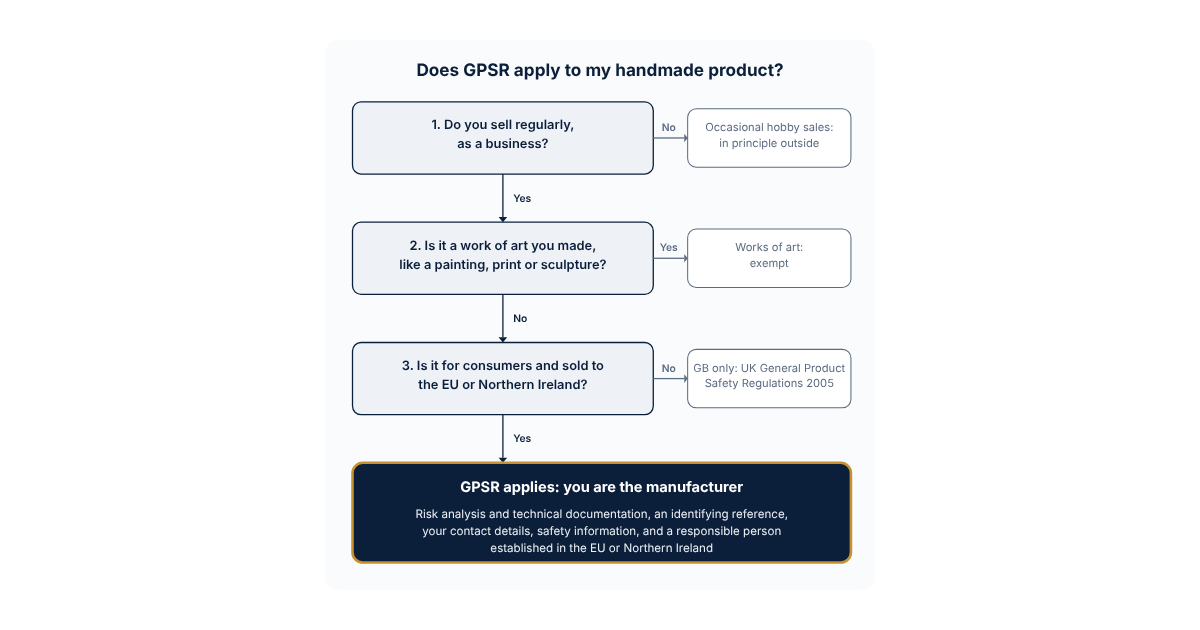
    Does GPSR apply to my handmade product?A three-question check. If you sell regularly as a business, the item is not a work of art made by you, and it is a consumer product sold to the EU or Northern Ireland, GPSR applies. Occasional hobby sales are in principle outside it, works of art are exempt, and Great Britain only sales stay under the UK General Product Safety Regulations 2005.Does GPSR apply to my handmade product?1. Do you sell regularly,as a business?Occasional hobby sales:in principle outsideNo2. Is it a work of art you made,like a painting, print or sculpture?Works of art:exemptYes3. Is it for consumers and sold tothe EU or Northern Ireland?GB only: UK General ProductSafety Regulations 2005NoYesNoYesGPSR applies: you are the manufacturerRisk analysis and technical documentation, an identifying reference,your contact details, safety information, and a responsible personestablished in the EU or Northern Ireland
    A quick scope check for makers. Based on the UK Office for Product Safety and Standards guidance on Regulation (EU) 2023/988.

    Does GPSR apply to handmade items?

    The regulation is about what you sell and how you sell it, not how the item was made. It covers consumer products placed on the market in the course of a commercial activity, where no specific EU rules with the same aim already exist. A hand-thrown vase, a knitted hat and a factory-made one are treated the same way.

    The UK government’s factsheet gives a maker’s example: if you create products yourself from materials you buy and then sell what you have made to a consumer in the EU or Northern Ireland, through a physical shop, an online shop or another business, that product is covered. The materials you buy in are not likely to be covered; the finished piece is. The example is written for a maker in Northern Ireland, but the same factsheet says that if you make a consumer product you are likely to be its manufacturer whether you are based in Great Britain or Northern Ireland.

    The hobby question

    Sales that are not a commercial activity are outside GPSR. The guidance says that, in principle, occasional supplies by hobbyists and charities do not count, but that each case is judged on its facts: how regularly you sell, what the product is, and what you intend. A maker with a shop that lists items for sale all year round will usually look like a business. Someone who sells a few pieces at one craft fair may not. If you are unsure, assume you are in scope; the steps below are proportionate for a small workshop.

    The art exemption

    GPSR does not apply to antiques, which include collectors’ items and works of art. The guidance says exempt works of art include most paintings, drawings, prints and sculptures produced entirely by the artist and usually entirely by hand, and that they do not need to be over 100 years old. Prints or copies that are not produced entirely by the artist may not qualify, so check the detailed guidance if you sell reproductions. Functional items you make by hand, such as mugs, candles, jewellery, bags or toys, are not works of art in this sense.

    Where GPSR applies, and where it doesn’t

    Pieces you had already placed on the market before 13 December 2024 do not need new action, as long as they met the product safety rules in force at the time, but pieces of the same type placed on the market after that date are covered.

    Handmade product types at a glance

    GPSR is the safety net for consumer products. Where a product has its own specific rules, those apply and GPSR covers only the gaps, so for some crafts the specific rules matter more.

    What you make GPSR position Also check
    Original paintings, drawings, prints, sculptures Exempt as works of art Nothing under GPSR
    Homeware, ceramics, decorations, bags, accessories In scope Any rules for the material, for example textile labelling for fabric items
    Jewellery In scope Nickel, cadmium and lead limits for jewellery
    Candles and wax melts In scope CLP labels and safety data sheets for candles
    Soaps, balms and other cosmetics Covered mainly by the cosmetics rules The cosmetics rules, which have their own requirements
    Soft toys and other toys Covered mainly by the toy safety rules Toy safety rules for GB and EU sales

    What a small maker has to do

    As the manufacturer of a product in scope, these are your duties under the regulation, as the UK government’s guidance sets them out:

    1. Make sure it is safe. Think about its design, materials, packaging and instructions, how it might be used with other products, and who will use it, especially children, older people and people with disabilities. Items likely to appeal to children, or that look like food, need extra care.
    2. Write a short risk analysis and technical documentation before you sell. The documentation gives a general description of the product and the characteristics that matter for its safety. For a small range, one document per product type is a sensible way to organise it. Our guide to what goes in a technical file has a contents checklist.
    3. Give each product an identifying reference. A type, batch or serial number, or another element that identifies it. If the piece is too small or delicate to carry it, put it on the packaging or an accompanying document.
    4. Show your contact details. Your name or trade name, a postal address and an electronic address (a web page is fine if it is easy to find how to contact you).
    5. Include safety information where needed. If the item cannot be used safely without instructions or warnings, provide them in a language consumers can easily understand. See how to write GPSR warnings.
    6. Have a responsible person in the EU or Northern Ireland. If you are based there, that can be you. If you are in Great Britain, you need someone established in the EU or Northern Ireland, for example an authorised representative with a written mandate. A PO box does not count.
    7. Put the responsible person’s details with the product. Their name and contact details, including a postal address, go on the product, its packaging, the parcel or an accompanying document. A despatch note sent with the order counts. Our GPSR label template shows a layout.
    8. Act if something goes wrong. If you find a product is dangerous, take corrective action (which can mean a withdrawal or recall), tell affected customers, and inform the authorities.

    The responsible person must keep your technical documentation available to the authorities for 10 years from when the product is placed on the market, check regularly that products match it, and work with the authorities if there is a safety problem.

    A worked example: a hand-knitted baby blanket

    Here is how those steps might look for a maker in Great Britain selling knitted baby blankets to customers in Ireland and France. It is an illustration of the process, not a complete assessment.

    Step What the maker records
    Who uses it Babies and young children: a vulnerable group, so the risk analysis needs care
    Possible hazards For example, buttons or beads that could come loose, long loose threads or fringes, and the yarn used
    How each is handled For example, no small decorations, short secured ends, and the yarn supplier’s details kept on file
    Identifying reference A batch code per yarn lot, on the sewn-in label or care card
    Contact details Business name, postal address and email on the care card
    Responsible person EU-established representative’s name and address on the despatch note
    Other rules Fibre content labelling for textiles

    Selling on Etsy, Amazon Handmade or your own shop

    The duties above are the same wherever you sell. The UK guidance notes that online marketplaces may also offer a responsible person service, so check what your platform provides before you pay for one. For the platform specifics, read our GPSR checklist for Etsy sellers and our guide to what to enter as manufacturer and safety information. If you sell from your own WooCommerce shop, our free GPSR plugins for WooCommerce fill in your manufacturer and responsible person details and show them on product pages.

    Getting a responsible person as a small maker

    If you are based in Great Britain and want to keep selling to EU customers, EU Brand Support can act as your EU responsible person and hold your technical file. EU cover is a fixed £35 a month or £350 a year per brand, and EU and UK cover is £49 a month or £490 a year. See our responsible person pricing or read more about the responsible person service.

    FAQ

    Do I need to follow GPSR if I only sell a few handmade items a year?

    Possibly not. Occasional hobby sales are, in principle, not a commercial activity, so GPSR does not apply to them. It is judged case by case on how regularly you sell, the product and your intentions, so a shop that is open all year is likely to be in scope.

    Are handmade prints and paintings covered by GPSR?

    Works of art are exempt. The UK guidance says this includes most paintings, drawings, prints and sculptures produced entirely by the artist and usually entirely by hand. Prints on functional items, such as mugs or tote bags, are not works of art in this sense.

    Does GPSR apply to handmade products sold in the UK?

    Only in Northern Ireland. Sales to customers in England, Scotland and Wales stay under the UK General Product Safety Regulations 2005.

    Do one-off handmade pieces need a batch number?

    Each product needs a type, batch or serial number or another element that identifies it. For one-off or small-batch work, a simple reference code is a practical way to meet this. If the piece is too small, put the reference on the packaging or an accompanying document.

    Can I be my own responsible person?

    Yes, if you are established in the EU or Northern Ireland, for example through your place of residence or a permanent place of business. A maker based only in Great Britain needs someone established there instead.
    Sources

  • GPSR on Amazon: what your EU listings need, field by field

    GPSR on Amazon: what your EU listings need, field by field

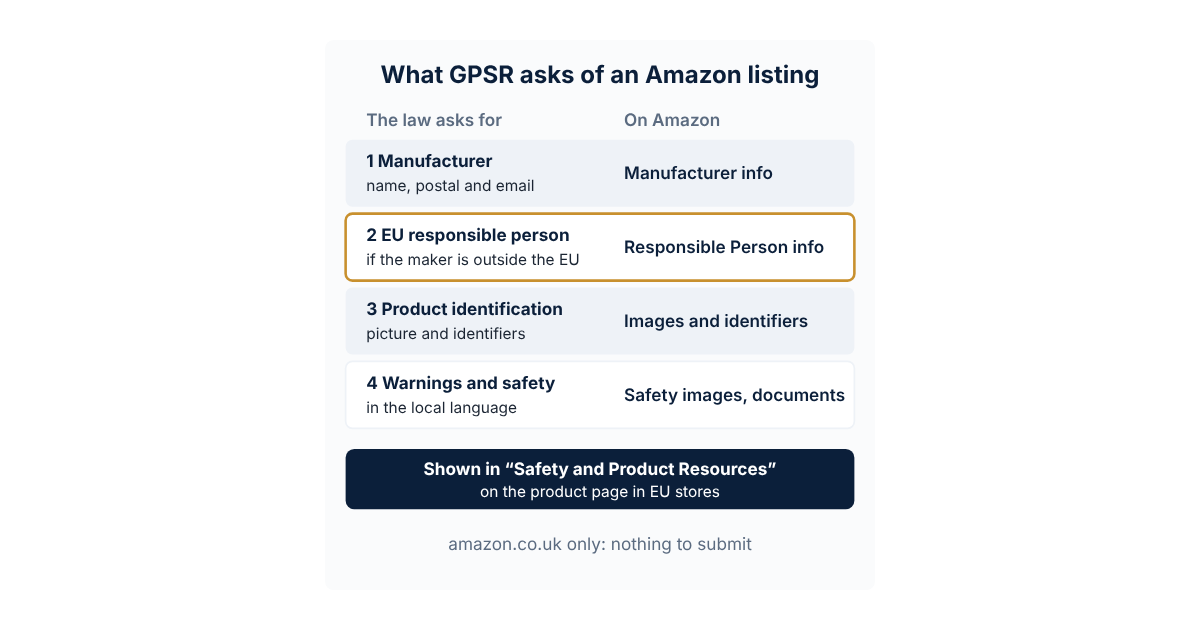
    On Amazon, the EU General Product Safety Regulation (GPSR) means every in-scope non-food listing in Amazon’s EU stores must show four things: the manufacturer’s name, postal and electronic address; an EU responsible person if the manufacturer is outside the EU; product identification, including a picture; and warnings in the local language. Listings on amazon.co.uk alone need none of it submitted.

    The four items come from Article 19 of the GPSR, Regulation (EU) 2023/988, which applies to products placed on the market from 13 December 2024. Amazon collects them in Seller Central and shows them on the product page. For a UK or other non-EU brand, the second item is the one that needs a new arrangement: an economic operator established in the EU that is responsible for the product. That is the role our EU Responsible Person service fills. Below is where each item goes on Amazon, what Amazon asks for on the product itself, and what changes if you resell another brand’s goods.

    What GPSR asks of an Amazon EU listingFour items from Article 19 of the GPSR and where each one goes on Amazon. 1: manufacturer name, postal and electronic address, entered as manufacturer information. 2: EU responsible person, if the manufacturer is outside the EU, entered as responsible person information. 3: a picture and other product identifiers, from your product images and identifiers. 4: warnings and safety information in the local language, uploaded as safety images or documents. Amazon shows them in the Safety and Product Resources section of the product page. Listings on amazon.co.uk only: nothing to submit.What GPSR asks of an Amazon listingThe law asks forOn Amazon1 Manufacturername, postal and emailManufacturer info2 EU responsible personif the maker is outside the EUResponsible Person info3 Product identificationpicture and identifiersImages and identifiers4 Warnings and safetyin the local languageSafety images, documentsShown in “Safety and Product Resources”on the product page in EU storesamazon.co.uk only: nothing to submit
    The four items GPSR Article 19 requires in an online offer, and where each one sits on an Amazon EU listing.

    Which Amazon stores GPSR applies to

    When Amazon announced its GPSR rules, it said that for listings on its UK store you don’t need to submit any information, but you must submit it for listings on its EU-based stores. That matches where the law applies: the GPSR applies in the EU and in Northern Ireland, but not in Great Britain, which stays under the UK General Product Safety Regulations 2005.

    Where you sellGPSR information to Amazon?What to check
    amazon.co.uk only, buyers in Great BritainNoGB rules still apply to the product itself
    amazon.co.uk, with orders going to Northern IrelandAmazon says none for the UK storeThe GPSR still applies to products placed on the Northern Ireland market, and the responsible operator must be established in Northern Ireland or the EU. Our Northern Ireland guide covers this
    Any EU store (.de, .fr, .it, .es and others)Yes, for every non-food listing in scopeAll four items on the listing, and the details Amazon asks for on the product

    Amazon describes the scope as most non-food consumer products, including used, repaired and reconditioned items, with exceptions such as medicinal products, food and drink, and living plants and animals.

    The four items, on the listing and on the product

    Article 19 sets what an online offer must show. The responsible person’s name and contact details must also be on the product, its packaging, the parcel or an accompanying document, and Amazon asks for the other items on the physical product as well as on the listing. So plan each item in two places.

    ItemOn the Amazon listingOn the product, as Amazon asks
    Manufacturer: name, postal and electronic addressManufacturer informationThe manufacturer’s contact details on the label, plus the importer’s if there is one
    EU responsible person, when the manufacturer is outside the EUResponsible Person informationTheir contact details on the product, its packaging, the parcel or an accompanying document, in an EU language
    Product identification, including a pictureYour product images and identifiersA unique identifier on each product
    Warnings and safety information, in the local languageSafety images and documentsThe same warning and safety information on the physical product

    Two of these trip sellers up. For a private-label brand, whether to enter the brand or the factory as the manufacturer is a frequent question; our guide to the GPSR manufacturer field explains how to decide. And “local language” means each country’s, so English-only warnings on amazon.de are a gap; our GPSR warnings guide covers how to write and place them.

    Who can be your EU responsible person

    A product can’t be placed on the EU market unless an economic operator established in the EU is responsible for it. That operator can be an EU manufacturer, an authorised representative with a written mandate, the importer or, only if none of those exists, a fulfilment service provider.

    So you can take the role yourself if your business is established in the EU. A UK or US brand selling through Amazon’s EU stores can rely on an EU importer, if it has one, or appoint an authorised representative. Using Fulfilment by Amazon doesn’t change that: a fulfilment service provider comes last on the list, and Amazon itself tells sellers it is mandatory to have a Responsible Person established within the EU for their non-food products.

    The role is more than an address. The responsible person must regularly check the product against its technical documentation and labelling rules, and show evidence of those checks on request. That is why a good provider asks for your documents before it takes a product on.

    Brand owner or reseller: what Amazon asks of each

    Amazon splits the work by seller type:

    • Brand owners: check the product complies, enrol in Amazon Brand Registry, appoint a Responsible Person, provide the manufacturer information and make sure the details show on product pages.
    • Resellers: check compliance, provide the Responsible Person and manufacturer information, and show product pictures and safety information.

    If you resell another brand’s goods, you usually enter that brand’s manufacturer details and its EU responsible person, so ask the brand for them before you list in the EU. If your own business is established in the EU and imports the goods, check whether you are the importer, which is one of the operators that can take the role.

    How to submit GPSR information in Seller Central

    1. Open Seller Central for the EU store you sell in. Amazon points sellers to the GPSR help page there; the UK store doesn’t need it.
    2. Go to the Manage your compliance dashboard and use the Add compliance information widget for each listing.
    3. Enter the manufacturer information and the Responsible Person information.
    4. Upload the warning and safety information as images, plus any product safety documents.
    5. Track the listings on the Account Health page. Amazon said in late 2024 that listings stay in the “Open” tab until its review is complete, and that you can see whether each image was accepted in Image Manager: a green tick means accepted and a red cross means rejected.

    Amazon says the Responsible Person and manufacturer information, with the images and safety documents, appears on the product detail page within 24 hours of confirmation. It shows them in a Safety and Product Resources section, kept apart from your marketing images.

    What happens if a listing is missing information

    Amazon says listings that don’t meet its GPSR requirements risk removal and are not eligible for flash sales, and that it deactivates offers it finds non-compliant, including those with invalid information or expired contracts. So keep your responsible person arrangement in place for as long as the listing is live. GPSR isn’t Amazon’s only check: it can also deactivate offers that lack EPR numbers, such as the LUCID number for German packaging. Our EU compliance service for Amazon sellers covers those alongside the Responsible Person.

    If you have already had Amazon’s deactivation email, our guide to the “Reactivate your EU listings” email walks through getting listings back.

    Worked example: a UK brand adding amazon.de

    A fictional UK brand sells its own stainless steel garlic press on amazon.co.uk and wants to add amazon.de and amazon.fr. It has no EU company.

    ItemWhat it does
    ManufacturerThe brand itself, with its UK postal address and a monitored email address
    EU responsible personAn EU authorised representative under a written mandate, because the brand isn’t established in the EU
    IdentificationA batch number moulded into the handle as its unique identifier, and a clear product image on each listing
    WarningsCare and safety text translated into German and French, on the insert card and uploaded as a safety image
    Documents behind itAn internal risk analysis and technical documentation, drawn up before the press goes on sale in the EU and kept for 10 years

    The amazon.co.uk listings stay as they are. Units it sends to Amazon’s EU fulfilment centres need the new label, because the responsible person’s details have to be on the product, its packaging, the parcel or an accompanying document, not only on the listing. Our GPSR label template shows how to fit everything on a small pack.

    GPSR Amazon checklist

    • List which Amazon stores you sell in, and whether any UK orders go to Northern Ireland.
    • Decide who the manufacturer is, with a postal and an electronic address.
    • Appoint an EU responsible person if your business isn’t established in the EU.
    • Give every product a unique identifier, as Amazon asks.
    • Translate warnings and safety information for each country you sell in.
    • Relabel stock going to EU fulfilment centres.
    • Submit the information for each EU listing and check its status in Account Health.
    • Have your risk analysis and technical documentation ready for your responsible person to check.

    Your next step

    If you sell on Amazon’s EU stores from outside the EU, EU Brand Support can act as your EU Responsible Person through EU Brand Support OÜ, our company registered in Estonia. You get an EU name and address for your labels and listings, we hold and review your technical file, and we handle authority requests. We review your documents before we take a product on, and if something is missing we tell you what. EU cover is from £35 a month, or £350 a year paid annually, per brand; the EU + UK plan, from £49 a month, also includes an Amazon GPSR listing check. Current plans are on our pricing page.

    This guide is general information, not legal advice. Amazon’s requirements can change, so check Seller Central for your store before you list.

    Frequently asked questions

    What are the GPSR regulations?

    The EU General Product Safety Regulation, Regulation (EU) 2023/988, which applies to products placed on the market from 13 December 2024. It sets safety rules for consumer products, and where a product already has EU sector rules with the same aim, the GPSR covers only the risks those rules leave. Our GPSR explainer covers the wider regulation.

    What is GPSR compliance on Amazon?

    Each in-scope non-food listing in Amazon’s EU stores shows the manufacturer, the EU responsible person where the manufacturer is outside the EU, product identification and any warnings in the local language, and the product itself is labelled as Amazon asks.

    Do I need GPSR information for amazon.co.uk?

    Amazon says listings on its UK store don’t need GPSR information submitted. The GPSR doesn’t apply in Great Britain, though it does apply to products placed on the Northern Ireland market.

    Can I be my own EU responsible person?

    Yes, if your business is established in the EU. If it isn’t, the role falls to an EU importer or an authorised representative with a written mandate, or, only if none of those exists, a fulfilment service provider.

    Does Amazon act as the responsible person for FBA sellers?

    Don’t rely on it. A fulfilment service provider is responsible only when there is no EU manufacturer, authorised representative or importer, and Amazon tells sellers to have a Responsible Person established within the EU.

    Sources

  • GPSR certificate cost in India: what you actually pay for

    GPSR certificate cost in India: what you actually pay for

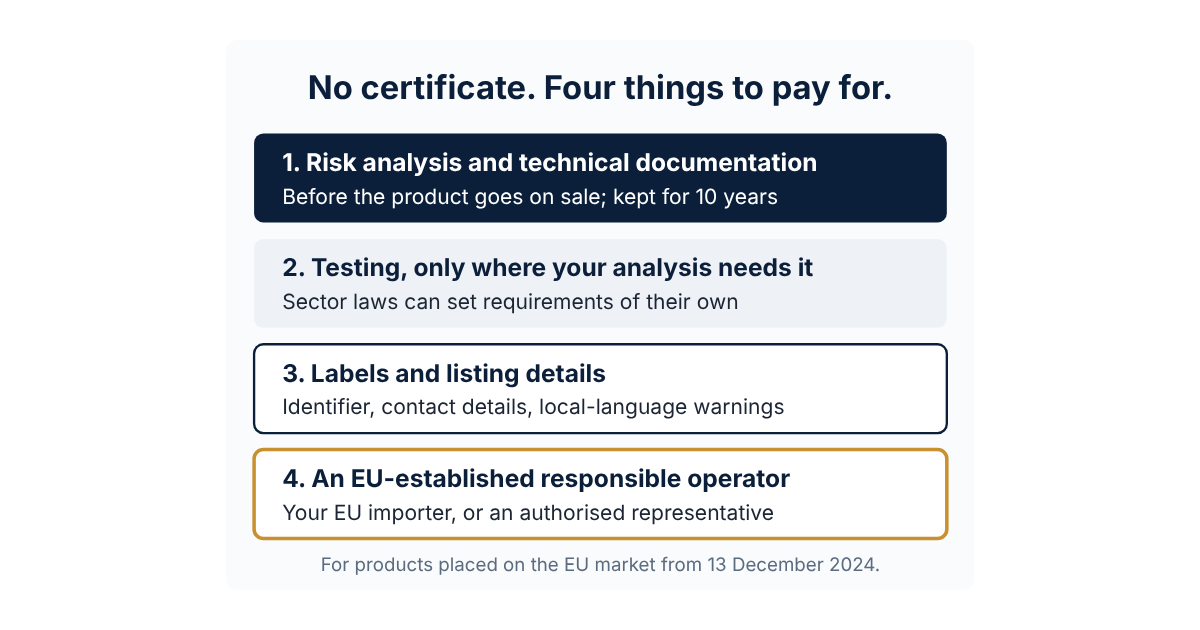
    There is no GPSR certificate to buy. The EU General Product Safety Regulation asks the manufacturer for an internal risk analysis and technical documentation, and an economic operator established in the EU must be responsible for the product. For a seller in India, the only recurring fee is usually an EU authorised representative: ours starts at £350 a year. Testing is needed only where your risk analysis relies on it.

    The biggest single decision is who acts as your EU responsible person.

    What a GPSR “certificate” really costsThere is no GPSR certificate. For a general consumer product, the cost is four pieces of work: a risk analysis and technical documentation, kept for 10 years; testing only where the risk analysis relies on it; labels and listing details; and an economic operator established in the EU who is responsible for the product.No certificate. Four things to pay for.1. Risk analysis and technical documentationBefore the product goes on sale; kept for 10 years2. Testing, only where your analysis needs itSector laws can set requirements of their own3. Labels and listing detailsIdentifier, contact details, local-language warnings4. An EU-established responsible operatorYour EU importer, or an authorised representativeFor products placed on the EU market from 13 December 2024.
    What a seller outside the EU pays for under the GPSR, in place of a certificate.

    Why there is no GPSR certificate

    The GPSR (Regulation (EU) 2023/988) applies from 13 December 2024 to consumer products placed on the EU market from that date. For a product that falls under the GPSR alone, the requirement is a risk analysis and technical documentation, not a Declaration of Conformity or a certificate. UK government guidance on the GPSR describes the manufacturer’s duty as carrying out “an internal risk assessment” and drawing up technical documentation before the product is placed on the market.

    That documentation should give a general description of the product and the characteristics that matter for its safety. According to the same guidance, it contains, as applicable, an analysis of the possible risks and the solutions to remove or reduce them, and a list of any relevant standards that apply, including any Declaration of Conformity.

    A Declaration of Conformity belongs to the CE regime, not to the GPSR. If your product falls under a CE sector law, it has its own conformity steps on top. If a supplier offers you a “GPSR certificate”, ask what is actually in it: what the regulation looks for is your risk analysis and technical file.

    What you actually pay for

    Cost itemDo you need it?What drives the cost
    Risk analysis and technical documentationYes, always, as the manufacturerYour own time, or a consultant. It must be kept for 10 years from when the product is placed on the market.
    TestingOnly where your risk analysis relies on it, or a sector law requires itThe product and the hazards your analysis finds. We don’t quote laboratory prices here because they vary by product.
    Labels and listing detailsYes for labels; listing details when you sell onlineMostly artwork and listing time: a product identifier and the manufacturer’s and responsible operator’s details on the product or, where the rules allow, its packaging, the parcel or an accompanying document, and warnings in the local language on each listing.
    EU responsible economic operatorYes, unless you are established in the EU yourselfNothing extra if your EU importer takes the role; a yearly fee if you appoint an authorised representative.

    Our guides to a GPSR risk assessment and to the technical file show what goes into the first item, and our GPSR label template covers the third.

    Who your EU responsible operator can be, and what each route costs you

    A product can’t be placed on the EU market unless an economic operator established in the EU is responsible for it. UK government guidance sets out who that is, in order:

    • The manufacturer, when it is established in the EU. A business based only in India is not.
    • An authorised representative, when the manufacturer appoints one. There must be a written mandate setting out the tasks it agrees to carry out, and it must be based in the EU (or Northern Ireland).
    • The importer, when the manufacturer is outside the EU and has no authorised representative. An importer is whoever places a product from a third country on the EU market.
    • A fulfilment service provider, only when there is no manufacturer, authorised representative or importer established in the EU.

    “Established” means a registered office or a permanent place of business in the EU, such as a distribution centre. Without a responsible operator, the UK government’s business guidance warns, goods are at risk of being blocked at the border.

    For an Indian exporter, how you sell decides the cost:

    How you sell into the EUWho is usually the responsible operatorExtra cost to you
    Wholesale to an EU business that imports your goodsThat importer, but only while you have no authorised representative for that productNo representative fee, but the importer must make sure your risk analysis and technical documentation exist, so you still pay for those
    Direct to EU consumers, through your own website or a marketplaceAn authorised representative you appointA yearly service fee
    Through a fulfilment service provider, with no manufacturer, representative or importer established in the EUThe fulfilment service provider, as a last resortAgree it with the provider before you ship

    Whoever takes the role has real duties. The guidance says they must verify the technical documentation, keep it available to market surveillance authorities for 10 years, and regularly check that the products comply with it, carry the right identification and come with clear instructions and safety information. A fee that buys only an address on your label doesn’t cover those duties. For what published representative fees look like across providers, see our page on what an EU responsible person costs.

    Worked example: a fictional Indian homeware brand

    Kesar Lane is a fictional business, used only to show the reasoning. It makes hand-block-printed table linen and brass tea-light holders in Jaipur, sells wholesale to a shop chain in the Netherlands, and wants to sell direct to consumers in Germany and France through a marketplace.

    1. The authorised representative: for its direct sales in Germany and France, Kesar Lane appoints one EU authorised representative under a written mandate. From then on, that representative is the responsible operator for those products, including the stock the Dutch chain imports, so its name and contact details go on the products (or their packaging, parcel or an accompanying document) and in every listing.
    2. The Dutch wholesale order: the Dutch chain still imports the goods, so it keeps an importer’s duties, such as making sure Kesar Lane has carried out the risk analysis and drawn up the technical documentation.
    3. Documents: one risk analysis and technical file per product type, covering, for example, the open flame of the tea-light holder. It decides whether any testing is needed from what that analysis finds, not because a buyer asked for a certificate. The table linen may also need fibre labelling: see our guide to EU and UK textile labelling regulations.
    4. Listings: warnings in German on the German store and in French on the French store, with the manufacturer’s and representative’s details and a picture.

    Kesar Lane’s spend is its own documentation time, one representative fee, which then covers both channels, and testing only if the analysis calls for it. There is no certificate line.

    What EU Brand Support charges

    Our prices, in pounds sterling (GBP), as listed on our pricing page on 11 November 2026:

    • EU Responsible Person: from £35 a month per brand, or £350 a year paid annually, with 1 template pack included. EU and UK together from £49 a month.
    • Technical files: from £495 per product for a CE or UKCA file and Declaration of Conformity, with lab testing at cost. That is for products under CE sector laws; for a GPSR-only product, the risk analysis and technical documentation are what you need.
    • Template packs: £45 per category, one-off, if you want to write the risk analysis and technical documentation yourself.

    A template is a starting point: you still need a real risk analysis, testing where relevant, and regular checks. We review your documents before we take a product on. If you are new to the regulation, read our guide to what GPSR is.

    This page is general information, not legal advice.

    Frequently asked questions

    Is a GPSR certificate mandatory for exporting from India to the EU?

    There is no GPSR certificate: UK government guidance describes the duty as an internal risk assessment and technical documentation. You also need an economic operator established in the EU who is responsible for the product. Products under CE sector laws have their own conformity steps.

    What is GPSR compliance?

    Meeting the duties in Regulation (EU) 2023/988: the manufacturer’s risk analysis and technical documentation, an EU-established responsible operator, identification and contact details on the product, and the required information on online listings.

    Can my Indian company be its own EU responsible person?

    Not from India. The operator must be established in the EU, meaning a registered office, headquarters or permanent place of business there. If you have none of these, the role falls to your importer, an authorised representative you appoint, or, as a last resort, a fulfilment service provider.

    Do I need a lab test for GPSR?

    The GPSR doesn’t require a lab test for every product. Your risk analysis decides what evidence you need, and testing is part of it where relevant. Products under CE sector laws follow those laws’ own rules.

    Does the GPSR apply to my sales in the UK?

    Only in Northern Ireland. Great Britain stays under the UK General Product Safety Regulations 2005.

    Sources

  • GPSR countries: where the GPSR applies, country by country

    GPSR countries: where the GPSR applies, country by country

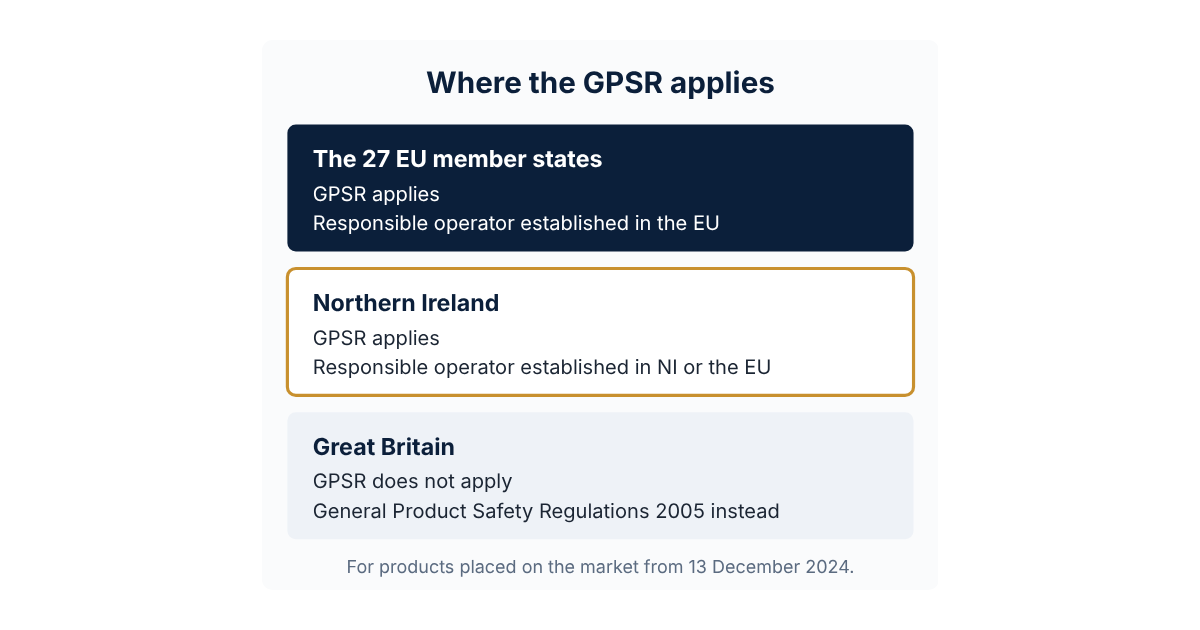
    The GPSR applies in all 27 EU member states and in Northern Ireland. It does not apply in Great Britain, which stays under the UK’s General Product Safety Regulations 2005. The rules have applied since 13 December 2024 to products placed on the market from that date.

    This page is the country list: every EU country, Northern Ireland and Great Britain in one table, with the Amazon store for each where Amazon has one, and what each answer means for where your EU responsible person has to be based. If you want to know what the regulation itself asks of you, start with our guide to what GPSR is.

    Where the GPSR appliesThree blocks. The 27 EU member states: GPSR applies, and the responsible economic operator must be established in the EU. Northern Ireland: GPSR applies, and the responsible economic operator must be established in Northern Ireland or the EU. Great Britain: GPSR does not apply; the General Product Safety Regulations 2005 apply instead.Where the GPSR appliesThe 27 EU member statesGPSR appliesResponsible operator established in the EUNorthern IrelandGPSR appliesResponsible operator established in NI or the EUGreat BritainGPSR does not applyGeneral Product Safety Regulations 2005 insteadFor products placed on the market from 13 December 2024.
    The three answers to “does the GPSR apply here?” for a seller based in the UK.

    GPSR countries list: all 27 EU states, Northern Ireland and Great Britain

    The EU has 27 member states, listed on the EU’s own country pages. The GPSR applies in every one of them. GOV.UK’s guidance for Northern Ireland says the GPSR also applies there, while products placed on, or made available to, the Great Britain market stay under the General Product Safety Regulations 2005.

    The Amazon column shows the European stores Amazon lists on its “Sell across Europe” page: Amazon.co.uk, Amazon.fr, Amazon.de, Amazon.it, Amazon.es, Amazon.pl, Amazon.nl, Amazon.se, Amazon.com.be and Amazon.ie (which the same page describes as a new store Amazon is launching). “None” means Amazon doesn’t list a store of its own for that country; the GPSR still applies to products placed on that market.

    CountryGPSR applies?Amazon Europe storeResponsible economic operator must be established in
    AustriaYesNoneThe EU
    BelgiumYesAmazon.com.beThe EU
    BulgariaYesNoneThe EU
    CroatiaYesNoneThe EU
    CyprusYesNoneThe EU
    CzechiaYesNoneThe EU
    DenmarkYesNoneThe EU
    EstoniaYesNoneThe EU
    FinlandYesNoneThe EU
    FranceYesAmazon.frThe EU
    GermanyYesAmazon.deThe EU
    GreeceYesNoneThe EU
    HungaryYesNoneThe EU
    IrelandYesAmazon.ieThe EU
    ItalyYesAmazon.itThe EU
    LatviaYesNoneThe EU
    LithuaniaYesNoneThe EU
    LuxembourgYesNoneThe EU
    MaltaYesNoneThe EU
    NetherlandsYesAmazon.nlThe EU
    PolandYesAmazon.plThe EU
    PortugalYesNoneThe EU
    RomaniaYesNoneThe EU
    SlovakiaYesNoneThe EU
    SloveniaYesNoneThe EU
    SpainYesAmazon.esThe EU
    SwedenYesAmazon.seThe EU
    Northern IrelandYesNone of its own (Amazon.co.uk is Amazon’s UK store)Northern Ireland or the EU
    Great BritainNo: the General Product Safety Regulations 2005 apply insteadAmazon.co.ukNot a GPSR question (see below)

    What about Iceland, Liechtenstein and Norway?

    None of these three is an EU member state, so none is in the list above. The official sources we checked for this page don’t say whether or how the GPSR applies in them, so we have left them out of the table rather than guess. If you sell into any of them, check the position for that country before you list.

    Selling in several GPSR countries: what changes per country

    The core duties are the same in every GPSR country. What changes from one country to the next is the language. Under Article 19 of the GPSR, an online listing must show:

    • the manufacturer’s name and postal and electronic address;
    • the name and contact details of the EU responsible person, where the manufacturer is outside the EU;
    • information that identifies the product, including a picture;
    • any warnings or safety information, in the local language.

    So a seller listing one product on Amazon.de, Amazon.fr and Amazon.it needs the same manufacturer and responsible person details on all three, but the warnings shown to buyers in each country in that country’s language. The product itself also has to come with clear instructions and safety information in a language consumers can easily understand, where it can’t be used safely without them. Our guide to GPSR warnings and safety information covers how to write that text, and the GPSR label template shows where the contact details go on the product, its packaging, the parcel or an accompanying document.

    The responsible person rule is set at EU level: an economic operator established in the EU must be responsible for the product. The rule doesn’t say that operator has to be based in the country you are selling to.

    Selling from Great Britain: what you need for each market

    You sell intoRules that applyWho can be the responsible economic operator
    Any EU countryGPSRAn operator established in the EU: an EU manufacturer, an authorised representative with a written mandate, the importer, or, only where none of those exists, a fulfilment service provider
    Northern IrelandGPSRAn operator established in Northern Ireland or the EU
    Great Britain onlyGeneral Product Safety Regulations 2005The GPSR responsible person rule doesn’t apply

    Three points from the GOV.UK factsheet for Northern Ireland help a GB business decide:

    • “Established” means having a presence in Northern Ireland or the EU.
    • A presence only in Great Britain does not meet the rule for Northern Ireland sales.
    • A business with a presence in both GB and Northern Ireland (or the EU) could be treated as established in Northern Ireland (or the EU) for the GPSR, depending on its circumstances.

    Products already placed on the Northern Ireland market before 13 December 2024, and which met the 2005 UK rules, need no action. Anything placed on the market from that date must meet the GPSR. Our guide to GPSR for UK small businesses selling into Northern Ireland and the EU walks through each case in more detail.

    Your next step

    If you are based in Great Britain or outside Europe and sell into any of the 27 EU countries, you need an economic operator established in the EU responsible for your products. EU Brand Support can act as your EU responsible person and hold your technical file. Our page on what an EU responsible person costs explains what a fair fee should cover.

    This guide is general information, not legal advice.

    Frequently asked questions

    Does the GPSR apply in the UK?

    Only in Northern Ireland. Great Britain stays under the General Product Safety Regulations 2005.

    How many countries does the GPSR apply in?

    All 27 EU member states, plus Northern Ireland.

    Do I need a separate responsible person for each EU country?

    The rule asks for an economic operator established in the EU to be responsible for the product. It doesn’t say the operator must be based in each country you sell to.

    Can a GB-based business be the responsible person for Northern Ireland?

    Not with a presence in Great Britain alone. For Northern Ireland the responsible economic operator must be established in Northern Ireland or the EU.

    Do my listings need translating for each country?

    The warnings and safety information on an online listing must be in the local language of the country you sell to. The manufacturer and responsible person details stay the same.

    Sources

  • Euverify alternatives: how EU Brand Support compares

    Euverify alternatives: how EU Brand Support compares

    If you are looking for a Euverify alternative, EU Brand Support is a Responsible Person service for small sellers that bills monthly, with an annual option, and lets you cancel at the end of the period you have paid for. Euverify is an all-in-one compliance platform with annual product plans, wider regulatory coverage and built-in document tools, so the better choice depends on what you sell and how many products you have.

    This page compares the two using Euverify’s public pricing page as at 3 November 2026 and our own published pages and terms. For what the Responsible Person role involves, see our Responsible Person service page.

    Euverify or EU Brand Support: which fits you?EU Brand Support may suit you if you are testing one or a few products, want monthly billing, want to cancel at any time and sell general consumer products. Euverify may fit better if you need medical devices, EU cosmetics notification, GDPR Article 27 representation, larger catalogues or built-in document tools. Neither provider tests your products.Which fits you?ChooseEU Brand Support if you:Are testing one or a few productsWant monthly billingWant to cancel at any timeSell general consumer productsChooseEuverify if you need:Medical devices or EU cosmeticsGDPR Article 27 representationLarger cataloguesBuilt-in document toolsNeither provider tests your products.
    How to choose between EU Brand Support and Euverify, based on the comparison below.

    What Euverify offers

    Euverify describes itself as an all-in-one product compliance platform for selling in the EU and UK. Its website says it is incorporated in both the United Kingdom and Ireland, lists offices in London and Cork, and says it is backed by a team of regulatory experts and e-commerce compliance specialists.

    Its product compliance plans, as at 3 November 2026, are billed annually, priced in pounds excluding VAT, and priced per product family rather than per SKU:

    • Starter: £490 a year, up to 5 product families, 1 user, EU or UK
    • Growth: £790 a year, up to 20 product families, 3 users, EU or UK
    • Scale: £1,490 a year, up to 50 product families, 5 users, EU and UK
    • Pro: £2,390 a year, up to 100 product families, 7 users, EU and UK, with priority support

    On Starter and Growth, an additional EU or UK representative is listed at £200 a year. Regulated products carry per-product add-ons each year: £50 for moderate risk (for example consumer electronics and lighting), £100 for high risk (for example toys and radio or wireless products), £100 for cosmetics, £900 for Class I medical devices and £1,400 for Class IIa. Euverify says final categories and fees are confirmed after documentation review.

    Plans include an EU and UKCA Declaration of Conformity generator, PPWR packaging compliance, risk assessment templates and 10-year document storage. Every plan has a 14-day free trial. Subscriptions renew automatically, annual plans end at the close of the 12-month term, and the page states: “We do not offer refunds for early cancellation.”

    What EU Brand Support offers

    EU Brand Support acts as your Responsible Person in the EU, in Great Britain, or both. Our EU company is EU Brand Support OÜ, registered in Estonia, and our UK company is UK Brand Support Ltd. Each plan includes:

    • an EU and/or UK address for your labels and listings
    • your technical file held and reviewed
    • authority requests handled
    • one category template pack (two on the EU + UK plan, which also includes an Amazon GPSR listing check)

    Plans are billed monthly, or annually with two months free. For current fees, see current prices. Under our Responsible Person terms, each store’s first plan has a 14-day free trial, you can cancel at any time, cover ends at the end of the period you have paid for and nothing further is charged. The terms set no minimum term. Fees already paid are not refunded, except where we end the service without fault on your side.

    We also offer EU EPR registration, UK packaging EPR, WEEE and batteries registration, technical files, a UK cosmetics Responsible Person service and compliance template packs. Some product types, including toys, electricals with batteries or radios, chemicals and cosmetics, are taken on only after we have reviewed the documents and agreed in writing.

    Euverify vs EU Brand Support at a glance

    Euverify (as at 3 November 2026) EU Brand Support
    Billing Annual for product plans Monthly, or annual with two months free
    Entry price Starter £490 a year, up to 5 product families, one region See current prices
    Second region £200 a year on Starter and Growth; included on Scale and Pro EU + UK plan available
    Risk-based add-ons £50 to £1,400 per product per year, by category None listed on our pricing page
    Free trial 14 days 14 days on a store’s first plan
    Cancellation Annual plans end at the close of the 12-month term; no refunds for early cancellation Cancel any time; cover ends at the end of the paid period
    Wider coverage Cosmetics (EU and UK), medical devices and IVD, GDPR Article 27 representative, PPWR, CRA Responsible Person for consumer products, EU and UK EPR, WEEE and batteries, technical files and UK cosmetics Responsible Person
    Document tools Declaration of Conformity generator, risk assessment templates, 10-year storage Category template packs; technical file held and reviewed

    Where Euverify is stronger

    • Broader regulation coverage. Euverify lists EU cosmetics notification, medical devices and IVD, GDPR Article 27 representation, PPWR and CRA compliance. We cover UK cosmetics but not EU cosmetics notification, and we do not take on medical devices or GDPR representation.
    • Document tools. Its plans include a Declaration of Conformity generator and document storage inside the platform.
    • Larger catalogues. Plans go up to 100 product families, with custom proposals above that.
    • Team and company presence. It presents itself as a platform backed by regulatory experts and compliance specialists, with UK and Irish companies.

    Where EU Brand Support may suit you better

    • You are testing one or a few products. Monthly billing means you are not committing to a year before you know whether the products sell in Europe.
    • You want to stop without waiting for a renewal date. You can cancel at any time and cover ends at the end of the period you paid for.
    • You sell general consumer products. If you do not need medical device, EU cosmetics or GDPR representation, you may not need a wider platform.

    Neither provider tests your products. Euverify’s pricing page says it checks that required documents are present and does not test products or verify compliance; our terms say we do not design, test or certify products. Both expect you to hold product liability insurance.

    Your next step

    If you sell a small range of general consumer products and want monthly billing, look at our Responsible Person plans and read the terms before you sign up. Selling cosmetics into Great Britain? See our cosmetics Responsible Person service. If you sell medical devices or cosmetics into the EU, or need GDPR representation, a broader provider such as Euverify may fit better.

    This guide is general information, not legal advice. Competitor details are taken from their public website on the date shown and may change; check their current pricing and terms before you decide.

    Frequently asked questions

    Does Euverify bill monthly?

    As at 3 November 2026, Euverify’s pricing page says its product compliance plans are billed annually. Its GDPR representative plans can be paid monthly or annually.

    Can I cancel EU Brand Support at any time?

    Yes. Under our terms you can cancel at any time through your platform’s billing or by email, and cover ends at the end of the period you have paid for.

    Do both cover the EU and the UK?

    Yes. Euverify’s Starter and Growth plans cover one region with a fee for the second, and Scale and Pro include both. We offer EU, UK and EU + UK plans.

    Which is better for cosmetics?

    For Great Britain, we act as your cosmetics UK Responsible Person for £350 a year for up to 5 products, plus £95 per SCPN notification, subject to review and a written agreement. Euverify lists a cosmetics add-on that covers EU CPNP notification as well as SCPN, so it fits better if you also sell cosmetics in the EU.

    Sources

  • GPSR manufacturer: who it is and what to enter as manufacturer and safety information

    GPSR manufacturer: who it is and what to enter as manufacturer and safety information

    Under the GPSR, the manufacturer is whoever makes a product, or has it designed or made, and sells it under their own name or trade mark. So an own-brand seller whose goods are made by a factory is usually the manufacturer. The manufacturer’s name, postal and electronic address go on the product (or its packaging or paperwork) and in every EU listing.

    This guide helps you work out whether you are the manufacturer, what the role asks of you, and exactly what to type into a marketplace’s “manufacturer and safety information” fields. If you are outside the EU, the manufacturer details are only half of it: you also need an EU Responsible Person whose details sit alongside yours.

    Who counts as the manufacturer under GPSR?

    The UK government’s guidance on the regulation (written for Northern Ireland, where it applies) defines a manufacturer as an entity that manufactures a product, or has a product designed or manufactured, and markets that product under its own name or trade mark. Making it yourself is not the test. Selling it under your name or brand is.

    Your situation Your role under GPSR Why
    You design products, a factory makes them, you sell them under your brand Manufacturer You have the product manufactured and market it under your trade mark
    You make products yourself and sell them under your shop or business name Manufacturer You manufacture it and market it under your name
    You resell another company’s branded products unchanged Usually a distributor A distributor makes a product available without being the manufacturer or importer; the brand owner is the manufacturer
    You are established in the EU and bring in goods made outside it Importer An importer places a product from a non-EU country on the EU market
    An online marketplace sells its own-brand products Manufacturer, for those products The guidance says a marketplace selling its own branded products is considered the manufacturer for them

    One business can hold more than one role. The guidance is clear that the same entity can fall into different categories and must meet the duties of each.

    What the manufacturer has to do

    Before a product in scope goes on sale in the EU or Northern Ireland, the manufacturer must:

    • Make sure it is safe. The product has to meet the regulation’s general safety requirement.
    • Carry out an internal risk analysis and draw up technical documentation, then keep it for 10 years (Article 9(2) and (3)). The documentation gives a general description of the product and the characteristics relevant to its safety.
    • Make the product identifiable with a type, batch or serial number or another identifying element, easy to see and read. If the product is too small, it can go on the packaging or an accompanying document.
    • Give a name and a way to get in touch: name, registered trade name or registered trade mark, and a postal and electronic address. If consumers should contact a different single contact point, add that too. A web link is allowed if a consumer can easily see from it where and how to make contact.
    • Add clear instructions and safety information in a language consumers can easily understand, where the product can’t be used safely without them.

    If a manufacturer believes a product it has sold is dangerous, it must act straight away: take corrective measures (which can mean withdrawal or recall), tell affected consumers and inform the market surveillance authorities.

    Manufacturer and safety information: what to enter in a listing

    Online marketplaces must give sellers a way to enter product safety information (Article 22). When a listing form asks for “manufacturer and safety information”, it is asking for the details Article 19 says every online offer to EU consumers must show. Fill it in like this:

    Field What to enter Rule Common mistake
    Manufacturer The manufacturer’s name, postal address and electronic address (email or contact web address) Art 19(a) Entering the factory’s details when you are the brand owner and therefore the manufacturer
    Responsible person The name and contact details of the person responsible in the EU, where the manufacturer is outside the EU Art 19(b) Leaving it blank because the manufacturer field is filled in
    Product identification Details that identify the product, including a picture, type and any other product identifier Art 19(c) A model or batch code in the listing that doesn’t match the one on the label
    Warnings and safety information Warnings or safety information, in the language of the country you sell to Art 19(d) Only English text in listings that deliver to countries where English isn’t an official language

    Our GPSR label template shows where each block can go on the product, packaging or paperwork.

    Manufacturer outside the EU? You also need a responsible person

    As a manufacturer outside the EU, you can’t be that EU contact yourself. Someone established in the EU has to be responsible for the product (Art 16(1)): an authorised representative you appoint with a written mandate, or, if there isn’t one, the EU importer, or, only if none of those exists, a fulfilment service provider. For Northern Ireland sales, being established in Northern Ireland also counts.

    “Established” means a real presence. The guidance says it can’t simply be a PO box: for a business it means a registered office, headquarters or permanent place of business there, and for an individual the place where they live.

    So a UK or Chinese brand owner stays the manufacturer, and its details still go in the manufacturer field. The responsible person is a second, separate entry. Their name and contact details must appear on the product, its packaging, the parcel or an accompanying document, and they must regularly check the product against its technical documentation and labels, with evidence of those checks on request.

    Selling only in Great Britain?

    The GPSR applies in Northern Ireland but not in Great Britain, which stays under the UK General Product Safety Regulations 2005. If you sell into the EU or Northern Ireland as well, the steps above apply to those sales. Our guide to GPSR for UK small businesses compares the routes.

    A quick check before you fill in the fields

    1. Is the product sold under your name or brand? If yes, you are the manufacturer: enter your own details.
    2. Is your business established in the EU? If not, make sure someone established in the EU (or, for Northern Ireland sales, in Northern Ireland) is responsible for the product: an EU importer, or an authorised representative you appoint with a written mandate. Add their details as a separate entry.
    3. Does the product carry a type, batch or serial number that matches the listing?
    4. Are your name and address on the product, or on its packaging or paperwork if it is too small?
    5. Have you done the risk analysis and technical documentation, and do your warnings come from it?
    6. Are the warnings in the language of each country you deliver to?

    If you are a UK maker selling handmade goods, our GPSR guide for Etsy sellers covers scope questions such as art and hobby sales. For the regulation in general, see what GPSR is.

    Your next step

    If you are the manufacturer and have no EU base, the one field you can’t fill yourself is the responsible person. Our EU Responsible Person service fills that entry and holds your technical file. Safety, the risk analysis and labelling remain your duties as manufacturer. For what those duties cost an exporter, with a worked example, see our guide to GPSR certificate costs in India.

    This page explains the rules in plain English. It isn’t legal advice.

    Frequently asked questions

    Is the factory in China the manufacturer if I sell under my own brand?

    Under the GPSR definition, the business that has the product made and markets it under its own name or trade mark is the manufacturer. If that is you, your details go in the manufacturer field.

    Can I use my responsible person’s details as the manufacturer?

    No. They are two separate entries. Listings must show the manufacturer’s details and, where the manufacturer is outside the EU, the responsible person’s details as well.

    Can the manufacturer’s electronic address be a web page?

    Yes, a link to a web page can be used, as long as a consumer can easily see from it where and how to make contact.

    Do I need to do anything for products I sold in the EU or Northern Ireland before 13 December 2024?

    The GPSR applies to products placed on the market from 13 December 2024. The UK government’s guidance for Northern Ireland says no action is needed for products already placed on the market there before that date that met the earlier rules.

    Sources

  • GPSR for Etsy sellers: what UK makers need for EU and Northern Ireland orders

    GPSR for Etsy sellers: what UK makers need for EU and Northern Ireland orders

    Handmade doesn’t mean exempt. For items in scope sold to EU or Northern Ireland buyers (orders to GB buyers aren’t affected), an Etsy maker needs a responsible person established in the EU (or Northern Ireland), a product code and contact details on the item, its packaging or an enclosed document, and the same details in every listing that delivers there.

    This guide is for small UK shops: makers, artists and vintage sellers. It covers whether your items are in scope, a listing checklist, a parcel checklist and a GB-only versus EU and Northern Ireland decision list. If you have no presence in the EU, the part a GB shop can’t do itself is the responsible person, which our EU Responsible Person service provides. For the regulation in general, see our GPSR explainer.

    First check: is your Etsy shop in scope?

    GPSR (Regulation (EU) 2023/988) has applied since 13 December 2024 to consumer products placed on the market from that date. It covers consumer products where no specific EU rules with the same aim exist; where sector rules exist, it covers only the risks they don’t. For handmade and small-batch shops, five points decide most cases. The examples below come from the UK government’s guidance for Northern Ireland, which applies the same regulation.

    • Hobby or business? Gov.uk says occasional supplies by hobbyists are, in principle, not a commercial activity. It is judged case by case, looking at how regularly you sell, the product and your intentions. A hobbyist who sells as part of a commercial activity is in scope, paid or not. If your shop has active listings and steady orders, plan on being in scope.
    • Original art. The regulation does not apply to antiques, which include works of art that buyers can’t reasonably expect to meet state-of-the-art safety standards. Gov.uk says exempt works of art include most paintings, drawings, prints and sculptures produced entirely by the artist and usually entirely by hand, and they don’t need to be 100 years old. Its own case study says artistic prints “may fall outside the scope”, so check yours against the definitions in Annex IX to Directive 2006/112/EC, and take independent advice if you’re unsure.
    • Vintage and second-hand. Second-hand goods are generally covered. They are exempt if they count as antiques, or if they are sold explicitly as needing repair or reconditioning before use, and that is made clear to the buyer at the point of sale.
    • Products with their own EU laws. Toys, cosmetics and electrical goods have product-specific rules. Gov.uk says a toy maker already meeting the toy safety rules is unlikely to need further action under GPSR. Those sector rules still apply in full, so a handmade toy or soap shop has more to check than this page covers.
    • Craft supplies and packaging. Only consumer products are in scope: things intended for, or likely to be used by, individuals. Packaging used to ship your order is exempt, but packaging sold to consumers for their own use (gift boxes, for example) is a consumer product. Craft supplies you sell to individuals for their own projects are consumer products too.

    If an item is covered, you are likely to be its manufacturer. Gov.uk says that if you make a consumer product you are likely to be the manufacturer, whether you are based in GB or Northern Ireland. The materials you buy in aren’t the point; the finished product you sell to a consumer in the EU or Northern Ireland is.

    What a maker has to do before the first EU or NI order

    As the manufacturer, gov.uk’s summary of your duties is:

    • make sure the product is safe for its reasonably foreseeable use (its own case study gives sharp edges and choking hazards as examples);
    • carry out an internal risk analysis and draw up technical documentation before you place the product on the market, and keep it for 10 years;
    • give the product a type, batch or serial number or another element that identifies it, on the product or, if its size or nature prevents it, on the packaging or an accompanying document;
    • show your name (or registered trade name or trade mark) and a postal and electronic address;
    • where the product can’t be used safely without them, include clear instructions and safety information in a language buyers can easily understand.

    For one-off or made-to-order pieces, note the wording: a type, batch or serial number “or other element enabling the identification of the product”. A design code or batch code that you record against your risk analysis fits that wording, as long as a buyer can find it on the item, packaging or paperwork.

    Who can be your EU responsible person

    To sell an item in scope to EU buyers, someone established in the EU has to be responsible for it. That can be an EU manufacturer, an authorised representative with a written mandate, the importer or, only if none of those exists, a fulfilment service provider. For Northern Ireland, the operator must be established in Northern Ireland or the EU.

    A quick test: where do you live or trade from? Gov.uk counts an individual’s place of residence, or permanent business premises, as being established. A maker who lives in Belfast or an EU country can usually fill the role for their own products. A workshop or home in Great Britain can’t, and a PO box address on its own won’t do either.

    For a GB shop posting orders direct to buyers, there is usually no EU importer, so the practical route is an authorised representative with a written mandate. Gov.uk notes that private services exist for this and that online marketplaces may also provide one; check what your marketplace offers rather than assuming it covers you. Whoever takes the role checks your item against your technical file and labels from time to time, and must be able to prove those checks if an authority asks. A single responsible operator can cover both the EU and Northern Ireland.

    Checklist 1: your Etsy listing, mapped to GPSR

    Article 19 sets what any online offer to EU buyers must show, whatever the platform. Marketplaces must also give sellers a way to enter product safety information (Article 22), so use the product safety fields in your listing editor where they exist, and the description where they don’t.

    Put in the listing What GPSR asks for Rule Tip for small shops
    Maker details Manufacturer’s name and postal and electronic address Art 19(a) Use the same name and address that appear on your label or despatch note, so the two match
    Responsible person The EU responsible person’s name and contact details, where the manufacturer is outside the EU Art 19(b) A GB maker always needs this line for EU and NI buyers
    Photos and product code Information identifying the product, including a picture of it Art 19(c) Show the item and mention the design or batch code that is on its tag
    Warnings Warnings, in the local language Art 19(d) The warnings should come from your risk analysis, e.g. small parts or care instructions

    Listings created before you set this up may lack these details, so check every listing that offers EU or Northern Ireland delivery.

    Checklist 2: the item and the parcel

    • Identifier: as above, on the item or else its packaging or paperwork.
    • Your name and postal and electronic address: on the item, or on the packaging or accompanying document if that isn’t possible.
    • Responsible person’s name and contact details: on the item, its packaging, the parcel or an accompanying document. A printed packing slip in the parcel counts: gov.uk lists receipts and despatch or shipping documents as accompanying documents, even when they sit outside the item’s own box.
    • Instructions and safety information: with the product, unless it can be used safely and as intended without them.

    Our GPSR label template sets out each block and where it can go.

    Behind the listing: the file you keep

    Buyers never see it, but authorities can ask for it. For each product type, keep the risk analysis and technical documentation (a general description of the product and what matters for its safety) for 10 years. Your responsible person checks the product against it. Our compliance template packs, including one for jewellery, give you a structure to start from. A template on its own doesn’t make a product compliant.

    Decision list: selling only to GB, or to Northern Ireland and the EU

    1. Where are your buyers? If any are in Northern Ireland or the EU, the steps on this page apply to those orders; our GB, Northern Ireland and EU comparison table sets out each route.
    2. Is the item exempt? Original art, antiques and second-hand items clearly sold as needing repair may be outside GPSR (see the first section). If you rely on an exemption, write down why.
    3. Does a sector law come first? Toys, cosmetics and electrical goods have their own EU rules; check those before the GPSR steps.
    4. Which EU countries do you deliver to? Listing warnings must be in the local language, so each country you open adds a language to check.
    5. Already sold the same item in the EU before 13 December 2024? Units placed on the market before then can stay on sale if they met the rules at the time. New units of the same type and model placed after that date are covered.

    For rules that apply in Great Britain by product type, see UK Responsible Person requirements.

    Your next step

    Once your risk analysis and labels are in hand, the remaining gap for a GB maker is the EU contact. Our EU Responsible Person service acts as your contact under GPSR and holds your technical file, so its name and address can go on your listings and packing slips. The product’s safety, labelling and any testing a sector law requires stay with you as the maker.

    Frequently asked questions

    Do I need a product code on a one-off piece?

    For items in scope, yes. The rule asks for a type, batch or serial number or another element that identifies the product, so a design or item code you record against your risk analysis should fit that wording. Put it on the item, or on the packaging or an enclosed document if the item is too small.

    Can my own name and address fill the responsible person line?

    Only if you are established where the rules require: in the EU, or for Northern Ireland orders, in Northern Ireland or the EU. A home or workshop in Great Britain doesn’t qualify. The marketplace isn’t on the regulation’s list of who can be responsible (EU manufacturer, authorised representative, importer, or fulfilment service provider as a last resort), though gov.uk says marketplaces may offer a representative service, so check what is offered and agree it in writing.

    Are handmade items exempt from GPSR?

    No, not because they are handmade. A handmade consumer product sold as part of a commercial activity is covered. The exemptions that matter most to Etsy shops are original works of art, antiques, and occasional sales by hobbyists, judged case by case.

    Do I need a CE mark for my handmade products?

    Not because of GPSR, which doesn’t require one. CE marking applies only where a sector law, such as the toy or electrical rules, asks for it. For a general product, GPSR asks for a risk analysis and technical documentation.

    Sources

    This page explains the rules in plain English. It isn’t legal advice.

  • Got the “Reactivate your EU listings” email from Amazon? Here’s what it means

    Got the “Reactivate your EU listings” email from Amazon? Here’s what it means

    If you sell on Amazon’s EU stores, you may have had an email from Amazon Services with the subject line “Reactivate your EU listings – GPSR compliance required”. This guide explains what it means, what happens if you ignore it, and how to get your listings back.

    What the email looks like

    Here’s a redacted mock-up of the email Amazon is sending to sellers (wording abridged):

    Reactivate your EU listings – GPSR compliance required

    Hello [Your business name],

    Some of your listings have been deactivated from our European Union (EU) stores due to missing compliance information. This action does not affect your account health.

    You can find examples of your deactivated listings at the bottom of this email and the full list on your Account Health page.

    Submit compliance information

    […] If you don’t provide the information within 30 days of receiving this email, it will be destroyed at your cost. […]

    Amazon Services

    Mock-up for illustration only. EU Brand Support is not affiliated with Amazon.

    Why Amazon has deactivated your listings

    The EU General Product Safety Regulation (GPSR) has applied since 13 December 2024 to most non-food consumer products offered for sale in the EU. Amazon is now removing listings that are missing the information it requires. There are three requirements:

    1. Responsible Person information: appoint an EU-established Responsible Person for your non-food products, update your product labelling, and show their details on your listings.
    2. Manufacturer information: show the manufacturer’s contact details on your listings and on your product labelling.
    3. Warning and safety information: make sure your listings and labelling carry the required safety warnings and traceability information.

    For most UK brands, the missing piece is the first one: there’s no EU-based Responsible Person. For where each item goes in Seller Central and on the product, see our field-by-field GPSR guide for Amazon.

    What happens if you ignore it

    Your deactivated listings stay unsellable until the information is provided. If you use Fulfilment by Amazon (FBA), you may not be able to send more stock into EU fulfilment centres, and your inventory there will be returned or disposed of. According to Amazon’s email, if you don’t provide the information within 30 days, that stock will be destroyed at your cost.

    How to reactivate your listings

    1. Go to your Account Health page in Seller Central.
    2. Select “Add filters” and tick “Listing removed” in the “Filter by action taken” column.
    3. Click “Submit” next to each deactivated listing and follow the instructions.
    4. Fix any other suppressed listing issues, because these can stop a listing being reactivated even when the GPSR information is complete.

    If you’ve already submitted the information and have no pending actions in the Regulatory compliance section of Account Health, you can disregard Amazon’s email.

    If you don’t want to keep selling in the EU

    You can delete the affected products in Manage Inventory and create a removal order for any stock held in EU fulfilment centres, so it isn’t disposed of. If all your stock is held in the UK, there’s no EU inventory at risk.

    Need an EU Responsible Person?

    EU Brand Support acts as the EU-based Responsible Person for UK brands, so you can complete Amazon’s compliance information and get your listings back. Not sure what applies to your products? Use our free compliance checkers, or see our EU and UK Responsible Person service. Amazon also asks for EPR numbers, such as the LUCID number in Germany; our page for Amazon sellers in the EU and UK shows how we handle those too.

  • How much does an EU Responsible Person cost?

    How much does an EU Responsible Person cost?

    Published prices we checked in October 2026 for an EU Responsible Person ranged from €199 to €1,500 a year for an entry plan, and £2,390 a year for the largest fixed plan we saw (up to 100 product families). What you pay depends on how the provider counts your range, which markets you need covered and how much of the legal work is actually included.

    If you already know you need one, our EU and UK Responsible Person service page sets out exactly what we do and what we need from you.

    What you are paying for

    Under the EU General Product Safety Regulation (GPSR), a product can’t be placed on the EU market unless an economic operator established in the EU is responsible for it. If you are a non-EU seller with no EU manufacturer or importer, that is often an authorised representative appointed under a written mandate. Our guide to what GPSR requires from sellers covers the background, so here we focus on the work behind the fee.

    Under Article 16 of the GPSR, as the UK government’s guidance on the regulation summarises it, the responsible operator has to:

    • check that the technical documentation exists, including the risk analysis and any Declaration of Conformity
    • check the product carries a type, batch or serial number or other identifier
    • keep the technical documentation available to market surveillance authorities for 10 years
    • regularly check the product against that documentation and show evidence of the checks on request
    • give authorities the information they ask for, tell them if a product may present a risk, and cooperate on corrective action

    Its name and contact details also go on the product, its packaging, the parcel or an accompanying document, and online listings must show it when the manufacturer is outside the EU. An address is only the visible part. Most of what you pay for is document checks, record keeping and being there when an authority writes.

    Published prices we checked

    We opened three providers’ public pricing pages on 26 October 2026. They are listed under Sources. Each counts your range differently, which is why headline prices are hard to compare.

    Pricing basis Published price (per year) Notes on the page
    Per product type €199 for one type, €349 for two, €690 for six, €1,790 for sixteen Extra types €119 to €149 each; optional priority support €199 a month
    Per product family £490 for up to 5 families, rising to £2,390 for up to 100 Excludes VAT; extra charges per product for moderate or high risk items; EU and UK both included only on the two larger plans
    Per product category €1,500 per category (EU); €900 a year (UK); €2,200 a year (EU and UK package) Only the EU price is stated per category; category coverage, external fees and taxes are set out in a proposal

    Three pages is a small sample, so treat this as a snapshot rather than a market survey. The useful lesson is the unit. A seller with one brand and twelve SKUs across three categories could pay very different amounts depending on whether a provider counts types, families or categories.

    What a fair fee should include

    Use this as a checklist against any quote. Each line comes from the legal tasks above, so a service that leaves one out is leaving part of the job with you.

    • A written mandate appointing the provider as your authorised representative.
    • An EU name and address you can put on labels, packaging and listings, belonging to a business that is actually established in the EU.
    • A document review before they sign: risk analysis, technical documentation and, for CE products, the Declaration of Conformity.
    • Keeping your file available to authorities for the full 10 years, and a clear answer on what happens to it if you leave.
    • Regular checks of the product against its documentation, with evidence kept.
    • Handling authority requests and cooperating on corrective action, without a fee per request.

    Base fee or extra? A cost-line table

    Cost line In the base fee? Often charged separately
    EU name and address for labels and listings Should be
    Written mandate Should be
    Technical file held for authorities Should be
    Authority requests and corrective action Should be, but only one of the three pricing pages we checked says so Ask whether requests are billed one by one
    More products, types or categories Up to the plan limit Per extra type, family or category
    Higher risk products Per product surcharge on one page we checked
    A second market (UK as well as EU) On combined plans Separate fee on smaller plans
    Priority support Monthly add-on on one page we checked
    Product testing or notified body certification No Paid separately to a lab or notified body where the law requires it
    VAT Check whether prices include it

    EPR is a separate duty with its own registrations and fees; see our EPR registration service if you sell packaged goods in Germany or France.

    UK Responsible Person cost: do you need both?

    An EU representative does not cover Great Britain. The GPSR applies in Northern Ireland but not in Great Britain, which stays under the UK General Product Safety Regulations 2005. For UKCA or CE goods sold in GB, importers and authorised representatives must be established in the UK. In Northern Ireland, the responsible operator can be established in Northern Ireland or the EU.

    So if you sell into both the EU and GB, expect two appointments or a combined plan. On the pages we checked, UK cover was priced at €900 a year on its own, included in combined plans, or added for £200 a year. For general products with no UKCA or CE marking, official guidance doesn’t yet settle whether GB needs a named UK responsible person. Our guide to who needs a UK Responsible Person sets out the rules product by product.

    Questions to ask before you sign

    1. What is one unit in your price: a brand, a product type, a family, a category or a SKU?
    2. Will you review my documents before you take me on, and tell me what is missing?
    3. Is your EU address a real business establishment? A PO box doesn’t count.
    4. Are authority requests and corrective action included, or billed each time?
    5. Does the price cover the UK, and Northern Ireland?
    6. Are there surcharges for higher risk products?
    7. Do prices include VAT, and is there a setup fee?
    8. What is the notice period, and what happens to my file if I leave?

    Treat these as red flags: a provider that never asks for your technical documentation, an address with no evidence of a business behind it, or any promise of “guaranteed compliance”. Whether a product conforms is for the manufacturer and the authorities to establish. No representative can guarantee it.

    What our service costs and includes

    We charge a fixed fee per brand: £25 a month for UK cover, £35 for EU cover or £49 for both, with two months free if you pay for the year. There are three packages: EU, UK, or EU and UK together. Current prices are on our Responsible Person pricing page.

    Every package includes our name and address for your labels, packaging and Amazon listings, a review of your Declaration of Conformity (for CE products), risk assessment, test reports and CE or UKCA marking before we take you on, your technical file held ready for inspection, and market surveillance requests handled for you. The EU and UK package adds an Amazon GPSR listing check. Each package includes a category template pack (two with the combined package), or you can buy compliance template packs by product category on their own.

    We don’t charge by the hour, there are no long contracts, and you can cancel any time: cover ends at the end of the period you’ve paid for. We won’t take on every product: if one needs testing or a notified body certificate you don’t have, we tell you before you pay. Templates don’t replace product testing or certification where the law requires it.

    Frequently asked questions

    Is an EU Responsible Person a one-off cost?

    No. The role carries ongoing duties, including regular checks and keeping your file available to authorities for 10 years, so every provider we checked charges a yearly or monthly fee.

    What does a GPSR representative cost?

    It is the same service under another name. A GPSR representative is usually an authorised representative acting as your EU responsible person, so the prices above apply. The representative is only one cost: our guide to GPSR costs for sellers outside the EU covers the risk analysis, technical documentation and any testing as well.

    Can Amazon or my fulfilment provider act as my Responsible Person instead?

    A fulfilment service provider can only fill the role if there is no EU manufacturer, importer or authorised representative. A marketplace doesn’t become your responsible person just by hosting your listing.

    Why do quotes vary so much?

    Mostly because of the pricing unit and the scope. A per-category price and a per-type price can give very different totals for the same catalogue, and some plans leave UK cover, risk surcharges or VAT outside the headline figure.

    Sources

  • GPSR for UK small businesses: Northern Ireland and EU sales explained

    GPSR for UK small businesses: Northern Ireland and EU sales explained

    If your UK small business sells only in Great Britain, the EU GPSR does not apply to those sales: GB stays under the UK General Product Safety Regulations 2005. It does apply when you sell into Northern Ireland or the EU. Then you need a responsible operator established in Northern Ireland or the EU, plus product and listing details.

    So the real question is where you want to sell, and what each route needs. Below are the three routes side by side and a fictional maker deciding. If you already want Northern Ireland or EU customers, our EU Responsible Person service provides the operator the rules ask for.

    Where you sell decides which rules apply

    The GPSR (Regulation (EU) 2023/988) applies to consumer products placed on the market from 13 December 2024, filling the gaps where no sector-specific EU rules cover a risk. Our country-by-country GPSR table lists every EU member state. For a GB-based business, here is what changes as you add destinations.

    Where you sell Product safety law for those sales Who must be responsible, and where they must be established What the product or parcel must show What the listing must show
    GB only (England, Scotland, Wales) UK General Product Safety Regulations 2005, not the EU GPSR For UKCA or CE goods: a UK-established importer or authorised representative where you use one. For roles under other UK product laws, such as cosmetics, see our UK Responsible Person guide. For UKCA or CE goods, your name and postal address as manufacturer (and the importer’s, for imported goods) normally appear on the product or its packaging The EU GPSR listing rules do not apply to GB sales
    GB plus Northern Ireland EU GPSR for the products you place on the NI market A responsible economic operator established in Northern Ireland or the EU. A PO box does not count. On the product (or, if its size or nature prevents it, the packaging or an accompanying document): your name and postal and email address as manufacturer, and a batch, serial or other identifier. On the product, its packaging, the parcel or an accompanying document: the responsible operator’s name and contact details Manufacturer’s name, postal and email address; responsible person’s details; product identifiers and a picture; warnings in a language buyers easily understand
    GB plus EU countries EU GPSR, plus EU sector laws (such as toys or electrical goods) where they apply An economic operator established in the EU: an EU manufacturer, an authorised representative with a written mandate, the importer, or, only if none exists, a fulfilment service provider As for Northern Ireland As for Northern Ireland, with warnings suited to each country’s buyers

    Behind the NI and EU rows sits the same groundwork: before placing a product on the market, the manufacturer does an internal risk analysis and draws up technical documentation, kept for 10 years. Our guide to the manufacturer’s role under GPSR explains who that is when a factory makes your goods.

    Selling only in Great Britain

    If all your customers are in England, Scotland and Wales, the EU GPSR is not your rulebook. GB continues to recognise CE marking for many product types, with no end date stated, though medical devices, construction products and some other sectors have separate rules. The Product Regulation and Metrology Act 2025 lets the government update UK product rules, and a consultation on a new framework closed on 23 June 2026, but no dates for new GB rules are confirmed. For GB roles by product type, see UK Responsible Person requirements by product type.

    Shipping to Northern Ireland

    Northern Ireland is a domestic sale, but for product safety it follows EU rules: the GPSR applies there, so a parcel to Belfast needs what an EU parcel needs.

    Who can be your responsible operator

    The operator must be established in Northern Ireland or the EU. Gov.uk explains that “established” means a presence there, such as a registered office or permanent place of business; for a sole trader it can be where you live. A PO box is not enough. A GB business has three realistic options:

    • Use your own NI premises, as in a gov.uk case study, if you have them.
    • Sell through an NI importer: if you wholesale to an NI business that brings your goods in from GB, it is likely to be the importer. This does not cover orders you send direct to NI customers.
    • Appoint an authorised representative established in Northern Ireland or the EU, with a written mandate.

    What goes on the product and parcel

    The operator’s name and contact details must appear on the product, its packaging, the parcel or an accompanying document. Gov.uk says that document can be a despatch note or receipt, and need not sit inside the product’s packaging as long as it travels with it. Products must also carry a batch, serial or other identifier.

    If you would rather not ship to Northern Ireland

    Some small sellers have decided a handful of NI orders is not worth the set-up. That is a business choice. If you make that choice, switch off Northern Ireland delivery on every channel you sell through, including marketplaces and your own website.

    Selling into the EU

    A product cannot be placed on the EU market unless an economic operator established in the EU is responsible for it. That operator must regularly check the product against its technical documentation and labelling rules, and show evidence of those checks on request. Our GPSR explainer covers these duties in general.

    The useful overlap: because Northern Ireland accepts an operator established in the EU, one EU-established representative can serve both. Gov.uk says a GB business that has already taken steps to trade in the EU should not have to make any additional changes to operate in NI.

    Two extras apply. CE-marked goods such as toys and electrical products need a Declaration of Conformity under their own laws; a product under the GPSR alone needs the risk analysis and technical documentation instead. And producer rules apply country by country: in Germany, businesses that first make packaged goods available there must register with the LUCID Packaging Register; France issues EPR unique identifiers (IDUs); and Amazon asks sellers for these numbers. See EPR registration for Germany and France.

    Etsy, Amazon or your own website: does the platform matter?

    Not for the core duties. The listing rules attach to any online or distance-sales offer, so Etsy, Amazon and your own site all need the same details for NI or EU buyers. What differs is where you enter them:

    • Marketplaces such as Etsy and Amazon must let sellers enter product safety information. Hosting your listing does not make the marketplace your responsible person.
    • Your own website has no form, so you add the details to each product page yourself.

    Worked example: a fictional GB maker decides

    Marsh Lane Studio is a fictional business, used only to show the reasoning. It is a Leeds sole trader printing cotton cushion covers and tote bags, selling on Etsy and its own website, GB only so far. Customers in Belfast and Dublin keep asking for delivery, and Amazon.de is a maybe for next year.

    1. GB orders: nothing changes because of the GPSR.
    2. Belfast and Dublin: both need an operator established in Northern Ireland or the EU. With no NI premises, the owner appoints one EU-established authorised representative with a written mandate, covering both.
    3. Before the first order: she writes a risk analysis and technical documentation for each product type, kept for 10 years, adds a batch code and her own name and postal and email address to the sewn-in label, and prints the representative’s name, postal and email address on her despatch note.
    4. Listings: she fills in Etsy’s product safety fields and adds the same details, a product code and warnings to each website page.
    5. Amazon.de: she waits. Germany also means LUCID packaging registration and warnings German buyers can easily understand.

    One appointment and the paperwork above cover the GPSR for both new markets; check each country’s producer rules too, and GB trading carries on as before.

    Your next step

    Decided to ship to Northern Ireland or the EU? Start with the operator. Our EU Responsible Person service is run by an Estonian company, so it is established in the EU, and gov.uk confirms that an operator established in the EU is accepted for Northern Ireland as well as the EU. We review your documents before you sign up. For your own risk analysis and technical documentation, our compliance template packs are a structured starting point; a template alone does not make a product compliant, which still takes a real risk analysis, testing where relevant, and checks. If you sell across several categories, there is also a bundle of all ten category packs.

    Frequently asked questions

    Does the GPSR apply to UK small businesses?

    Only to their sales into Northern Ireland or the EU. Sales in Great Britain stay under the UK General Product Safety Regulations 2005. The gov.uk Northern Ireland guidance does not set separate rules for small businesses.

    Do I need an EU responsible person to sell to Northern Ireland on Etsy?

    You need a responsible operator established in Northern Ireland or the EU. Without NI premises or an NI importer, the route is an authorised representative established in Northern Ireland or the EU. Etsy does not become your responsible person by hosting the listing. Our GPSR checklist for Etsy sellers covers the listing and parcel details.

    Can my GB company be the responsible operator for Northern Ireland?

    Only with a real presence in Northern Ireland or the EU, such as premises. A GB address does not count, nor does a PO box.

    Do hobby sellers need to comply?

    Gov.uk says occasional supplies by hobbyists or charities are, in principle, not a commercial activity, but it is judged case by case, including how regularly you sell. If you sell regularly, do not rely on it. Our guide to whether GPSR applies to handmade products covers the hobby and art exceptions in more detail.

    Sources