Category: Selling on marketplaces

Guides for Amazon, Etsy and other marketplace sellers: compliance emails, listing fields and category rules.

  • GPSR on Amazon: what your EU listings need, field by field

    GPSR on Amazon: what your EU listings need, field by field

    On Amazon, the EU General Product Safety Regulation (GPSR) means every in-scope non-food listing in Amazon’s EU stores must show four things: the manufacturer’s name, postal and electronic address; an EU responsible person if the manufacturer is outside the EU; product identification, including a picture; and warnings in the local language. Listings on amazon.co.uk alone need none of it submitted.

    The four items come from Article 19 of the GPSR, Regulation (EU) 2023/988, which applies to products placed on the market from 13 December 2024. Amazon collects them in Seller Central and shows them on the product page. For a UK or other non-EU brand, the second item is the one that needs a new arrangement: an economic operator established in the EU that is responsible for the product. That is the role our EU Responsible Person service fills. Below is where each item goes on Amazon, what Amazon asks for on the product itself, and what changes if you resell another brand’s goods.

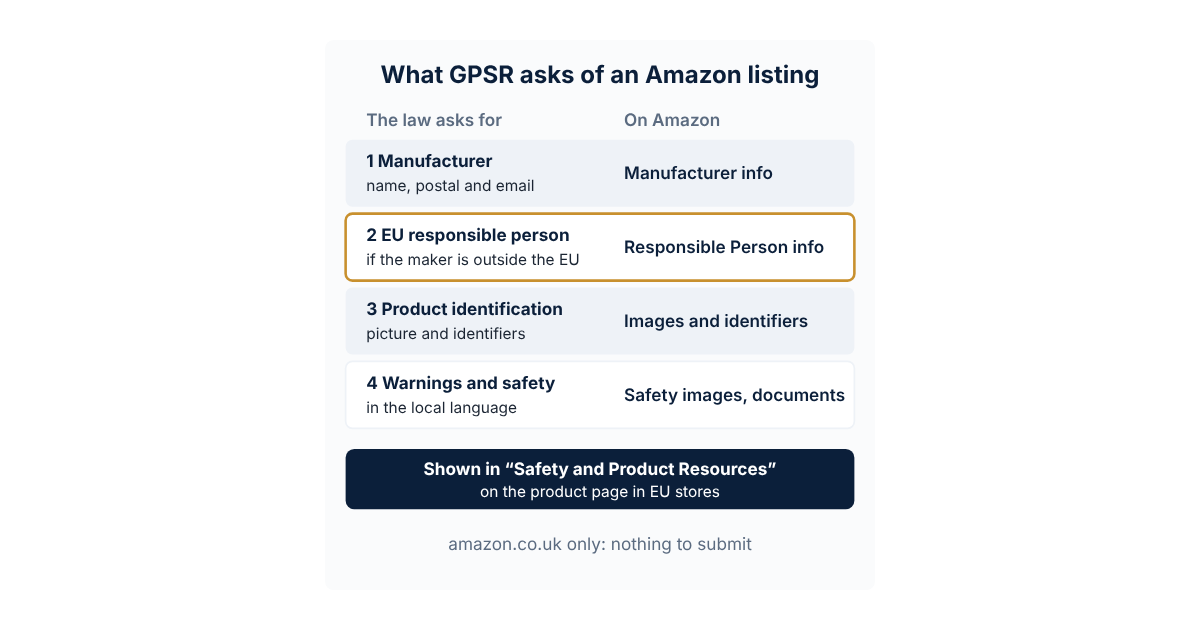
    What GPSR asks of an Amazon EU listingFour items from Article 19 of the GPSR and where each one goes on Amazon. 1: manufacturer name, postal and electronic address, entered as manufacturer information. 2: EU responsible person, if the manufacturer is outside the EU, entered as responsible person information. 3: a picture and other product identifiers, from your product images and identifiers. 4: warnings and safety information in the local language, uploaded as safety images or documents. Amazon shows them in the Safety and Product Resources section of the product page. Listings on amazon.co.uk only: nothing to submit.What GPSR asks of an Amazon listingThe law asks forOn Amazon1 Manufacturername, postal and emailManufacturer info2 EU responsible personif the maker is outside the EUResponsible Person info3 Product identificationpicture and identifiersImages and identifiers4 Warnings and safetyin the local languageSafety images, documentsShown in “Safety and Product Resources”on the product page in EU storesamazon.co.uk only: nothing to submit
    The four items GPSR Article 19 requires in an online offer, and where each one sits on an Amazon EU listing.

    Which Amazon stores GPSR applies to

    When Amazon announced its GPSR rules, it said that for listings on its UK store you don’t need to submit any information, but you must submit it for listings on its EU-based stores. That matches where the law applies: the GPSR applies in the EU and in Northern Ireland, but not in Great Britain, which stays under the UK General Product Safety Regulations 2005.

    Where you sellGPSR information to Amazon?What to check
    amazon.co.uk only, buyers in Great BritainNoGB rules still apply to the product itself
    amazon.co.uk, with orders going to Northern IrelandAmazon says none for the UK storeThe GPSR still applies to products placed on the Northern Ireland market, and the responsible operator must be established in Northern Ireland or the EU. Our Northern Ireland guide covers this
    Any EU store (.de, .fr, .it, .es and others)Yes, for every non-food listing in scopeAll four items on the listing, and the details Amazon asks for on the product

    Amazon describes the scope as most non-food consumer products, including used, repaired and reconditioned items, with exceptions such as medicinal products, food and drink, and living plants and animals.

    The four items, on the listing and on the product

    Article 19 sets what an online offer must show. The responsible person’s name and contact details must also be on the product, its packaging, the parcel or an accompanying document, and Amazon asks for the other items on the physical product as well as on the listing. So plan each item in two places.

    ItemOn the Amazon listingOn the product, as Amazon asks
    Manufacturer: name, postal and electronic addressManufacturer informationThe manufacturer’s contact details on the label, plus the importer’s if there is one
    EU responsible person, when the manufacturer is outside the EUResponsible Person informationTheir contact details on the product, its packaging, the parcel or an accompanying document, in an EU language
    Product identification, including a pictureYour product images and identifiersA unique identifier on each product
    Warnings and safety information, in the local languageSafety images and documentsThe same warning and safety information on the physical product

    Two of these trip sellers up. For a private-label brand, whether to enter the brand or the factory as the manufacturer is a frequent question; our guide to the GPSR manufacturer field explains how to decide. And “local language” means each country’s, so English-only warnings on amazon.de are a gap; our GPSR warnings guide covers how to write and place them.

    Who can be your EU responsible person

    A product can’t be placed on the EU market unless an economic operator established in the EU is responsible for it. That operator can be an EU manufacturer, an authorised representative with a written mandate, the importer or, only if none of those exists, a fulfilment service provider.

    So you can take the role yourself if your business is established in the EU. A UK or US brand selling through Amazon’s EU stores can rely on an EU importer, if it has one, or appoint an authorised representative. Using Fulfilment by Amazon doesn’t change that: a fulfilment service provider comes last on the list, and Amazon itself tells sellers it is mandatory to have a Responsible Person established within the EU for their non-food products.

    The role is more than an address. The responsible person must regularly check the product against its technical documentation and labelling rules, and show evidence of those checks on request. That is why a good provider asks for your documents before it takes a product on.

    Brand owner or reseller: what Amazon asks of each

    Amazon splits the work by seller type:

    • Brand owners: check the product complies, enrol in Amazon Brand Registry, appoint a Responsible Person, provide the manufacturer information and make sure the details show on product pages.
    • Resellers: check compliance, provide the Responsible Person and manufacturer information, and show product pictures and safety information.

    If you resell another brand’s goods, you usually enter that brand’s manufacturer details and its EU responsible person, so ask the brand for them before you list in the EU. If your own business is established in the EU and imports the goods, check whether you are the importer, which is one of the operators that can take the role.

    How to submit GPSR information in Seller Central

    1. Open Seller Central for the EU store you sell in. Amazon points sellers to the GPSR help page there; the UK store doesn’t need it.
    2. Go to the Manage your compliance dashboard and use the Add compliance information widget for each listing.
    3. Enter the manufacturer information and the Responsible Person information.
    4. Upload the warning and safety information as images, plus any product safety documents.
    5. Track the listings on the Account Health page. Amazon said in late 2024 that listings stay in the “Open” tab until its review is complete, and that you can see whether each image was accepted in Image Manager: a green tick means accepted and a red cross means rejected.

    Amazon says the Responsible Person and manufacturer information, with the images and safety documents, appears on the product detail page within 24 hours of confirmation. It shows them in a Safety and Product Resources section, kept apart from your marketing images.

    What happens if a listing is missing information

    Amazon says listings that don’t meet its GPSR requirements risk removal and are not eligible for flash sales, and that it deactivates offers it finds non-compliant, including those with invalid information or expired contracts. So keep your responsible person arrangement in place for as long as the listing is live. GPSR isn’t Amazon’s only check: it can also deactivate offers that lack EPR numbers, such as the LUCID number for German packaging. Our EU compliance service for Amazon sellers covers those alongside the Responsible Person.

    If you have already had Amazon’s deactivation email, our guide to the “Reactivate your EU listings” email walks through getting listings back.

    Worked example: a UK brand adding amazon.de

    A fictional UK brand sells its own stainless steel garlic press on amazon.co.uk and wants to add amazon.de and amazon.fr. It has no EU company.

    ItemWhat it does
    ManufacturerThe brand itself, with its UK postal address and a monitored email address
    EU responsible personAn EU authorised representative under a written mandate, because the brand isn’t established in the EU
    IdentificationA batch number moulded into the handle as its unique identifier, and a clear product image on each listing
    WarningsCare and safety text translated into German and French, on the insert card and uploaded as a safety image
    Documents behind itAn internal risk analysis and technical documentation, drawn up before the press goes on sale in the EU and kept for 10 years

    The amazon.co.uk listings stay as they are. Units it sends to Amazon’s EU fulfilment centres need the new label, because the responsible person’s details have to be on the product, its packaging, the parcel or an accompanying document, not only on the listing. Our GPSR label template shows how to fit everything on a small pack.

    GPSR Amazon checklist

    • List which Amazon stores you sell in, and whether any UK orders go to Northern Ireland.
    • Decide who the manufacturer is, with a postal and an electronic address.
    • Appoint an EU responsible person if your business isn’t established in the EU.
    • Give every product a unique identifier, as Amazon asks.
    • Translate warnings and safety information for each country you sell in.
    • Relabel stock going to EU fulfilment centres.
    • Submit the information for each EU listing and check its status in Account Health.
    • Have your risk analysis and technical documentation ready for your responsible person to check.

    Your next step

    If you sell on Amazon’s EU stores from outside the EU, EU Brand Support can act as your EU Responsible Person through EU Brand Support OÜ, our company registered in Estonia. You get an EU name and address for your labels and listings, we hold and review your technical file, and we handle authority requests. We review your documents before we take a product on, and if something is missing we tell you what. EU cover is from £35 a month, or £350 a year paid annually, per brand; the EU + UK plan, from £49 a month, also includes an Amazon GPSR listing check. Current plans are on our pricing page.

    This guide is general information, not legal advice. Amazon’s requirements can change, so check Seller Central for your store before you list.

    Frequently asked questions

    What are the GPSR regulations?

    The EU General Product Safety Regulation, Regulation (EU) 2023/988, which applies to products placed on the market from 13 December 2024. It sets safety rules for consumer products, and where a product already has EU sector rules with the same aim, the GPSR covers only the risks those rules leave. Our GPSR explainer covers the wider regulation.

    What is GPSR compliance on Amazon?

    Each in-scope non-food listing in Amazon’s EU stores shows the manufacturer, the EU responsible person where the manufacturer is outside the EU, product identification and any warnings in the local language, and the product itself is labelled as Amazon asks.

    Do I need GPSR information for amazon.co.uk?

    Amazon says listings on its UK store don’t need GPSR information submitted. The GPSR doesn’t apply in Great Britain, though it does apply to products placed on the Northern Ireland market.

    Can I be my own EU responsible person?

    Yes, if your business is established in the EU. If it isn’t, the role falls to an EU importer or an authorised representative with a written mandate, or, only if none of those exists, a fulfilment service provider.

    Does Amazon act as the responsible person for FBA sellers?

    Don’t rely on it. A fulfilment service provider is responsible only when there is no EU manufacturer, authorised representative or importer, and Amazon tells sellers to have a Responsible Person established within the EU.

    Sources

  • Selling cleaning products on Amazon Germany: a checklist for UK and non-EU brands

    Selling cleaning products on Amazon Germany: a checklist for UK and non-EU brands

    Selling cleaning products on Amazon Germany from the UK or elsewhere outside the EU means meeting EU chemical law (CLP, and the Detergents Regulation for detergents), German notification and packaging rules, and Amazon’s own dangerous goods review before your listing goes live. The first gap for most non-EU brands is not the label itself but who acts as the EU-established importer or supplier that these rules assume.

    EU Brand Support can take on the importer, supplier and Responsible Person roles through our CLP and chemicals service, after a review of your documents and a separate written agreement. Here is the checklist.

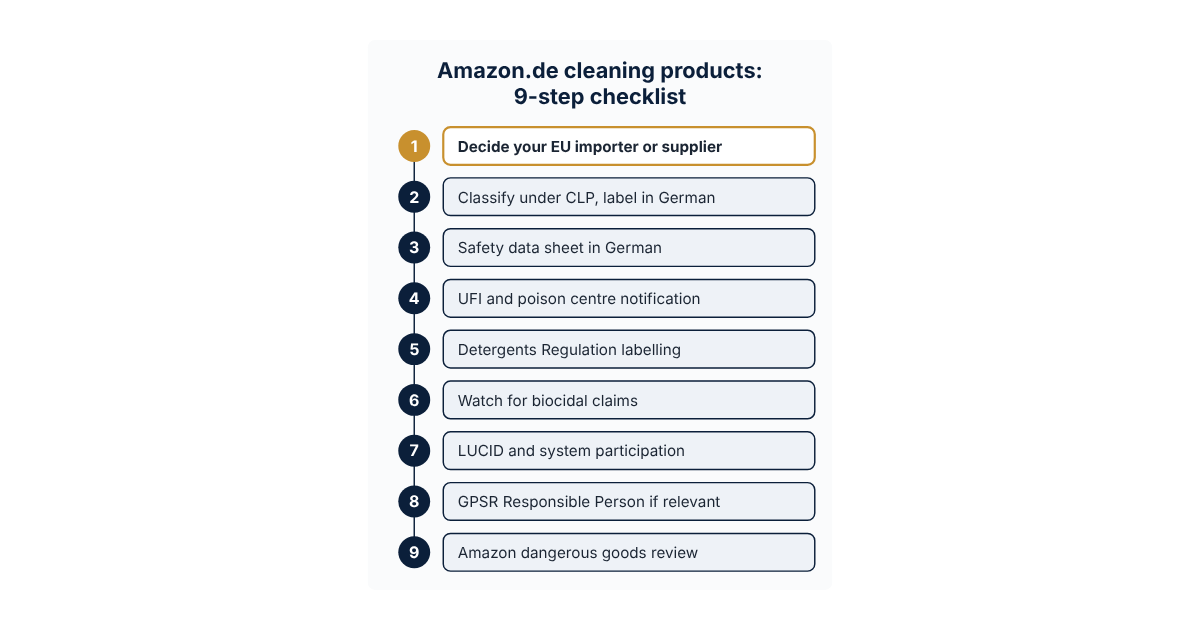
    Checklist for selling cleaning products on Amazon GermanyNine steps for selling cleaning products on Amazon Germany from outside the EU: 1, Decide your EU importer or supplier; 2, Classify under CLP, label in German; 3, Safety data sheet in German; 4, UFI and poison centre notification; 5, Detergents Regulation labelling; 6, Watch for biocidal claims; 7, LUCID and system participation; 8, GPSR Responsible Person if relevant; 9, Amazon dangerous goods review. Step 1 is the first gap for most non-EU brands.Amazon.de cleaning products:9-step checklist1Decide your EU importer or supplier2Classify under CLP, label in German3Safety data sheet in German4UFI and poison centre notification5Detergents Regulation labelling6Watch for biocidal claims7LUCID and system participation8GPSR Responsible Person if relevant9Amazon dangerous goods review
    The nine steps in this checklist, in order.

    1. Decide who is your EU importer or supplier

    CLP defines manufacturers, importers, downstream users and distributors as persons established in the EU, and treats import as placing on the market. A UK brand therefore holds none of these roles in the EU, so the business that imports into the EU carries the CLP duties, and its name, address and telephone number go on the label as the supplier.

    The Detergents Regulation similarly treats an importer as the “manufacturer” responsible for placing a detergent on the market.

    2. Classify the product and label it in German

    Get the mixture classified under CLP by a qualified specialist. If it is hazardous, it needs a CLP label with supplier details, product identifier, nominal quantity, pictograms and statements. CLP labels must be in the official language of the member state where the product is placed on the market, which for Amazon.de means German. Our CLP labelling guide covers each element and the revised CLP dates.

    Your listing counts too: under CLP Article 48, an advertisement that lets the public buy a hazardous mixture without seeing the label must mention the hazards shown on it.

    3. Safety data sheet in German

    Under REACH Article 31, the supplier must provide a safety data sheet (SDS) to recipients where a mixture meets the criteria for classification as hazardous under CLP. Article 31 has an exception for some hazardous products offered or sold to the general public, but a downstream user or distributor can still request one. The Institute for Occupational Safety of Germany’s statutory accident insurance (DGUV IFA) notes that the SDS must be written in an official language of the member state concerned, which for Germany is German.

    Even for consumer-only sales, Amazon may ask for an SDS in its dangerous goods review (step 9), so plan to have one.

    4. UFI and poison centre notification

    If the mixture is classified for health or physical hazards, the EU importer or downstream user must submit information under CLP Annex VIII to the body each member state appoints (in Germany, the BfR) and print a 16-character UFI code, preceded by “UFI:”, on the label. Notifications for Germany usually go through the ECHA Submission portal, and the BfR does not charge for them.

    5. Detergents Regulation labelling

    Under Regulation (EC) No 648/2004, a detergent is a product containing soaps or other surfactants intended for washing and cleaning. Its packaging must show the product’s name and trade name; the name or trademark, full address and telephone number of the party responsible for placing it on the market; the content in the Annex VII A format; and instructions for use and special precautions where needed.

    For detergents sold to the general public, Annex VII A requires certain ingredient classes added above 0.2% by weight, such as anionic or non-ionic surfactants, phosphonates and bleaching agents, to be shown in bands (less than 5%, 5% to under 15%, 15% to under 30%, 30% and more). Enzymes, disinfectants, optical brighteners and perfumes must be listed whatever their concentration, as must preservatives. Allergenic fragrances above 0.01% must be named. The pack must also give a website address where the full ingredient list can be found. Where a member state requires labelling in its national language, this information must be given in it, so confirm the German position with your importer.

    Germany adds a national step: under section 10 of the Detergents and Cleaning Agents Act (WRMG), manufacturers must send the BfR a data sheet under Annex VII C of the Detergents Regulation no later than first placing on the market, where no CLP Annex VIII notification already applies. So even a non-hazardous detergent is notified in Germany.

    A new Detergents and Surfactants Regulation, (EU) 2026/405, will replace 648/2004 and, according to the Swedish Chemicals Agency, applies from 23 September 2029. Until then, 648/2004 is the rule.

    6. Watch for biocidal claims

    Odour neutralisers and disinfectants need care. Under the Biocidal Products Regulation (EU) No 528/2012, a product is biocidal if it is intended to destroy, deter, render harmless, prevent the action of, or otherwise control any harmful organism by means other than mere physical or mechanical action. Biocidal products cannot be made available on the market or used unless authorised under that regulation, which is a separate regime from CLP and the Detergents Regulation. Claims such as killing bacteria can bring a product into scope. Biocide advertising also may not use terms such as “non-toxic”, “harmless” or “natural”.

    7. German packaging law: LUCID and system participation

    The Central Agency Packaging Register (ZSVR) says anyone distributing packaged goods in Germany must register in LUCID before making them available. A foreign company shipping packaged goods directly to German end users is at least the producer of its shipping packaging, and shipping packaging is always subject to system participation, meaning a contract with a system operator (often called a dual system) that collects, sorts and recycles household packaging. Volumes are then reported to the operator and LUCID.

    Two further points matter for foreign sellers. A company based abroad without a German branch that sells packaging directly to end users in Germany must appoint an authorised representative for extended producer responsibility from 12 August 2026; registration itself remains a personal duty you complete in LUCID. Online platforms must also obtain and check proof of registration before their services are used, and products without it may not be offered.

    8. GPSR Responsible Person where relevant

    The General Product Safety Regulation (EU) 2023/988 applies to consumer products where there are no sector-specific provisions with the same objective. Where it applies, a responsible economic operator established in the EU is needed, and their name and contact details, including a postal address, must be on the product, packaging, parcel or an accompanying document. For chemical products, check how far it applies alongside CLP product by product.

    9. Amazon’s dangerous goods review

    Amazon’s seller guidance says it reviews products that may be dangerous goods (hazmat), including detergents and aerosols, to decide whether the inventory is safe for Fulfilment by Amazon. You may be asked to upload a safety data sheet or an exemption sheet through the “Manage dangerous goods classification” tool.

    Worked example: a fictional UK enzyme spray brand

    This example is fictional. A small UK maker of enzyme cleaning sprays, Brand A, wants to sell a 500ml trigger spray on Amazon.de through FBA. The formula contains a non-ionic surfactant, enzymes and a perfume.

    Question Brand A’s position
    EU importer or supplier None yet. It appoints an EU business to import and to appear on the label.
    CLP classification A chemical specialist classifies it. Suppose it has a health hazard classification: a German CLP label, German SDS and hazard mention in the listing follow.
    UFI and notification The importer generates a UFI and submits a PCN for Germany.
    Detergents Regulation It contains a surfactant, so it is a detergent: the pack lists the non-ionic surfactant band (if added above 0.2%), enzymes and perfume, the responsible party and an ingredient-list web address.
    Biocides Brand A drops an “antibacterial” claim from its draft listing rather than enter the biocides regime.
    Packaging It registers in LUCID, arranges system participation and, if selling directly to German end users, appoints an authorised representative.
    Amazon It uploads the SDS for the dangerous goods review before sending stock.

    The formula is ready; what is missing is the EU business that holds the duties.

    Your next step

    EU Brand Support can act as EU importer or supplier for chemical and cleaning-product brands outside the EU, carrying the CLP and UFI duties, and as your GPSR Responsible Person where that applies. We coordinate classification and safety data sheets with a qualified chemical specialist; we do not write safety data sheets ourselves. See our CLP and chemicals service or contact us with your product list. Chemical products are taken on only after we’ve reviewed the documents and agreed in writing, under a separate written agreement.

    This guide is general information, not legal advice. Check the current rules for your specific product before launch.

    Frequently asked questions

    Can I sell cleaning products on Amazon.de from the UK without an EU company?

    You need an EU-established business in the importer or supplier role, because CLP places its duties on EU-established operators. That business does not have to be your own company.

    Does my label have to be in German?

    Yes for CLP label elements on products placed on the German market. Detergents Regulation information must also be in the national language where a member state requires it.

    Do non-hazardous detergents need anything in Germany?

    Yes. Detergents Regulation labelling applies, and section 10 WRMG requires a data sheet to be sent to the BfR by first placing on the market.

    Sources

  • GPSR for Etsy sellers: what UK makers need for EU and Northern Ireland orders

    GPSR for Etsy sellers: what UK makers need for EU and Northern Ireland orders

    Handmade doesn’t mean exempt. For items in scope sold to EU or Northern Ireland buyers (orders to GB buyers aren’t affected), an Etsy maker needs a responsible person established in the EU (or Northern Ireland), a product code and contact details on the item, its packaging or an enclosed document, and the same details in every listing that delivers there.

    This guide is for small UK shops: makers, artists and vintage sellers. It covers whether your items are in scope, a listing checklist, a parcel checklist and a GB-only versus EU and Northern Ireland decision list. If you have no presence in the EU, the part a GB shop can’t do itself is the responsible person, which our EU Responsible Person service provides. For the regulation in general, see our GPSR explainer.

    First check: is your Etsy shop in scope?

    GPSR (Regulation (EU) 2023/988) has applied since 13 December 2024 to consumer products placed on the market from that date. It covers consumer products where no specific EU rules with the same aim exist; where sector rules exist, it covers only the risks they don’t. For handmade and small-batch shops, five points decide most cases. The examples below come from the UK government’s guidance for Northern Ireland, which applies the same regulation.

    • Hobby or business? Gov.uk says occasional supplies by hobbyists are, in principle, not a commercial activity. It is judged case by case, looking at how regularly you sell, the product and your intentions. A hobbyist who sells as part of a commercial activity is in scope, paid or not. If your shop has active listings and steady orders, plan on being in scope.
    • Original art. The regulation does not apply to antiques, which include works of art that buyers can’t reasonably expect to meet state-of-the-art safety standards. Gov.uk says exempt works of art include most paintings, drawings, prints and sculptures produced entirely by the artist and usually entirely by hand, and they don’t need to be 100 years old. Its own case study says artistic prints “may fall outside the scope”, so check yours against the definitions in Annex IX to Directive 2006/112/EC, and take independent advice if you’re unsure.
    • Vintage and second-hand. Second-hand goods are generally covered. They are exempt if they count as antiques, or if they are sold explicitly as needing repair or reconditioning before use, and that is made clear to the buyer at the point of sale.
    • Products with their own EU laws. Toys, cosmetics and electrical goods have product-specific rules. Gov.uk says a toy maker already meeting the toy safety rules is unlikely to need further action under GPSR. Those sector rules still apply in full, so a handmade toy or soap shop has more to check than this page covers.
    • Craft supplies and packaging. Only consumer products are in scope: things intended for, or likely to be used by, individuals. Packaging used to ship your order is exempt, but packaging sold to consumers for their own use (gift boxes, for example) is a consumer product. Craft supplies you sell to individuals for their own projects are consumer products too.

    If an item is covered, you are likely to be its manufacturer. Gov.uk says that if you make a consumer product you are likely to be the manufacturer, whether you are based in GB or Northern Ireland. The materials you buy in aren’t the point; the finished product you sell to a consumer in the EU or Northern Ireland is.

    What a maker has to do before the first EU or NI order

    As the manufacturer, gov.uk’s summary of your duties is:

    • make sure the product is safe for its reasonably foreseeable use (its own case study gives sharp edges and choking hazards as examples);
    • carry out an internal risk analysis and draw up technical documentation before you place the product on the market, and keep it for 10 years;
    • give the product a type, batch or serial number or another element that identifies it, on the product or, if its size or nature prevents it, on the packaging or an accompanying document;
    • show your name (or registered trade name or trade mark) and a postal and electronic address;
    • where the product can’t be used safely without them, include clear instructions and safety information in a language buyers can easily understand.

    For one-off or made-to-order pieces, note the wording: a type, batch or serial number “or other element enabling the identification of the product”. A design code or batch code that you record against your risk analysis fits that wording, as long as a buyer can find it on the item, packaging or paperwork.

    Who can be your EU responsible person

    To sell an item in scope to EU buyers, someone established in the EU has to be responsible for it. That can be an EU manufacturer, an authorised representative with a written mandate, the importer or, only if none of those exists, a fulfilment service provider. For Northern Ireland, the operator must be established in Northern Ireland or the EU.

    A quick test: where do you live or trade from? Gov.uk counts an individual’s place of residence, or permanent business premises, as being established. A maker who lives in Belfast or an EU country can usually fill the role for their own products. A workshop or home in Great Britain can’t, and a PO box address on its own won’t do either.

    For a GB shop posting orders direct to buyers, there is usually no EU importer, so the practical route is an authorised representative with a written mandate. Gov.uk notes that private services exist for this and that online marketplaces may also provide one; check what your marketplace offers rather than assuming it covers you. Whoever takes the role checks your item against your technical file and labels from time to time, and must be able to prove those checks if an authority asks. A single responsible operator can cover both the EU and Northern Ireland.

    Checklist 1: your Etsy listing, mapped to GPSR

    Article 19 sets what any online offer to EU buyers must show, whatever the platform. Marketplaces must also give sellers a way to enter product safety information (Article 22), so use the product safety fields in your listing editor where they exist, and the description where they don’t.

    Put in the listing What GPSR asks for Rule Tip for small shops
    Maker details Manufacturer’s name and postal and electronic address Art 19(a) Use the same name and address that appear on your label or despatch note, so the two match
    Responsible person The EU responsible person’s name and contact details, where the manufacturer is outside the EU Art 19(b) A GB maker always needs this line for EU and NI buyers
    Photos and product code Information identifying the product, including a picture of it Art 19(c) Show the item and mention the design or batch code that is on its tag
    Warnings Warnings, in the local language Art 19(d) The warnings should come from your risk analysis, e.g. small parts or care instructions

    Listings created before you set this up may lack these details, so check every listing that offers EU or Northern Ireland delivery.

    Checklist 2: the item and the parcel

    • Identifier: as above, on the item or else its packaging or paperwork.
    • Your name and postal and electronic address: on the item, or on the packaging or accompanying document if that isn’t possible.
    • Responsible person’s name and contact details: on the item, its packaging, the parcel or an accompanying document. A printed packing slip in the parcel counts: gov.uk lists receipts and despatch or shipping documents as accompanying documents, even when they sit outside the item’s own box.
    • Instructions and safety information: with the product, unless it can be used safely and as intended without them.

    Our GPSR label template sets out each block and where it can go.

    Behind the listing: the file you keep

    Buyers never see it, but authorities can ask for it. For each product type, keep the risk analysis and technical documentation (a general description of the product and what matters for its safety) for 10 years. Your responsible person checks the product against it. Our compliance template packs, including one for jewellery, give you a structure to start from. A template on its own doesn’t make a product compliant.

    Decision list: selling only to GB, or to Northern Ireland and the EU

    1. Where are your buyers? If any are in Northern Ireland or the EU, the steps on this page apply to those orders; our GB, Northern Ireland and EU comparison table sets out each route.
    2. Is the item exempt? Original art, antiques and second-hand items clearly sold as needing repair may be outside GPSR (see the first section). If you rely on an exemption, write down why.
    3. Does a sector law come first? Toys, cosmetics and electrical goods have their own EU rules; check those before the GPSR steps.
    4. Which EU countries do you deliver to? Listing warnings must be in the local language, so each country you open adds a language to check.
    5. Already sold the same item in the EU before 13 December 2024? Units placed on the market before then can stay on sale if they met the rules at the time. New units of the same type and model placed after that date are covered.

    For rules that apply in Great Britain by product type, see UK Responsible Person requirements.

    Your next step

    Once your risk analysis and labels are in hand, the remaining gap for a GB maker is the EU contact. Our EU Responsible Person service acts as your contact under GPSR and holds your technical file, so its name and address can go on your listings and packing slips. The product’s safety, labelling and any testing a sector law requires stay with you as the maker.

    Frequently asked questions

    Do I need a product code on a one-off piece?

    For items in scope, yes. The rule asks for a type, batch or serial number or another element that identifies the product, so a design or item code you record against your risk analysis should fit that wording. Put it on the item, or on the packaging or an enclosed document if the item is too small.

    Can my own name and address fill the responsible person line?

    Only if you are established where the rules require: in the EU, or for Northern Ireland orders, in Northern Ireland or the EU. A home or workshop in Great Britain doesn’t qualify. The marketplace isn’t on the regulation’s list of who can be responsible (EU manufacturer, authorised representative, importer, or fulfilment service provider as a last resort), though gov.uk says marketplaces may offer a representative service, so check what is offered and agree it in writing.

    Are handmade items exempt from GPSR?

    No, not because they are handmade. A handmade consumer product sold as part of a commercial activity is covered. The exemptions that matter most to Etsy shops are original works of art, antiques, and occasional sales by hobbyists, judged case by case.

    Do I need a CE mark for my handmade products?

    Not because of GPSR, which doesn’t require one. CE marking applies only where a sector law, such as the toy or electrical rules, asks for it. For a general product, GPSR asks for a risk analysis and technical documentation.

    Sources

    This page explains the rules in plain English. It isn’t legal advice.

  • Got the “Reactivate your EU listings” email from Amazon? Here’s what it means

    Got the “Reactivate your EU listings” email from Amazon? Here’s what it means

    If you sell on Amazon’s EU stores, you may have had an email from Amazon Services with the subject line “Reactivate your EU listings – GPSR compliance required”. This guide explains what it means, what happens if you ignore it, and how to get your listings back.

    What the email looks like

    Here’s a redacted mock-up of the email Amazon is sending to sellers (wording abridged):

    Reactivate your EU listings – GPSR compliance required

    Hello [Your business name],

    Some of your listings have been deactivated from our European Union (EU) stores due to missing compliance information. This action does not affect your account health.

    You can find examples of your deactivated listings at the bottom of this email and the full list on your Account Health page.

    Submit compliance information

    […] If you don’t provide the information within 30 days of receiving this email, it will be destroyed at your cost. […]

    Amazon Services

    Mock-up for illustration only. EU Brand Support is not affiliated with Amazon.

    Why Amazon has deactivated your listings

    The EU General Product Safety Regulation (GPSR) has applied since 13 December 2024 to most non-food consumer products offered for sale in the EU. Amazon is now removing listings that are missing the information it requires. There are three requirements:

    1. Responsible Person information: appoint an EU-established Responsible Person for your non-food products, update your product labelling, and show their details on your listings.
    2. Manufacturer information: show the manufacturer’s contact details on your listings and on your product labelling.
    3. Warning and safety information: make sure your listings and labelling carry the required safety warnings and traceability information.

    For most UK brands, the missing piece is the first one: there’s no EU-based Responsible Person. For where each item goes in Seller Central and on the product, see our field-by-field GPSR guide for Amazon.

    What happens if you ignore it

    Your deactivated listings stay unsellable until the information is provided. If you use Fulfilment by Amazon (FBA), you may not be able to send more stock into EU fulfilment centres, and your inventory there will be returned or disposed of. According to Amazon’s email, if you don’t provide the information within 30 days, that stock will be destroyed at your cost.

    How to reactivate your listings

    1. Go to your Account Health page in Seller Central.
    2. Select “Add filters” and tick “Listing removed” in the “Filter by action taken” column.
    3. Click “Submit” next to each deactivated listing and follow the instructions.
    4. Fix any other suppressed listing issues, because these can stop a listing being reactivated even when the GPSR information is complete.

    If you’ve already submitted the information and have no pending actions in the Regulatory compliance section of Account Health, you can disregard Amazon’s email.

    If you don’t want to keep selling in the EU

    You can delete the affected products in Manage Inventory and create a removal order for any stock held in EU fulfilment centres, so it isn’t disposed of. If all your stock is held in the UK, there’s no EU inventory at risk.

    Need an EU Responsible Person?

    EU Brand Support acts as the EU-based Responsible Person for UK brands, so you can complete Amazon’s compliance information and get your listings back. Not sure what applies to your products? Use our free compliance checkers, or see our EU and UK Responsible Person service. Amazon also asks for EPR numbers, such as the LUCID number in Germany; our page for Amazon sellers in the EU and UK shows how we handle those too.