Category: Packaging & recycling

Guides to EPR registration, PPWR, WEEE and batteries for sellers in the EU and UK.

  • PPWR authorised representative: who needs one, what it does and what it costs

    PPWR authorised representative: who needs one, what it does and what it costs

    A PPWR authorised representative is a business established in an EU member state that a packaging producer appoints, by written mandate, to carry out its extended producer responsibility (EPR) duties in that country. If you sell packaged goods directly to consumers in a member state where you are not established, Article 45(3) of Regulation (EU) 2025/40 requires you to appoint one there.

    Not sure where you stand? Try our free PPWR checker: answer five questions and see, country by country, whether you are likely to need packaging EPR registration and an authorised representative.

    This guide covers who needs one, what the representative does and what providers charge. For the wider rules, see our PPWR guide for online sellers, and for registrations country by country, our EPR registration hub.

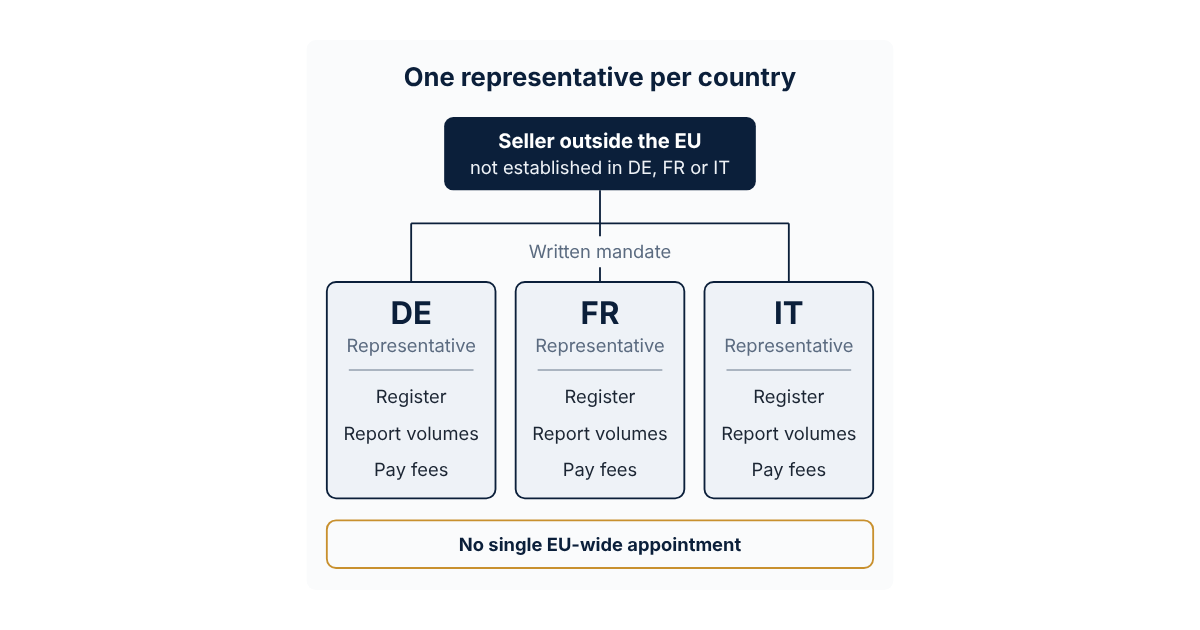
    One PPWR authorised representative per EU countryDiagram. A seller established outside the EU is linked by a separate written mandate to an authorised representative in each EU country where it is the producer, for example Germany, France and Italy. Each representative handles registration, reporting packaging volumes and fee payments in its own country. There is no single EU-wide appointment.One representative per countrySeller outside the EUnot established in DE, FR or ITWritten mandateDERepresentativeRegisterReport volumesPay feesFRRepresentativeRegisterReport volumesPay feesITRepresentativeRegisterReport volumesPay feesNo single EU-wide appointment
    One authorised representative, under its own written mandate, in each EU country where you are the producer and not established.

    Who needs a PPWR authorised representative?

    You need one in each member state where both of these are true:

    • you are the producer there, typically because you sell directly to end users through your own website or a marketplace seller account, and
    • you are not established in that member state.

    There is one representative per member state and no single EU-wide appointment, so a seller shipping to five EU countries needs five appointments. This applies to EU businesses selling across borders as well as to businesses outside the EU. Where an EU importer or distributor takes on the producer role in a country, a separate representative may not be needed there.

    The Commission states that since August 2026 the requirement applies in all member states.

    Is the requirement being suspended?

    Not for sellers outside the EU. On 10 December 2025 the Commission proposed suspending Article 45(3) until 1 January 2035, but only for producers established in another EU member state. Taxually reports that the Council discontinued negotiations on 24 June 2026, citing strong reservations from a large majority of member states.

    The proposal has since moved again. PPWR Connect reports that the European Parliament adopted its position on 20 October 2026 and that the Council agreed a negotiating mandate on 21 October 2026. Neither position covers producers outside the EU, and neither is law: a suspension needs both institutions to agree a text and publish it in the Official Journal.

    Meanwhile, the Commission has urged member states to enforce the obligation “in a constructive and pragmatic way and abstain from sanctioning operators” while the proposal is examined. That is a request to national authorities, not a change to the law.

    What does the representative do?

    The written mandate sets out the scope, but the EPR tasks usually include:

    • Registration with the national producer register and the producer responsibility organisation (PRO).
    • Reporting your packaging volumes by material.
    • Fee payments to the scheme, which are calculated per kilogram of packaging by material type.

    Coolset says the mandate should cover the member states and obligations included, duration, termination, data exchange and who pays the fees. The representative is liable within the scope of the mandate, not for whether the packaging itself conforms to Articles 5 to 12. The Declaration of Conformity remains the manufacturer’s job.

    How it differs from other representatives

    Role Law What it covers
    PPWR authorised representative for EPR PPWR Article 45 Registration, reporting and fee payments for packaging, in one member state
    PPWR authorised representative (product conformity) PPWR Article 17 Appointed by the packaging manufacturer; keeps copies of the Declaration of Conformity and technical documentation and answers national authorities
    GPSR responsible person GPSR Article 16 An economic operator established in the EU responsible for set tasks for the product itself, before it can be placed on the market

    These roles do not replace each other. Coolset notes that you need a separate mandate for EPR even if you already have an authorised representative for CE marking or REACH. Our Responsible Person service covers the GPSR role, which is about the product rather than its packaging waste.

    Germany: the LUCID example

    Germany shows how this works in practice. The central agency ZSVR says companies based abroad without a German branch that sell packaging or packaged products directly to end users in Germany must appoint an authorised representative before distributing packaging there. The obligation applies from 12 August 2026, under the PPWR and the German Packaging Law Implementation Act (VerpackDG).

    According to ZSVR, the representative must:

    • have a registered office or branch in Germany
    • have a written agreement with you in German
    • be registered in LUCID with its own authorised representative login and ID
    • not be affiliated with your company

    The representative takes full responsibility for your packaging obligations in its own name, including system participation, volume reports and declarations of completeness. One task stays with you: you must complete your own LUCID registration and make any later changes to it. You then add the representative in LUCID, and once it confirms, it appears in the public register of producers the next day.

    ZSVR does not publish a list of representatives and cannot act as one itself. You have to choose a provider and check it is suitable.

    How much does a PPWR authorised representative cost?

    Prices depend on the number of countries, your packaging volumes and your product range. Published examples we found (checked 3 November 2026):

    Provider Country Published price
    Interzero (tariff page, undated) Austria Annual flat rate from €300 for the first area where yearly licence fees are under €1,500, rising to €800 where they exceed €20,000; lower rates for second and third areas; VAT treatment not stated
    EPR Representative (page updated 7 October 2026) France From €190 a year excluding VAT per stream
    Lizenzero (pricing page, undated) EU countries €299 per country for its compliance service, plus volume-based scheme fees; the page does not say whether representation is included

    ComplianceGate (last updated 13 July 2026) reported Lizenzero’s representative pricing as starting at €499 per country, or €299 from the second year. That differs from Lizenzero’s current page, so ask for a written quote. In every case, the scheme’s own fees for your packaging are charged on top.

    How to choose a representative

    1. Country coverage: does it cover every member state where you are the producer, either itself or through local representatives?
    2. Local requirements: in Germany, check it is registered in LUCID, has a German office or branch and offers a German-language agreement.
    3. The mandate: read the scope, duration, termination terms and who pays scheme fees.
    4. Reporting: how does it collect your volume data, and when?
    5. Fee transparency: separate its service fee from the scheme’s packaging fees.

    Worked example: a US candle brand on amazon.de and amazon.fr

    A fictional US candle brand sells through its own seller accounts to customers in Germany and France and has no EU establishment.

    • Germany: it registers itself in LUCID, then appoints a German representative that is registered in LUCID and signs a German-language agreement.
    • France: it appoints a separate French representative under its own written mandate.
    • Product safety: its EPR representatives do not cover the GPSR, so it still needs an EU responsible person for the candles.

    Your next step

    EU Brand Support handles EU and UK Responsible Person cover and EPR registration. Where a country requires a PPWR authorised representative, we work with established local representatives in each country.

    See our EPR registration page, or contact us with the countries you sell into.

    This guide is general information, not legal advice.

    Frequently asked questions

    Can one authorised representative cover the whole EU?

    No. You need one in each member state where you are the producer and are not established.

    Does the proposed suspension help sellers outside the EU?

    No. The Commission proposal and both institutions’ positions cover only producers established in the EU, and none of them is law yet.

    Is my GPSR responsible person also my PPWR representative?

    Not automatically. They are different roles under different laws, and the PPWR role needs its own written mandate in each country.

    Does ZSVR recommend representatives in Germany?

    No. ZSVR publishes no list of representatives, so you choose and check a provider yourself.

    Sources

  • PPWR explained: what the EU packaging regulation means for online sellers

    PPWR explained: what the EU packaging regulation means for online sellers

    The PPWR is the EU Packaging and Packaging Waste Regulation, Regulation (EU) 2025/40, and it has applied in every EU country since 12 August 2026. For online sellers it means packaging rules that travel with each parcel: if you sell directly to consumers in an EU country where you are not established, you are treated as the packaging producer there and must meet that country’s extended producer responsibility (EPR) duties.

    Not sure where you stand? Try our free PPWR checker: answer five questions and see, country by country, whether you are likely to need packaging EPR registration and an authorised representative.

    This guide is for sellers outside the EU, including UK sellers, who ship packaged goods to EU customers. If you already know you need to register, our EPR registration hub sets out how the registrations work country by country.

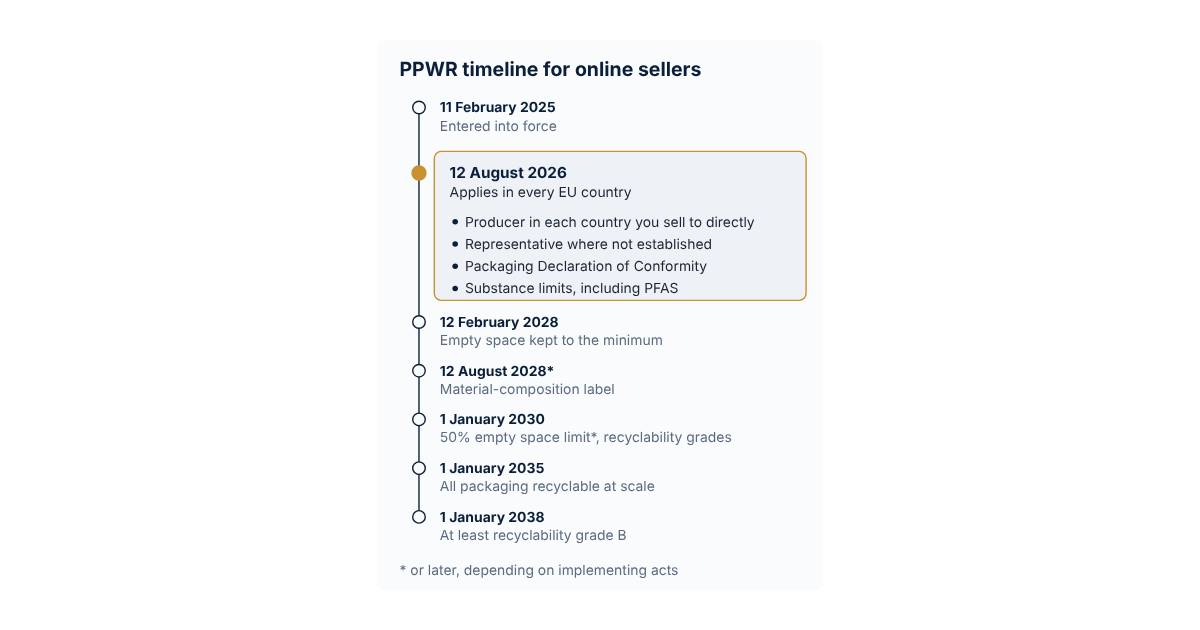
    PPWR timeline for online sellersVertical timeline. 11 February 2025: the PPWR entered into force. 12 August 2026: it applies in every EU country; for sellers this means you are the producer in each country you sell to directly, you need an authorised representative where you are not established, packaging needs a Declaration of Conformity, and substance limits, including PFAS, apply. 12 February 2028: empty space in sales packaging kept to the minimum. 12 August 2028, or later: harmonised material-composition label. 1 January 2030: maximum 50% empty space ratio, or later, and recyclability grades apply. 1 January 2035: all packaging recyclable at scale. 1 January 2038: packaging at least grade B.PPWR timeline for online sellers11 February 2025Entered into force12 August 2026Applies in every EU countryProducer in each country you sell to directlyRepresentative where not establishedPackaging Declaration of ConformitySubstance limits, including PFAS12 February 2028Empty space kept to the minimum12 August 2028*Material-composition label1 January 203050% empty space limit*, recyclability grades1 January 2035All packaging recyclable at scale1 January 2038At least recyclability grade B* or later, depending on implementing acts
    Key PPWR dates for online sellers, from entry into force to 2038.

    What is the PPWR?

    The PPWR entered into force on 11 February 2025 and applies from 12 August 2026. It replaces the 1994 Packaging Directive (94/62/EC), which was generally repealed on that date, although the Commission notes that some of its provisions continue to apply.

    EPR registration still runs through national registers: the Commission says you must keep following national EPR rules in the country where your packaging is likely to become waste.

    What changed for online sellers on 12 August 2026

    You can be a producer in each country you ship to

    If you sell directly to end users in a member state where you are not established, you are the producer in that member state. For cross-border e-commerce, the packaging is placed on the market in the buyer’s country. Producer status is assessed country by country, so you may be a producer in some countries and not others.

    There is no single EU-wide registration. Each member state runs its own producer register, and producers register, report packaging volumes and pay fees in each one.

    An authorised representative where you are not established

    Article 45(3) requires producers selling directly to end users in a member state where they are not established to appoint an authorised representative for EPR there. The Commission states that since August 2026 the requirement applies in all member states. Our guide to the PPWR authorised representative covers who needs one, what it does and what it costs.

    Marketplaces and registration numbers

    The picture here is mixed:

    • The Commission says online platforms are currently not required to ask for an EPR registration number. Once harmonised national registers exist, you will have to give the platform your national registration number before you use its service.
    • Some platforms are not waiting. eBay says that from 12 August 2026 sellers into EU markets must provide EPR packaging registration numbers, that it will ask sellers to self-certify, and that listings may be hidden in countries where numbers are missing.
    • Under its own packaging law, Germany has required electronic marketplaces to check that sellers are registered in the LUCID packaging register since 1 July 2022, and to block goods from sellers who are not.

    A Declaration of Conformity for packaging

    Packaging placed on the EU market now needs an EU Declaration of Conformity under Article 39 and Annex VIII, and technical documentation kept for at least 5 years for single-use packaging and 10 years for reusable packaging. Guides from Packaging Europe and Coolset describe the declaration as covering the requirements of Articles 5 to 12, with a separate declaration for each format, material and configuration.

    Sources differ on how much it must cover today. PPWR Connect reports a Commission factsheet of 19 October 2026 saying the declaration only needs to cover the substance requirements for now. We could not open that factsheet ourselves, so ask your packaging supplier which version they issue and keep a copy.

    Substance limits, including PFAS

    From 12 August 2026, food-contact packaging must not exceed these PFAS limits: 25 ppb for any single PFAS, 250 ppb for the sum of targeted PFAS, and 50 ppm for total PFAS including polymeric PFAS. A combined limit of 100 mg/kg for lead, cadmium, mercury and hexavalent chromium applies to all packaging.

    According to Packaging Europe, a June 2026 Commission Notice says packaging produced before 12 August 2026 that exceeds the PFAS limits does not need to be withdrawn.

    What comes later: empty space, recyclability and labels

    Date What applies
    12 February 2028 Fillers must keep empty space in sales packaging to the minimum needed for the packaging to work
    12 August 2028 (or 24 months after the implementing acts, if later) Harmonised material-composition label
    1 January 2030 (or 36 months after the implementing acts, if later) Maximum 50% empty space ratio for grouped, transport and e-commerce packaging; filling material such as bubble wrap counts as empty space
    1 January 2030 Recyclability grades apply; packaging below grade C cannot be placed on the market
    1 January 2035 All packaging must be recyclable at scale
    1 January 2038 Packaging should be at least grade B

    The calculation method for the 50% rule is still to be set by implementing act, so check it before you redesign your shipping boxes.

    What a non-EU or UK seller should do now

    1. List every EU country you ship to directly, including through your own website and marketplaces where you are the seller.
    2. Work out your producer status in each one. If an EU importer or distributor first makes your goods available there, it may be the producer instead of you.
    3. Register with the national register in each country where you are the producer, and join the relevant compliance scheme. Registration can take several weeks.
    4. Appoint an authorised representative in each of those countries by written mandate.
    5. Collect your registration numbers and add them to your marketplace accounts. Check that any existing numbers, such as a German LUCID number, are still accurate.
    6. Get packaging paperwork from suppliers: a Declaration of Conformity and, for food-contact packaging, evidence on PFAS.
    7. Measure your packaging volumes by material, as reports and fees are based on them.
    8. Plan for 2030: right-size e-commerce boxes and ask suppliers about recyclability grades.

    Small producers, defined by the Commission as those producing less than 10 tonnes of packaging a year, may get lighter treatment, such as reduced registration fees or flat fees, but only where a member state chooses to offer it.

    A note for UK sellers

    Selling from the UK does not take you out of scope: the PPWR applies to producers shipping into the EU from other countries. UK packaging EPR is a separate scheme with its own thresholds (turnover of £1 million or more and over 25 tonnes of packaging handled), so meeting one does not cover the other.

    Worked example: a UK homeware brand selling into the EU

    A fictional UK brand sells ceramic mugs from its own warehouse. Orders come from its website and from its own seller account on amazon.de, and parcels go to customers in Germany and France. It has no EU company or branch.

    • Producer status: it sells directly to end users in Germany and France and is not established in either, so it is the producer in both.
    • Registration: it needs a LUCID registration in Germany and a French registration, each with its own number. A German number does not cover France.
    • Representation: it appoints an authorised representative in Germany and another in France, each under a written mandate.
    • Packaging: its gift boxes are not food-contact packaging, so the PFAS limits do not apply to them, but it still asks its box supplier for a Declaration of Conformity.

    Your next step

    EU Brand Support handles EU and UK Responsible Person cover and EPR registration for sellers outside the EU and UK. Where a country also requires a PPWR authorised representative, we work with established local representatives in that country, so you have one point of contact across your registrations.

    Start with our EPR registration page, or contact us with the countries you ship to and the packaging you use.

    This guide is general information, not legal advice.

    Frequently asked questions

    When did the PPWR come into force?

    It entered into force on 11 February 2025 and has applied since 12 August 2026. Several requirements, such as the empty space ratio and recyclability grades, start later.

    Does the PPWR apply to UK sellers?

    Yes, if you sell packaged goods to customers in the EU. Producer status is assessed in each EU country you ship to, and UK packaging EPR does not count towards it.

    Do I need a separate EPR registration in every EU country?

    Yes, in each country where you are the producer. There is no single EU-wide registration.

    Sources

  • EPR registration cost: what you pay, to whom and how often

    EPR registration cost: what you pay, to whom and how often

    Registering for EPR can be cheap or even free. The bigger cost is usually the yearly fee you pay a scheme for your packaging, electricals or batteries. In Germany, LUCID packaging registration is free, while stiftung ear charges €9.50 per equipment type to register electricals plus €32.80 a quarter. France’s Citeo charges a flat €110 a year for household packaging below 10,000 units.

    Those figures were checked on the registers’ and schemes’ own pages in October 2026 and are net of VAT. They change, so treat them as a guide to how the costs work rather than a quote.

    Registration fees and licence fees are two different bills

    EPR cost is easier to follow as three separate payments:

    • Register fees. What the national register charges to record you as a producer. Sometimes nothing, sometimes a fee: a few euros at stiftung ear, but £2,842 for a large UK producer registering directly.
    • Scheme or licence fees. What a compliance scheme (a dual system in Germany, an éco-organisme in France) charges to take on the recycling of what you sell. It depends on weight, material or units, so it grows with what you sell.
    • Representative or service fees. What a private provider charges to act for you or do the filing. These are set by each provider, not by law.

    In Germany, paying one does not cover the others: a LUCID number with no scheme contract still leaves your packaging unlicensed, and a scheme contract does not register you. In France, joining an éco-organisme includes your registration. If you would rather not work through this alone, see what our EPR registration service for Amazon sellers covers. Whoever helps you, the LUCID registration itself has to be made in your own name.

    Why Amazon sellers face these costs

    Amazon asks sellers for EPR numbers: the LUCID number for German packaging and a unique identifier (IDU) for each French category. It may deactivate offers that are not compliant, and the seller stays legally responsible. In Germany, marketplaces and fulfilment providers must also regularly check that their partners meet their obligations under German packaging law. Our compliance service for Amazon sellers keeps your EPR numbers, with their renewal dates, on one dashboard.

    What EPR costs in Germany

    Packaging: LUCID plus a dual system licence

    The Zentrale Stelle Verpackungsregister states that registration, data reporting and related activities in LUCID are free of charge for producers. You still pay participation fees to the system you choose, for the recovery and recycling of your packaging. Those fees are set by each system and depend on the packaging volumes you report, so there is no single published rate.

    A foreign producer can appoint an authorised representative for its packaging duties, but not for the LUCID registration itself. The register says handing registration to a third party is prohibited under section 35(1) of the Packaging Act, so you register in your own name.

    Electricals (WEEE): stiftung ear fees plus a representative

    A company with no German branch cannot register electrical goods itself. It needs an authorised representative located in Germany, appointed in writing, in German, signed by both sides, for at least three months. Stiftung ear then charges these administrative fees (net of VAT, under the ElektroGBattGGebV fee regulation):

    Fee Amount How often
    Registration €9.50 per equipment type (per represented company when a representative registers) One-off
    Authorised representative confirmation €50.60 per represented company One-off
    Quarterly fee €32.80 Every quarter
    Guarantee check (any guarantee form) €3.80 per equipment type Yearly
    Individual guarantee check €156.90 One-off (stiftung ear lists it with the one-time fees)

    Products for private households (b2c) also need an insolvency-safe guarantee, checked at registration and every year after. You either join a collective guarantee system, which charges for it, or arrange an individual one, such as a bank suretyship (banks usually charge for it) or a deposit with a German court (usually free). The representative’s own fee comes on top and is set privately.

    Batteries

    Stiftung ear lists a battery registration fee of €16.40 per battery type and a quarterly fee of €3.80, again net of VAT. The fee page lists register fees only, not what a take-back scheme charges.

    What EPR costs in France

    In France, producers are registered in ADEME’s SYDEREP register and receive an IDU. If you join an éco-organisme, it enters your details in SYDEREP for you, so the scheme membership is the cost that matters. For household packaging, Citeo’s 2026 tariff guide (updated 22 June 2026) works on three levels:

    • Under 10,000 sales units a year: a flat €110 excluding VAT. Citeo counts a product’s own packaging and its shipping carton as separate units.
    • 10,000 to 500,000 units: you can use a simplified declaration, priced per unit by product family.
    • Over 500,000 units: priced per unit from the weight and material of its packaging. For example, 25.81 cents per kg for paper and cardboard, and 70.00 cents per kg for clear PET bottles, adjusted up or down by eco-modulation.

    Citeo’s guide says membership includes allocation of your IDU. Other French categories, such as electricals, furniture or textiles, each need their own IDU and membership of an éco-organisme for that category, at its own tariff. Amazon expects a number for every category you sell.

    What packaging EPR costs in the UK

    UK packaging EPR only applies to businesses established in the UK with a worldwide turnover of £1 million or more that supplied over 25 tonnes of packaging in the previous year. A business with its head office abroad still counts as established in the UK if it has a UK branch, warehouse, PO box, returns address or other UK postal address. Large producers (over £2 million turnover and over 50 tonnes) registering for 2027 pay a registration fee of £2,842 directly to their regulator, or £1,803 through a compliance scheme, plus that scheme’s own fees. Large producers also pay waste disposal fees, which a scheme cannot pay on their behalf. If you sell into the UK from abroad with no UK address, note that gov.uk lists owning an online marketplace through which packaging is supplied into the UK from outside the UK as a producer activity of the marketplace owner.

    Who you pay, for what and how often

    Market and category Register Register fee Scheme or licence fee Representative
    Germany, packaging LUCID Free Set by the dual system on the packaging volumes you report Optional for packaging duties; cannot register for you
    Germany, electricals stiftung ear €9.50 per type once, then €32.80 a quarter Insolvency-safe guarantee for b2c goods, priced by the provider Required without a German branch; €50.60 confirmation fee plus their own charge
    Germany, batteries stiftung ear €16.40 per type once, then €3.80 a quarter Not on the register’s fee page Not covered in this guide
    France, household packaging SYDEREP (via Citeo) Included in membership From €110 a year (under 10,000 units) Not covered in this guide
    France, other categories SYDEREP (via each éco-organisme) Included in membership Each scheme’s own tariff Not covered in this guide
    UK, packaging (large producer) Environmental regulator £2,842 direct or £1,803 via a scheme, yearly Scheme fees on top We can file it: UK packaging EPR, £245 a year (WEEE and batteries: £195 a year)

    Worked example: a fictional small seller

    Lumen Desk Co. is a made-up US brand. It sells one type of LED desk lamp for home use on Amazon.de and Amazon.fr, shipped in a cardboard box, and sells about 3,000 units a year in France. Its EPR cost lines look like this:

    1. German packaging. LUCID registration: €0. Dual system licence for the cardboard: quoted by the system on the packaging volumes you report.
    2. German electricals. Year one register fees: €9.50 registration, €50.60 representative confirmation, €131.20 in quarterly fees for a full year and €3.80 for the yearly guarantee check, so €195.10 net. From year two: €135.00 net. Stiftung ear charges these to the representative, so ask how yours passes them on. Add the guarantee provider’s charge and the representative’s own fee.
    3. French packaging. Under 10,000 units, so Citeo’s flat €110 excluding VAT, with the IDU allocated through membership.
    4. French electricals. A separate IDU and éco-organisme contribution for the lamp, at that scheme’s rate.

    The fixed register fees are small. The line that grows with sales is the scheme fee, so ask for that quote first, along with any representative’s fee.

    Next step

    Our fee is from £99 per country and registration type per year, with scheme and licence fees passed on at cost; see EPR and Responsible Person pricing. If you also need someone established in the EU for product safety, that is a separate service covered on our EU and UK Responsible Person page. Selling electronics? The consumer electronics compliance template pack covers the Declaration of Conformity, a risk assessment and a technical file checklist.

    Frequently asked questions

    Is EPR registration free?

    In some places, yes. LUCID registration in Germany is free, and in France your éco-organisme registers you in SYDEREP as part of membership. Stiftung ear and the UK regulator charge register fees. Scheme fees apply on top in Germany and France. In the UK, large producers also pay waste disposal fees, plus scheme fees if they register through a scheme.

    What is the difference between EPR registration fees and licence fees?

    The registration fee pays the register to record you. The licence or participation fee pays a scheme to recycle what you sell, and it is usually based on weight, material or units.

    How do I check an EPR registration number in Germany?

    Use LUCID’s public register of producers. It confirms registration only. It does not show whether a system participation contract exists; your system operator gives you a separate confirmation for that.

    Can someone else register on LUCID for me?

    No. An authorised representative can take on your other packaging duties, but the register says the registration itself cannot be handed to a third party.

    Sources