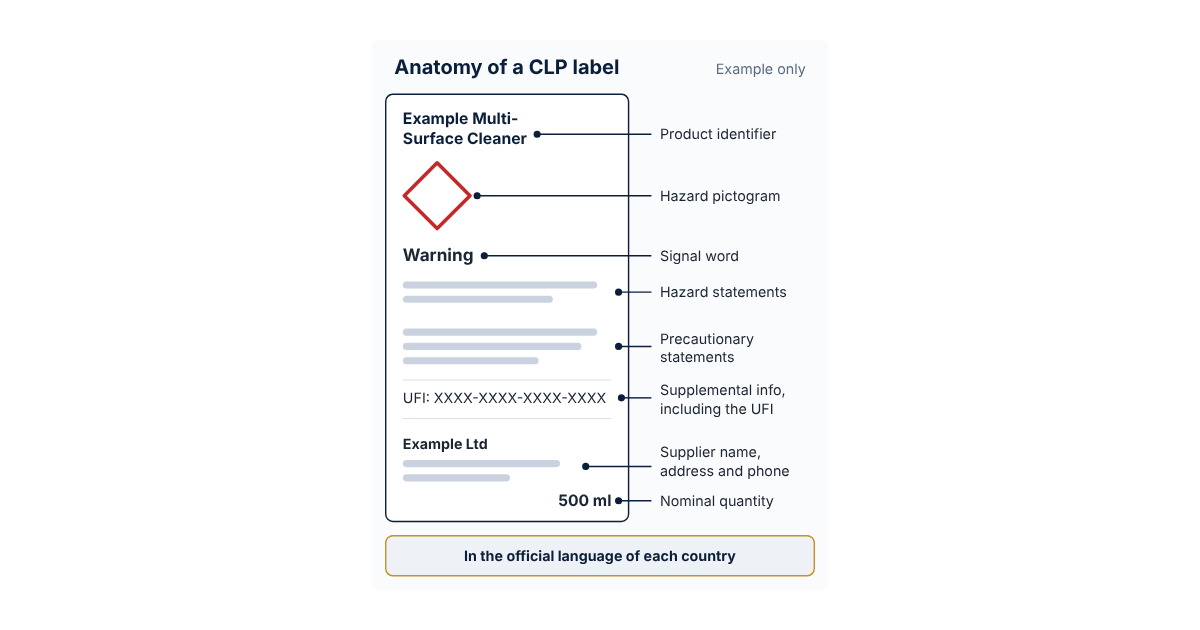
CLP labelling is the hazard label that Regulation (EC) No 1272/2008 (the CLP Regulation) requires on a hazardous chemical substance or mixture in packaging before it is placed on the EU market. The label carries the supplier’s details, the product identifier, any hazard pictograms, signal word, hazard and precautionary statements, the nominal quantity for consumer packs and, where poison centre rules apply, a UFI, all in the official language of each member state you sell into.
This guide is for online sellers of cleaning sprays, detergents, odour neutralisers, aerosols and similar products who are based outside the EU or UK. CLP duties sit with businesses established in the EU, so a brand selling from abroad needs an EU importer or supplier to carry them: our CLP and EU importer service covers that role.
What must a CLP label show?
Article 17 of CLP says a substance or mixture classified as hazardous and contained in packaging must bear a label with:
- the name, address and telephone number of the supplier or suppliers
- the nominal quantity in packages made available to the general public, unless it is shown elsewhere on the package
- the product identifiers set out in Article 18
- where applicable, hazard pictograms, a signal word, hazard statements and precautionary statements
- where applicable, a section for supplemental information
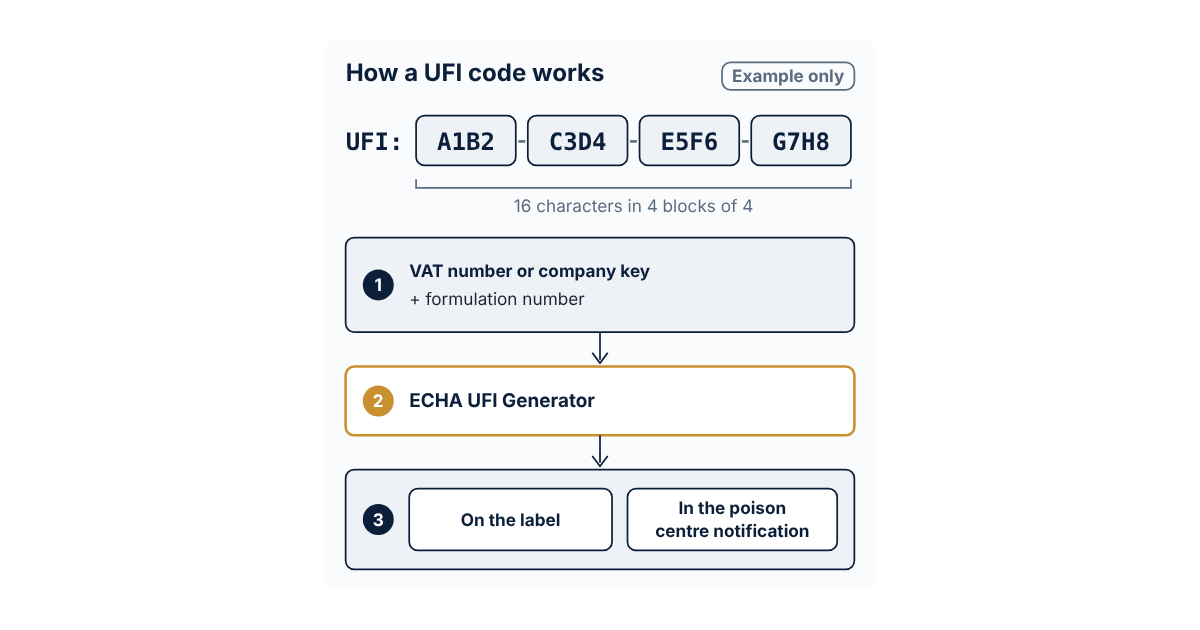
The supplemental information section is also where the UFI code goes. Where a business creates a unique formula identifier for poison centre notification, Article 25(7) requires it to be included there.
Classification comes first: the label can only be as accurate as the classification behind it.
Who is responsible for CLP labelling?
Under Article 4, manufacturers, importers and downstream users must classify substances and mixtures before placing them on the market, and where a product is classified as hazardous, suppliers must label and package it in line with CLP. Products that do not comply must not be placed on the market.
The definitions matter for sellers outside the EU. CLP defines a supplier as a manufacturer, importer, downstream user or distributor, and each of those roles is defined as a person established within the EU. An importer is the EU-established person responsible for import, and import itself counts as placing on the market. A UK or other non-EU brand therefore cannot hold these duties itself; the business that brings the goods into the EU does, and its details are the supplier details on the label.
Language rules
The label must be written in the official language or languages of each member state where the product is placed on the market, unless that member state provides otherwise. You may add more languages, as long as the same details appear in all of them.
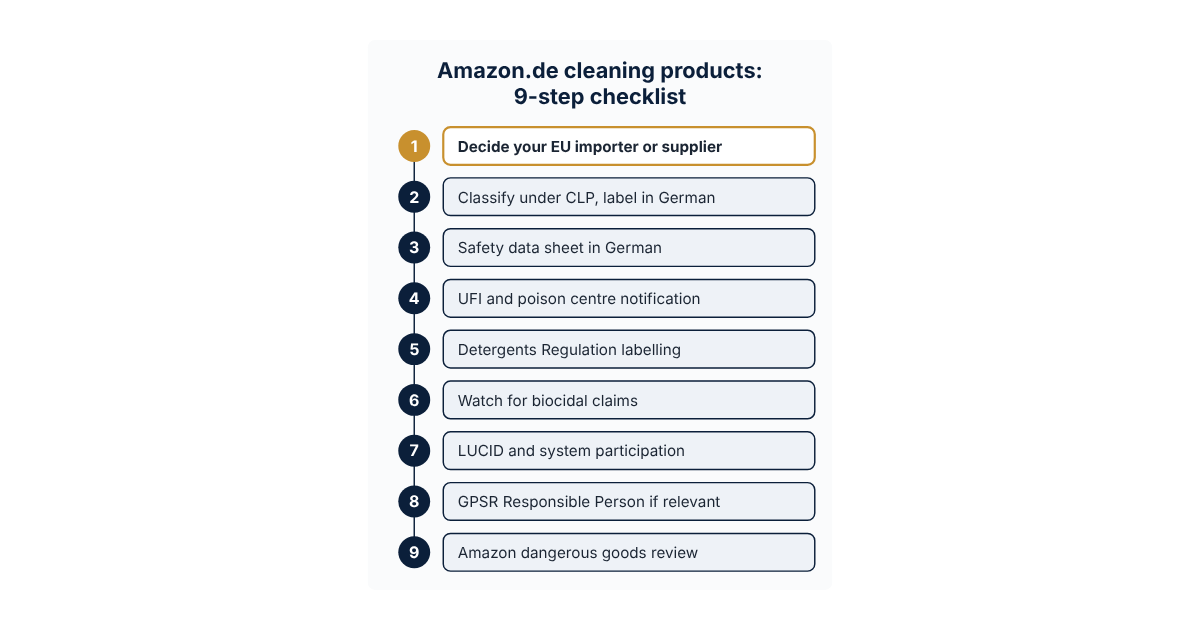
So a product sold on Amazon.de needs a German label. Our checklist for selling cleaning products on Amazon Germany covers the German side in detail.
Online listings and advertising
CLP already reaches beyond the physical label. Under Article 48, any advertisement for a mixture classified as hazardous that lets a member of the public buy without first seeing the label must mention the type or types of hazard shown on the label. For an online seller, that means the product page, not just the pack.
The revised CLP Regulation and the “stop the clock”
CLP has been revised by Regulation (EU) 2024/2865, which entered into force on 10 December 2024. The European Commission summarised the main changes as clearer hazard information in online stores, information on chemical hazards in advertisements and online offers, more flexible fold-out labels, digital labelling, better label legibility, and rules for selling household chemicals through refill stations.
Some of those rules were then postponed by Regulation (EU) 2025/2439, the “stop the clock” regulation, published in the Official Journal on 3 December 2025. According to the Council, the affected dates had been 1 July 2026 for some provisions and 1 January 2027 for others. TÜV Rheinland and IHK Braunschweig list the provisions moved to 1 January 2028:
| Provision | What it covers | Applies from |
|---|---|---|
| Article 30(1) to (4) | Updating labels after a change (relabelling deadlines) | 1 January 2028 |
| Article 31(3) and Annex I, points 1.2.1.4 and 1.2.1.5 | Label formatting requirements (fold-out labels excluded) | 1 January 2028 |
| Article 48 | Advertising | 1 January 2028 |
| Article 48a | Distance sales offers | 1 January 2028 |
| Annex II, Part 5(a) | Labelling at filling stations | 1 January 2028 |
The table follows the Council’s announcement and the summaries by TÜV Rheinland and IHK Braunschweig. Official summaries describe the scope of the postponement in slightly different terms, so check the Official Journal text before relying on the date for any provision not listed.
A further delay is in progress
In June 2026 the Council and the European Parliament reached a provisional agreement on a wider simplification package (“Omnibus VI”). The Council says it would extend the CLP date set by the stop the clock to 1 January 2030, apply only general readability criteria in business-to-business settings while keeping safeguards such as minimum font sizes for products aimed at the public, and give operators a few extra months to update labels. The European Parliament’s legislative tracker described it as close to adoption on 20 September 2026. Until it is formally adopted and published, plan around 1 January 2028.
GB CLP: a separate regime for Great Britain
Great Britain is not covered by EU CLP. The amended CLP Regulation was kept as GB law, HSE acts as the GB CLP Agency, and the main classification, labelling and packaging duties remain. Points that differ in practice:
- Labels for Great Britain must be in English; other languages can be added if they carry the same details.
- Classification must follow the GB mandatory classification and labelling list (GB MCL) where relevant, which started from the EU harmonised entries in force on 31 December 2020.
- Northern Ireland follows EU CLP, not GB CLP.
- There is no obligation to generate a UFI in Great Britain. GB importers and downstream users are encouraged to send safety data sheets to the National Poisons Information Service voluntarily.
A practical CLP checklist for online sellers
- Confirm your EU supplier. Decide which EU-established business imports the product and will appear on the label.
- Get the mixture classified by someone qualified, using full composition data from the manufacturer.
- Build the label from the classification: pictograms, signal word, hazard and precautionary statements, supplier details, product identifier and nominal quantity.
- Translate it into the official language of each market, keeping the same content in every language.
- Check poison centre duties and add the UFI where one is created.
- Update your listings so online offers mention the hazards shown on the label.
- Diary the revision dates for formatting and distance-sales rules, and watch for the Omnibus VI outcome.
Your next step
If you sell chemical or cleaning products into the EU from outside it, EU Brand Support can take on the EU importer or supplier role, so the CLP and UFI duties sit with an EU-established business and your labels carry an EU name and address. We can also act as your GPSR Responsible Person where that applies. Classification and safety data sheets are prepared by a qualified chemical specialist we coordinate with; we do not write safety data sheets ourselves. See our CLP and chemicals service or contact us with your product list. Chemical products are taken on only after we’ve reviewed the documents and agreed in writing, under a separate written agreement.
This guide is general information, not legal advice. Check the current regulation text for your specific product.
Frequently asked questions
Does every cleaning product need a CLP label?
The CLP hazard label applies to substances and mixtures classified as hazardous and contained in packaging. A product that is not classified as hazardous does not need the CLP hazard elements, though other rules, such as the Detergents Regulation, can still apply to its packaging.
Can I use one label for several EU countries?
Yes, if it is written in the official language of each member state where it is sold and the same details appear in every language.
Is my GB CLP label valid in the EU?
Not on its own. An EU label needs an EU-established supplier and the local language, and Great Britain and the EU now maintain separate classification lists.
Do the new formatting rules apply yet?
The formatting requirements of the revised CLP are postponed to 1 January 2028 by Regulation 2025/2439, and a provisional agreement would move the date to 1 January 2030 if it is adopted.
Sources
- Regulation (EC) No 1272/2008, Article 17 as adopted (legislation.gov.uk)
- Regulation (EC) No 1272/2008, Article 2 definitions as adopted (legislation.gov.uk)
- Regulation (EC) No 1272/2008, Article 4 as adopted (legislation.gov.uk)
- Regulation (EC) No 1272/2008, Article 48 as adopted (legislation.gov.uk)
- Regulation (EC) No 1272/2008, Article 25 as at 31 December 2020 (legislation.gov.uk)
- ECHA: Understanding CLP
- European Commission: Revised chemical labelling regulation enters into force
- Council of the EU: Council signs off postponing CLP rules to 2028
- TÜV Rheinland: Regulation (EU) 2025/2439 CLP amendment
- IHK Braunschweig: CLP stop-the-clock regulation published (German)
- Council of the EU: Council and Parliament strike deal to simplify requirements for chemical products
- European Parliament Legislative Train: Omnibus VI chemicals
- HSE: The GB CLP Regulation
- GB CLP, Article 17 (legislation.gov.uk)
- GOV.UK: Submitting chemicals information to the National Poisons Information Service